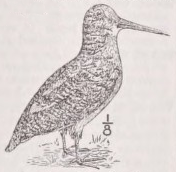
WOODCOCK (A.-S., W ude-cocc, Wudu-coc, and Wudu-snite), a bird as much extolled for the table, on account of its flavour, as by the sportsman, who, from its relative scarcity in regard to other kinds of winged game, the uncertainty of its occurrence, as well as the suddenness of its appearance and the irregularity of its flight, thinks himself lucky when he has laid one low. Yet, under favourable conditions, large bags of Woodcocks are made in many parts of Great Britain, and still larger in Ireland, though the numbers are trifling compared with those that have fallen to the gun in various parts of the European Continent, and especially in Albania and Epirus. In England of old time Woodcocks were taken in nets and springes, and, though the former method of capture seems to have been disused for many years, the latter was practised in some places until nearly the middle of the present century (cf Knox, Game-birds and Wild Fowl, pp. 148-151) or even later....
The Woodcock is the Scolopax rusticula of ornithology, and is well enough known to need no minute description. Its long bill, short legs, and large eyes—suggestive of its nocturnal or crepuscular habits—have over and over again been the subject of remark, while its mottled plumage of black, chestnut-and umber-brown, ashy-grey, buff, and shining white—the last being confined to the tip of the lower side of the tail-quills, but the rest intermixed for the most part in beautiful combination—could not be adequately described within the present allotted space. Setting aside the many extreme aberrations from the normal colouring which examples of this species occasionally present (and some of them are extremely curious, not to say beautiful), there is much variation to be almost constantly observed in the plumage of individuals, in some of which the richer tints prevail while others exhibit a greyer coloration. This variation is often, but not always accompanied by a variation in size or at least in weight. The paler birds are generally the larger, but the difference, whether in bulk or tint, cannot be attributed to age, sex, season, or, so far as can be ascertained, to locality. It is, notwithstanding, a very common belief among sportsmen that there are two “species” of Woodcock, and many persons of experience will have it that, beside the differences just named, the “little red Woodcock” invariably flies more sharply than the other. However, a sluggish behaviour is not really associated with colour, though it may possibly be correlated with weight —for it is quite conceivable that a fat bird will rise more slowly, when flushed, than one which is in poor condition. It may suffice here to say that ornithologists, some of whom have taken a vast amount of trouble about the matter, are practically unanimous in declaring against the existence of two “species” or even “races,” and moreover in agreeing that the sex of the bird cannot be determined from its plumage, though there are a few who believe that the young of the year can be discriminated from the adults by having the outer web of the first quill-feather in the wing marked with angular notches of a light colour, while the old birds have no trace of this “vandyke” ornament. Careful dissections, weighings, and measurings seem to shew that the male varies most in size; on an average he is slightly heavier than the female, yet some of the lightest birds have proved to be cocks.
Though there are probably few if any counties in the United Kingdom in which the Woodcock does not almost yearly breed, especially since a ‘ ‘ close time” has been afforded by the legislature for the protection of the species, there can be no doubt that by far the greater number of those shot in the British Islands have come from abroad,—mostly, it is presumed, from Scandinavia. These arrive on the east coast in autumn—generally about the middle of October —often in an exhausted and impoverished state. Most of them seem to cross the sea by night, and at that season it is a brutal practice for men to sally forth and slaughter the helpless and almost starving wanderers, who are often found seeking refuge in any shelter that may present itself. If unmolested, however, they are soon rested, pass inland, and, as would appear, in a marvellously short time recover their condition. Their future destination seems to be greatly influenced by the state of the weather. If cold or frost stop their supply of food on the eastern side of Great Britain they press onward and, letting alone Ireland, into which the immigrant stream is pretty constant, often crowd into the extreme south-west, as Devonshire and Cornwall, and to the Isles of Scilly, while not a few betake themselves to the unknown ocean, finding there doubtless a watery grave, though instances are on record of examples having successfully crossed the Atlantic and reaching Newfoundland, New Jersey, and Virginia. To return, however, to the Woodcocks which breed in Britain, whose habits have been much more frequently observed since the folly and cruelty of killing them in spring has been recognized, and it may be hoped abandoned. Pairing takes place very early in February and the eggs are laid often before the middle of March. These are four in number, of a yellowish cream-colour blotched and spotted with reddish-brown, and seldom take the pyriform shape so common among those of Limicoliue birds. The nest—always made on the ground amid trees or underwood, and usually near water or at least in a damp locality —is at first little more than a slight hollow in the soil, but as incubation proceeds dead leaves are collected around its margin until a considerable mass is accumulated. During this season the male Woodcock performs at twilight flights of a remarkable kind (c∕. Birds, vol. iii. p. 771), repeating evening after evening (and it is believed at dawn also) precisely the same course, which generally describes a triangle, the sides of which may be a quarter of a mile or more long. On these occasions the bird’s appearance on the wing is quite unlike that which it presents when hurriedly flying after being flushed, and though its speed is great the beats of the wings are steady and slow. At intervals an extraordinary sound is produced, whether from the throat of the bird, as is commonly averred, or from the plumage is uncertain. To the present writer the sound seems to defy description, though some hearers have tried to syllable it. This characteristic flight is in some parts of England called “roading,” and the track taken by the bird a “cock-road.” In England in former times advantage was taken of this habit to catch the simple performer in nets called “cock-shutts,” which were hung between trees across the open glades or rides of a wood, and in many parts of the Continent it still is, or was till very lately, the disgraceful habit of persons calling themselves sportsmen to lie in wait and shoot the bird as he indulges in his measured love-flight. A still more interesting matter in relation to the breeding of Woodcocks is the fact, asserted by several ancient writers, but for long doubted if not disbelieved, and yet finally established on good evidence, that the old birds transport their newly-hatched offspring, presumably to places where food is more accessible. The young are clasped between the thighs of the parent, whose legs hang down during the operation, while the bill is to some extent, possibly only at starting, brought into operation to assist in adjusting the load if not in bearing it through the air.
The Woodcock inhabits suitable localities across the northern part of the Old World, from Ireland to Japan, migrating southward towards autumn. As a species it is said to be resident in the Azores and other Atlantic Islands; but it is not known to penetrate very far into Africa during the winter, though in many parts of India it is abundant during the cold weather, and reaches even Ceylon and Tenasserim. The popular belief that Woodcocks live “by suction” is perhaps hardly yet exploded; but those who have observed them in confinement know that they have an almost insatiable appetite for earthworms, which the birds seek by probing soft ground with their highly sensitive and flexible bill. This fact seems to have been first placed on record by Bowles, who noticed it in the royal aviary at San Ildefonso in Spain, and it has been corroborated by other observers, and especially by Montagu, who discovered that bread and milk made an excellent substitute for their ordinary food.
The eastern part of North America possesses a Woodcock, much smaller than though generally (and especially in habits) similar to that of the Old continent. It is the Scolopax minor of most authors: but, chiefly on account of its having the outer three primaries remarkably attenuated, it has been placed in a separate genus, Philohela. In Java is found a distinct and curiously coloured species, described and figured many years ago by Horsfield {Trans. Linn. Society, xiii. p. 191, and Zoolog. Researches, pl.) as & saturata. To this Mr Seebohm has lately referred the >S'. rosenbergi of Schlegel {Nederl. Tijds. v. d. Dierkunde, iv. p. 54) from New Guinea; but, as the culpable destruction of the typespecimen of the former (during its transfer from the old museum of the East India Company to the British Museum) has made a comparison of the two impossible, the identification can scarcely be said to be free from doubt. Another species is S. rochusseni from the Moluccas, but this last, though resembling the other Woodcocks in most of the characters which distinguish them from the Snipes {q.vf, has like the latter the lower part of the tibia bare of feathers. (a. n.)