Altern
[Adjective]
Webster's Dictionary 1828
1. Acting by turns; one succeeding another; alternate, which is the word generally used.
2. In
crystallography, exhibiting, on two parts, an upper and a lower part, faces which alternate among themselves, but which, when the two parts are compared, correspond with each other.
3. Altern-base, in
trigonometry, is a term used in distinction from the true base. Thus in oblique triangles, the true base is the sum of the sides, and then the difference of the sides is the altern-base; or the true base is the difference of the sides, and then the sum of the sides is the altern-base.
Altern
[Adjective]
Webster's Dictionary 1913
Acting by turns; alternate.
Performance or actions by turns. [Little used.]
Alternal
[Adjective]
Webster's Dictionary 1828
Alternative. [Little used.]
Alternant
[Verb transitive]
Webster's Dictionary 1913
Composed of alternate layers, as some rocks.
Alternate
[Adjective]
Webster's Dictionary 1828
1. Being by turns; one following the other in succession of time or place; hence reciprocal.
2. And
bid alternate passions fall and rise.
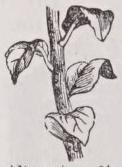
3. In botany branches and leaves are alternate when they rise higher on opposite sides alternately, come out singly, and follow in gradual order.
5. Alternate angles, in geometry, the internal angles made by a line cutting two parallels, and lying on opposite sides of the cutting line; the one below the first parallel, and the other above the second.
6. In
heraldry, the first and fourth quarters, and the second and third, are usually of the same nature, and are called alternate quarters.
That which happens by turns with something else;
vicissitude.
Alternate
[Verb intransitive]
Webster's Dictionary 1828
1. To happen or to act by turns; as, the flood and
ebb tides alternate with each other.
2. To follow reciprocally in place.
3. Different species alternating with each other.
Alternate
[Verb transitive]
Webster's Dictionary 1828
To perform by turns, or in succession; to cause to succeed by turns; to change one thing for another reciprocally; as, God alternates good and evil.
Alternate
[Adjective]
Webster's Dictionary 1913
1. Being or succeeding by turns; one following the other in succession of time or place; by turns first one and then the other; hence, reciprocal.
2. Designating the members in a series, which regularly
intervene between the members of another series, as the odd or even numbers of the
numerals; every other; every second; as, the alternate members 1, 3, 5, 7, etc. ; read every alternate line.
3. Distributed, as leaves, singly at different heights of the stem, and at equal intervals as respects angular
divergence.
1. That which alternates with something else;
vicissitude.
2. A substitute; one designated to take the place of another, if necessary, in performing some duty.
3. A proportion derived from another proportion by
interchanging the means.
Alternate
[Verb intransitive]
Webster's Dictionary 1913
1. To happen, succeed, or act by turns; to follow reciprocally in place or time; -- followed by with; as, the flood and
ebb tides alternate with each other.
2. To vary by turns; as, the land alternates between rocky hills and sandy plains.
Alternate
[Verb transitive]
Webster's Dictionary 1913
To perform by turns, or in succession; to cause to succeed by turns; to
interchange regularly.
Alternated
[Imperfect tense and past participle]
Webster's Dictionary 1913
In reciprocal succession; by turns, so that each is succeeded by that which it succeeds, as night follows day and day follows night.
1. In reciprocal succession; succeeding by turns; in alternate order.
The quality of being alternate, or of following in succession.
The quality of being alternate, or of following by turns.
Alternating
[Participle present tense]
Webster's Dictionary 1828
Performing or following by turns.
Alternating
[Present participle and verbal noun]
Webster's Dictionary 1913
1. The reciprocal succession of things, in time or place; the act of following and being followed in succession; as, we observe the alternation of day and night, cold and heat, summer and winter.
2. The different changes or alterations of orders, in numbers. Thus, if it is required to know how many changes can be
rung on six bells, multiply the numbers 1, 2, 3, 4, 5, 6, continually into one another, and the last product is the number required. This is call
permutation.
3. The answer of the congregation speaking alternately with the minister.
4. Alternate performance, in the
choral sense.
1. The reciprocal succession of things in time or place; the act of following and being followed by turns; alternate succession, performance, or occurrence; as, the alternation of day and night, cold and heat, summer and winter, hope and fear.
3. The
response of the congregation speaking alternately with the minister.
Offering a choice of two things.
1. That which may be chosen or omitted; a choice of two things, so that if one is taken, the other must be left. Thus, when two things offer a choice of one only, the two things are called alternatives. In strictness, then, the word can not be applied to more than two things, and when one thing only is offered for choice, it is said there is no alternative
2. Between these alternatives there is no middle ground.
1. Offering a choice of two things.
3. Alternate; reciprocal.
1. An offer of two things, one of which may be chosen, but not both; a choice between two things, so that if one is taken, the other must be left.
2. Either of two things or propositions offered to one's choice. Thus when two things offer a choice of one only, the two things are called alternatives.
3. The course of action or the thing offered in place of another.
4. A choice between more than two things; one of several things offered to choose among.
In the manner of alternatives; in a manner that admits the choice of one out of two things.
In the manner of alternatives, or that admits the choice of one out of two things.
The quality or state of being alternative.
The quality of being alternative, or of offering a choice between two.