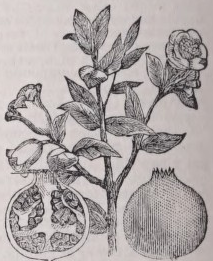
1. The fruit of a tree belonging to the genus Punica. This fruit is as large as an orange, having a hard rind filled with a soft pulp and numerous seeds. It is of a reddish color.
2. The tree that produces pomegranates.
3. An ornament resembling a pomegranate on the robe and ephod of the Jewish high priest.
1. The fruit of the tree Punica Granatum; also, the tree itself (see Balaustine), which is native in the Orient, but is successfully cultivated in many warm countries, and as a house plant in colder climates. The fruit is as large as an orange, and has a hard rind containing many rather large seeds, each one separately covered with crimson, acid pulp.
2. A carved or embroidered ornament resembling a pomegranate.
POMEGRANATE. The pomegranate (Punica Granatum) is of exceptional interest by reason of its structure, its history, and its utility. It forms a tree of small stature, or a bush with opposite, shining, lance-shaped leaves, from the axils of some of which proceed the brilliant scarlet flowers. These are raised on a short stalk, and consist of a thick fleshy cylindrical or bell-shaped calyx tube, with five to seven short lobes at the top. From the throat of the calyx proceed five to seven roundish, crumpled, scarlet or crimson petals, and below them very numerous slender stamens. The pistil consists of two rows of carpels placed one above another, both rows embedded in, and partially inseparate from, the inner surface of the calyx tube. The styles are confluent into one filiform thread. The fruit, which usually attains the size of a large orange, consists of a hard leatheryrind, which is the enlarged calyx tube, enclosing a quantity of pulp derived from the coats of the numerous seeds. This pulp, filled as it is with refreshing acid juice, constitutes the chief value of the tree. The more highly cultivated forms contain more of it than the wild or half-wild varieties. The great structural peculiarity consists in the presence of the two rows of carpels one above another (a state of things which occurs exceptionally in apples and oranges), and in the fact that, while in the lower series (fig. 1 ) the seeds are attached to the inner border or lower angle of the cavity, they occupy the outer side in the upper series (fig. 2), as if, during growth, the upper whorl had become completely bent over....
By Bentham and Hooker the genus Punica is included under Lythraceae ; others consider it more nearly allied to the myrtles; while its peculiarities are so great as, in the opinion of many botanists, to justify its inclusion in a separate order. Not only is the fruit valuable in hot countries for the sake of its pulp, but the rind and the bark and the outer part of the root are valuable as astringentsowing to the large quantity of tannin that they contain. The bark of the root is likewise valued in cases of tape-worm.
The tree is without doubt wild in Afghanistan, north-western India, and the districts south and south-west of the Caspian, but it has been so long cultivated that it is difficult to say whether it is really native in Palestine and the Mediterranean region. It has been cited as wild in northern Africa, but this appears to be a mistake. Recently, however, Prof. Bayley Balfour met with a wild species, heretofore unknown, in the island of Socotra, the flowers of which have only a single row of carpels, which suggests the inference that it may have been the source of the cultivated varieties. But, on the other hand, in Afghanistan, where Aitchison met with the tree truly wild, a double row of carpels was present as usual. The antiquity of the tree as a cultivated plant is evidenced by the Sanskrit name Dâdimba, and by the references to the fruit in the Old Testament, and in the Odyssey, where it is spoken of as cultivated in the gardens of the kings of Phaeaeia and Phrygia. The fruit is frequently represented on ancient Assyrian and Egyptian sculptures, and had a religious significance in connexion with several Oriental cults, especially the Phrygiancult of Cybele (Arnob., v. 5 sq.∙, see also Baudissin, Studien, ii. 207 sq.). It was well known to the Greeks and Romans, who were acquainted with its medicinal properties an'd its use as a tanning material. The name given by the Romans, malum punicum, indicates that they received it from Carthage, as indeed is expressly stated by Pliny; and this circumstance has given rise to the notion that the tree was indigenous in northern Africa. On a review of the whole evidence, botanical, literary, and linguistic, Alphonse de Candolle (Origine des Plantes Cultivées) pronounces against its African origin, and decides in favour of its source in Persia and the neighbouring countries. According to Saporta the pomegranate existed in a fossil state in beds of the Pliocene epoch near Meximieux in Burgundy. The pomegranate is sometimes met with in cultivation against a wall in England, but it is too tender to withstand a severe winter. The double-flowered varieties are specially desirable for the beauty and long duration of their flowers.
9th ed. Encyclopædia Britannica, vol. 19, p. 441 [749 words — estimated reading time: 5 minutes]
רמון, Numbers xiii, 23; xx, 5; 1 Sam. xiv, 2, &c, a low tree growing very common in Palestine, and in other parts of the east. Its branches are very thick and bushy; some of them are armed with sharp thorns. They are garnished with narrow spear-shaped leaves. Its flowers are of an elegant red colour, resembling a rose. It is chiefly valued for the fruit, which is as big as a large apple, is quite round, and has the general qualities of other summer fruits, allaying heat and quenchingthirst. The high estimation in which it was held by the people of Israel, may be inferred from its being one of the three kinds of fruit brought by the spies from Eshcol to Moses and the congregation in the wilderness, Num. xiii, 23; xx, 5; and from its being specified by that rebellious people as one of the greatest luxuries which they enjoyed in Egypt, the want of which they felt so severely in the sandy desert. The pomegranate, classed by Moses with wheat and barley, vines and figs, oil olive and honey, was, in his account, one principal recommendation of the promised land, Deut. viii, 8. The form of this fruit was so beautiful, as to be honoured with a place at the bottom of the high priest’s robe, Exodus xxviii, 33; Ecclus. xlv, 9; and was the principal ornament of the stately columns of Solomon’s temple. The inside is full of small kernels, replenished with a generous liquor. In short there is scarcely any part of the pomegranate which does not delight and recreate the senses.
And beneath upon the hem of it thou shalt make pomegranates of blue, and of purple, and of scarlet, round about the hem thereof; and bells of gold between them round about:
Make pomegranates of blue, purple, and scarlet yarn all the way around the lower hem, with gold bells between them,
And they came unto the brook of Eshcol, and cut down from thence a branch with one cluster of grapes, and they bare it between two upon a staff; and they brought of the pomegranates, and of the figs.
When they came to the Valley of Eshcol, they cut down a branch with a single cluster of grapes, which they carried on a pole between two men. They also took some pomegranates and figs.
And wherefore have ye made us to come up out of Egypt, to bring us in unto this evil place? it is no place of seed, or of figs, or of vines, or of pomegranates; neither is there any water to drink.
Why have you led us up out of Egypt to bring us to this wretched place? It is not a place of grain, figs, vines, or pomegranates—and there is no water to drink!”
And Saul tarried in the uttermost part of Gibeah under a pomegranate tree which is in Migron: and the people that were with him were about six hundred men;
Meanwhile, Saul was staying under the pomegranate tree in Migron on the outskirts of Gibeah. And the troops who were with him numbered about six hundred men,
And he made the pillars, and two rows round about upon the one network, to cover the chapiters that were upon the top, with pomegranates: and so did he for the other chapiter.
Likewise, he made the pillars with two rows of pomegranates around each grating to cover each capital atop the pillars.
And the chapiters upon the two pillars had pomegranates also above, over against the belly which was by the network: and the pomegranates were two hundred in rows round about upon the other chapiter.
On the capitals of both pillars, just above the rounded projection next to the network, were the two hundred pomegranates in rows encircling each capital.
And four hundred pomegranates for the two networks, even two rows of pomegranates for one network, to cover the two bowls of the chapiters that were upon the pillars;
the four hundred pomegranates for the two sets of network (two rows of pomegranates for each network covering both the bowl-shaped capitals atop the pillars);
The height of the one pillar was eighteen cubits, and the chapiter upon it was brass: and the height of the chapiter three cubits; and the wreathen work, and pomegranates upon the chapiter round about, all of brass: and like unto these had the second pillar with wreathen work.
Each pillar was eighteen cubits tall. The bronze capital atop one pillar was three cubits high, with a network of bronze pomegranates all around. The second pillar, with its network, was similar.
And four hundred pomegranates on the two wreaths; two rows of pomegranates on each wreath, to cover the two pommels of the chapiters which were upon the pillars.
the four hundred pomegranates for the two sets of network (two rows of pomegranates for each network covering both the bowl-shaped capitals atop the pillars);
Let us get up early to the vineyards; let us see if the vine flourish, whether the tender grape appear, and the pomegranates bud forth: there will I give thee my loves.
Let us go early to the vineyards to see if the vine has budded, if the blossom has opened, if the pomegranates are in bloom— there I will give you my love.
This site uses cookies to remember your display preferences (search sources and editions, Bible version, auto-link, images, light/dark theme). No personal data whatsoever is collected. Privacy Policy