
An instrument for determining the weight or pressure of the atmosphere, and hence for judging of the probable changes of weather, or for ascertaining the height of any ascent.
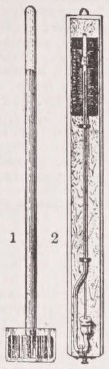
BAROMETER, the instrument by which the weight or pressure of the atmosphere is estimated. The barometer was invented by Torricelli, a pupil of Galileo, in 1643. It had shortly before been found, in attempting to raise water from a very deep well near Florence, that, in spite of all the pains taken in fitting the piston and valves, the water could by no effort be made to rise higher in the pump than about 32 feet. This remarkable phenomenon Torricelli accounted for by attributing pressure to the air. He reasoned that water will rise in a vacuum only to a certain height, so that the downward pressure or weight of the column of water will just balance the pressure of the atmosphere; and he further argued that if a fluid heavier than water be used it will not rise so high in the tube as the water. To prove this, he selected a glass tube about a quarter of an inch in diameter and 4 feet long, and hermetically sealed one of its ends; he then filled it with mercury and, applying his finger to the open end, inverted it in a basin containing mercury. The mercury instantly sank to nearly 30 inches above the surface of the mercury in the basin, leaving in the top of the tube an apparent vacuum, which is, indeed, one of the most perfect that can yet be produced, and is called after this great experimenter, the Torricellian vacuum. He next converted the mercurial column into a form suited for observation by bending the lower end of the tube, thus constructing what has since been called the siphon barometer. The fundamental principle of the barometer cannot be better illustrated than by his experiment (see fig. 2). In truth, a scale is all that is required to render this simple apparatus a perfect barometer....
The heights of the columns of two fluids in equilibrium are inversely as their specific gravities; and as mercury is 10,784 times heavier than air, the height of the atmosphere would be 10,784 times 30 inches, or nearly five miles, if it were composed of layers equally dense throughout. But since air becomes less dense as we ascend, owing to its great elasticity and the diminished pressure, the real height of the atmosphere is very much greater. From observations of luminous meteors, it has been inferred that the height is at least 120 miles, and that, in an extremely attenuated form, it may even considerably exceed 200 miles.
Various fluids might be used in constructing barometers. If water were used, the barometric column would be about 35 feet long. The advantages, however, which water barometers might be supposed to possess in showing changes of atmospheric pressure on a large scale, are more than counterbalanced by a serious objection. The space in the tube above the column of water is far from being a vacuum, being filled with aqueous vapour, which presses on the column with a force varying with the temperature. At a temperature of 32° Fahr, the column would be depressed half an inch, and at 75° a foot. Since in mercurial barometers the space at the top of the column is one of the most perfect vacuums that can be produced, the best fluid for the construction of barometers is mercury. It is therefore the only fluid used where scientific accuracy is aimed at. Pure mercury must be used in filling the tubes of barometers; because if it be impure, the density will not be that of mercury, and, consequently, the length of the columns will not be the same as that of a column composed of pure mercury alone. Even should the density happen to be the same as that of pure mercury the impurities would soon appear, impeding the action of the fluid as it rises and falls, and thus rendering the instrument unfit for accurate observation. In filling barometer tubes, air and moisture get mixed with the mercury, and must be expelled by boiling the mercury in the tube. It being essential that the mercury be quite freed from air and moisture, no barometer should be used till it has been well ascertained that this has been done. Some time after the instrument has been hung in an observing position, let it be inclined gently and with care, so that the mercury may strike against the top of the glass tube; if there is no air within, a sharp metallic click will be heard, but if the sound is dull, the air and moisture have not been entirely expelled. If the mercury should appear at any time to adhere somewhat to the tube and the convex surface assume a more flattened form, it may be concluded that air or moisture is present. If on examining the mercury with a lens minute bubbles are visible, air is present. In all these cases the instrument must be rectified.
The best barometers are usually fitted with an air-trap, originally proposed by Gay-Lussac for the purpose of arresting the ascent to the Torricellian vacuum of any air that may have found its way into the column by the cistern. The air-trap is fitted into the tube somewhere between the scale and the cistern. Barometers furnished with an air-trap can be conveyed from place to place with more safety, and they remain longer in good working order.
There are two classes of barometers— Siphon Barometers and Cistern Barometers. The Siphon Barometer (fig. 1) consists of a tube bent in the form of a siphon, and is of the same diameter throughout. A graduated scale passes along the whole length of the tube, and the height of the barometer is ascertained by taking the difference of the readings of the upper and lower limbs respectively. This instrument may also be read by bringing the zero-point of the graduated scale to the level of the surface of the lower limb by means of a screw, and reading off the height at once from the surface of the upper limb. This barometer requires no correction for errors of capillarity or capacity. Since, however, impurities are contracted by the mercury in the lower limb, which is usually in open contact with the air, the satisfactory working of the instrument comes soon to be seriously interfered with.
Fig. 2. shows the Cistern Barometer in its essential and its simplest form. This barometer is subject to two kinds of error, the one arising from capillarity, and the other from changes in the level of the surface of the cistern as the mercury rises and falls in the tube, the latter being technically called the error of capacity. If a glass tube of small bore be plunged into a vessel containing mercury, it will be observed that the level of the mercury in the tube is not in the line of that of the mercury in the vessel, but somewhat below it, and that the surface is convex. The capillary depression is inversely proportional to the diameter of the tube. If the diameter of the tube be 0T inch, the capillary depression of mercury in boiled tubes, or error of capillarity, is 0Ό70 inch; if 0'2 inch, the error is 0Ό29 inch; if 0 - 3 inch, it is 0Ό14 inch; and if 0'5 inch, it is only 0Ό03 inch. Since capillarity depresses the height of the column, cistern barometers require an addition to be made to the observed height, in order to give the true pressure, the amount depending, of course, on the diameter of the tube.
The error of capacity arises in this way. The height of the barometer is the perpendicular distance between the surface of the mercury in the cistern and the upper surface of the mercurial column. Now, when the barometer falls from 30 to 29 inches, an inch of mercury must flow out of the tube and pass into the cistern, thus raising the cistern level, and, on the other hand, when the barometer rises, mercury must flow out of the cistern into the tube, thus lowering the level of the mercury in the cistern. Since the scales of barometers are usually engraved on their brass cases, which are fixed (and, consequently, the zero-point from which the scale is graduated is also fixed), it follows that, from the incessant changes in the level of the cistern, the readings would be sometimes too high and sometimes too low, if no provision were made against this source of error.
A simple way of correcting the error of capacity is—· to ascertain (1) the neutral point of the instrument, or that height at which the zero of the scale is exactly at the height of the surface of the cistern, and (2) the rate ot error as the barometer rises or falls above this point, and then apply a correction proportional to this rate. In many of the barometers used on the Continent the surface area of the cistern is 100 times greater than that of the tube, in which case the error is small, and can, besides, be easily calculated. This is a good barometer for ordinary observers, inasmuch as no error arises in bringing the surface of the mercury of the cistern to the zero-point of the scale, which one requires to have some skill as a manipulator and good light to do correctly. Another way of getting rid of this error is effected by the Board of Trade Barometer, constructed originally by Adie of London. In this barometer the error of capillarity is allowed for in fixing the zeropoint of the scale, and the error of capacity is obviated by making the scale-inches not true inches, but just so much less as exactly to counterbalance the error of capacity.
But the instrument in which the error of capacity is satisfactorily (indeed, entirely) got rid of is Fortiris Barometer. Fig. 3 shows how this is effected. The cistern is formed of a glass cylinder, through which the level of the mercury may be seen. The bottom is made like a bag, of flexible leather, against which a screw works. At the top of the interior of the cistern is a small piece of ivory, the point of which coincides with the zero of the scale. By means of the screw, which acts on the flexible cistern bottom, the level of the mercury can be raised or depressed so as to bring the ivory point exactly to the surface of the mercury in the cistern. In some barometers the cistern is fixed, and the ivory point is brought to the level of the mercury in the cistern by raising or depressing the scale.
What is called the Fitzroy Barometer is only a modified form of the siphon barometer, with the lower limb blown into a moderately-sized bulb, resembling a cistern in some respects, and thus giving a larger range to the readings of the upper limb. It is only suited for popular, not for scientific purposes. The common Wheel Barometer, the popular form of the weather glass, is also a modification of the siphon barometer. A small weight, glass or iron, floats on the mercury in the lower limb; to this weight a thread is attached, which is led round a horizontal axis, a small weight being suspended at its free extremity to keep it tight. The float rises and falls with the fluctuations of the barometer, and a pointer fixed to a horizontal axis being turned by this means indicates the height of the barometer by figures on a dial. Since the mercury only rises or falls in the open end of the siphon to the extent of half the oscillation, a cistern is added to the top of the upper limb to increase the amount of the oscillation in the lower limb. This form of the barometer is only suited for very rough purposes, since large and uncertain errors arise from the shortening and lengthening of the thread with the varying dampness or dryness of the air, and from the friction of the different parts of the mechanism of the instrument.
Since in working out the great atmospheric problem of the force of the wind in its relation to the barometric gradient (i.e., the differences of the pressures at different places, reduced to the same level) readings from about the hundredth of an inch (0Ό10), or even ιess, require to be observed and stated with great accuracy, the extreme importance of accurate sensitive barometers will be apparent,—instruments not only possessing’ a great range of scale, but a scale which will truly indicate the real atmospheric pressure at all times. The two barometers which best satisfy this requirement are King’s Barometer, which has been in use for many years at the Liverpool Observatory, and IIowson ’ s Barometer. Fig. 4 shows the essential and peculiar parts of Howson’s barometer. A is the barometer tube, which is of large diameter, and longer than ordinary in order to admit of a greater length of range. B is a movable cylindrical cistern, having attached to its bottom a long hollow tube or stalk c, hermetically sealed, springing to a height of about 28 inches above the fixed level of the mercury in the cistern. This stalk terminates a little below the upper level of the mercury, and its upper end is thus exposed to no more downward pressure than that of the mercury above it; consequently, there is an excess of upward pressure of the air which tends to raise the cistern. When the excess of upward pressure is exactly balanced by the weight of the cistern with its stalk and contained mercury up to δ, an equilibrium will be established, which will keep the apparatus stationary or hanging in suspension. If now the atmospheric pressure acting on the cistern be increased, and if the thickness of the glass tube A be supposed to be nothing, the cistern would continue to ascend to an indefinite extent, since there is nothing to stop it. But as the glass is a substance of some thickness, mercury is displaced by the glass as it is plunged further into the cistern; and as it thus offers a resistance to the ascent of the cistern, the cistern will come to rest when the quantity of mercury displaced is equivalent to the increase of pressure. The extent of range which this barometer possesses over the ordinary barometer is determined by the ratio of the internal area of the tube A to that of the annulus of glass which bounds it,—the range increasing as the internal area is increased, or as the thickness of the glass is diminished.
The liability of the barometer to be broken in carriage is great. This risk is considerably lessened in the Board of Trade Barometer, which has the tube very much reduced in diameter for a part of its length, breakage from “pumping” being so much lessened thereby that the instrument may be sent as a parcel by rail, if only very ordinary care be taken in the carriage. This is essentially the principle of the Marine Barometer, which, however, has the tube still more contracted. For rougher modes of transit an ingeniously constructed iron barometer has been invented by Mr T, Stevenson, C.E.
The sympiezometer was invented by Adie of Edinburgh. It consists of a glass tube, with a small chamber at the top and an open cistern below. The upper part of the tube is filled with air, and the lower part and cistern with glycerine. When atmospheric pressure is increased, the air is compressed by the rising of the fluid; but when it is diminished the fluid falls, and the contained air expands. To correct for the error arising from the increased pressure of the contained air when its temperature varies, a thermometer and sliding-scale are added, so that the instrument may be adjusted to the temperature at each observation. It is a sensitive instrument, and well suited for rough purposes at sea and for travelling, but not for exact observation. It has been for some time superseded by the Aneroid, which far exceeds it in handiness, portability, and correctness. The Aneroid Barometer was invented by Vidi, and patented in England in 1844. Its action depends on the effect produced by the pressure of the atmosphere on a circular metallic chamber partially exhausted of air and hermetically sealed. Fig. 5 represents the internal construction, as seen when the face is removed, but with the hand still attached, a is a flat circular metallic box, having its upper and under surfaces corrugated in concentric circles. This box or chamber being partially exhausted of air, through the short tube δ, which is subsequently made air-tight by soldering, constitutes a spring, which is affected by every variation of pressure in the external atmosphere, the corrugations on it3 surface increasing its elasticity. At the centre of the upper surface of the exhausted chamber there is a solid cylindrical projection X, to the top of which the principal lever cde is attached, as shown in the drawing. This lever rests partly on a spiral spring at cl; it is also supported by two vertical pins, with perfect freedom of motion. The end e of the lever is attached to a second or small lever f, from which a chain g extends to ħ, where it works on a drum attached to the axis of the hand, connected with a hair spring at ∕q changing the motion from vertical to horizontal, and regulating the hand, the attachments of which are made to the metallic plate i. The motion originates in the corrugated elastic box a, the surface of which is depressed or elevated as the weight of the atmosphere is increased or diminished, and this motion is communicated through the levers to the axis of the hand at h. The spiral spring on which the lever rests at d is intended to compensate for the effects of alterations of temperature. The actual movement at the centre of the exhausted box, from whence the indications emanate, is very slight, but by the action of the levers this is multiplied 657 times at the point of the hand, so that a movement of the 22Oth part of an inch in the box carries the point of the hand through three inches on the dial. The effect of this combination is to multiply the smallest degrees of atmospheric pressure, so as to render them sensible on the index.
The instrument requires, however, to be repeatedly compared with a mercurial barometer, being liable to changes from the elasticity of the brass chamber changing, or from changes in the system of levers which work the pointer. Though aneroids are constructed showing great accuracy in their indications, yet none can lay any claim to the exactness of mercurial barometers. The mechanism is liable to get fouled and otherwise go out of order, so that they may change 0’300 inch in a few weeks, or even indicate pressure so inaccurately and so irregularly that no confidence can be placed in them for even a few days, if the means of comparing them with a mercurial barometer be not at hand.
Of the self-registering barometers, the best are those which accomplish this object by photography. This is done by concentrating the rays of a gas flame by means of a lens, so that they strike the top of the mercurial column. A sheet of prepared paper is attached to a frame placed behind a screen, with a narrow vertical slit in the line of the rays. The mercury being opaque throws a part of the paper in the shade, while above the mercury the rays from the flame pass unobstructed to the paper. The paper being carried steadily round on a drum at a given rate per hour, the height of the column of mercury is photographed continuously on the paper. From the photograph the height of the barometer at any instant may be taken. King's, Hardfs, Hough's, Hipps, and Thorell's self-registering barometers may also be referred to as giving continuous records of the pressure. In all continuously registering barometers, however, it is necessary, as a check, to make eye-observations with a mercury standard barometer hanging near the registering barometer from four to eight times daily.
In constructing the best barometers three materials are employed, viz. :—(1) brass, for the case, on which the scale is engraved; (2) glass, for the tube containing the mercury; and (3) the mercury itself. Brass is the best material for the case and scale, inasmuch as its co-efficient of expansion is well known, and is practically the same though the alloy be not in all cases exactly alike. It is evident that if the co-efficient of expansion of mercury and brass were the same, the height of the mercury as indicated by the brass scale would be the true height of the mercurial column. But this is not the case, the co-efficient...