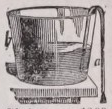
1. A bent pipe or tube whose legs are of unequal length, used for drawing liquor out of a vessel by causing it to rise over the rim or top. For this purpose, the shorter leg is inserted in the liquor, and the air is exhausted by being drawn through the longer leg. The liquor then rises by the weight of the atmosphere to supply the vacuum, till it reaches the top of the vessel, and then descends in the longer leg of the siphon
2. The pipe by which the chambers of a shell communicate.
1. A device, consisting of a pipe or tube bent so as to form two branches or legs of unequal length, by which a liquid can be transferred to a lower level, as from one vessel to another, over an intermediate elevation, by the action of the pressure of the atmosphere in forcing the liquid up the shorter branch of the pipe immersed in it, while the continued excess of weight of the liquid in the longer branch (when once filled) causes a continuous flow. The flow takes place only when the discharging extremity of the pipe ia lower than the higher liquid surface, and when no part of the pipe is higher above the surface than the same liquid will rise by atmospheric pressure; that is, about 33 feet for water, and 30 inches for mercury, near the sea level.
SIPHON, or Syphon, an instrument usually in the form of a bent tube for conveying liquid over the edge of a vessel and delivering it at a lower level, or in a position of less hydrostatic pressure. The principle on which it acts (see Hydromechanics) may be understood from the accompanying diagram. ABC is a tube filled with liquid, the shorter limb dipping under the surface of the liquid in jar a, the longer in jar b. The pressure in the tube at A is atmospheric pressure minus that of the vertical column
AB', while that at C is atmospheric pressure minus that of the column
CB". When CB'' is longer than AB'...
the pressure at C is of course less than that at A, and a current flows in the direction ABC through the siphon. When AB' = B"C, that is, when the liquid stands at the same level, pressure is equal in the two limbs, and the current ceases. The siphon has practically a certain minimum diameter for each liquid, as capillarity prevents a fluid from flowing out of tubes of very small bore unless under the influence of electricity, heat, or great pressure. The instrument is largely employed for chemical work, both in the laboratory and in manufacturing processes; it is formed of glass, india-rubber, lead, or other substance, according to the purpose for which it is intended. The simple siphon (see fig.) is used by filling it with the liquid to be decanted, closing the longer limb with the finger and plunging the shorter into the liquid, and it must be filled for each time of using. Innumerable forms have been devised adapted for all purposes, and provided with arrangements for filling the tube, or for keeping it full and starting it into action automatically when required. The former purpose is usually effected by blowing into the vessel through a second opening in the stopper through which the siphon passes, or by means of a sucking or blowing tube attached to the longer limb, or by pouring in liquid through a flexible tube attached at the bend. The second plan is frequently realized by having a stopcock on the longer limb and a valve opening upwards on the shorter, or by having both limbs of equal length and each standing in a cup, in which case when the level changes in either cup the siphon tends to equalize it by conveying liquid from the higher to the lower. Many other forms are in constant use in the arts, and the siphon is also employed in some of its modifications in surgery, in engineering, and in other sciences.
9th ed. Encyclopædia Britannica, vol. 22, p. 95 [442 words — estimated reading time: 3 minutes]
Any one of numerous species of limpet-shaped pulmonate gastropods of the genus Siphonaria. They cling to rocks between high and low water marks and have both lunglike organs and gills.
A tribe of bivalve mollusks in which the posterior mantle border is prolonged into two tubes or siphons. Called also Siphoniata. See Siphon, 2 (a), and Quahaug.
A tribe of gastropods having the mantle border, on one or both sides, prolonged in the form of a spout through which water enters the gill cavity. The shell itself is not always siphonostomatous in this group.
An order of pelagicHydrozoa including species which form complex free-swimming communities composed of numerous zooids of various kinds, some of which act as floats or as swimming organs, others as feeding or nutritive zooids, and others as reproductive zooids. See Illust. under Physallia, and Porpita.
Adv. from hand to hand, from pillar to post, on the way, by the way, on the road, on the wing, under way, in transit, on course, as one goes, in transitu, en route, chemin faisant, en passant, in mid progress, in mid course
This site uses cookies to remember your display preferences (search sources and editions, Bible version, auto-link, images, light/dark theme). No personal data whatsoever is collected. Privacy Policy