BILLIARDS is a well-known indoor game of skill, played on a rectangular table with ivory balls, which are driven into pockets and against each other according to certain defined rules. Of the origin of billiards comparatively little is known,—some considering that the game was invented by the French, and others that it was improved by them out of an ancient German diversion. Even the French themselves are doubtful on this point; for, while it is generally asserted that Henrique Devigne, an artist, who lived in the reign of Charles IX., gave form and rule to the pastime, the Dictionnaire Universel and the Académie des Jeux ascribe its invention to the English. Bouillet in the first work says—“Billiards appear to be derived from the game of bowls. It was anciently known in England, where, perhaps, it was invented. It was brought into France by Louis XIV., whose physician recommended this exercise.” In the other work quoted we read—“It would seem that the game was invented in England.” Strutt, a rather doubtful authority, notwithstanding the reputation attained by his Sports and Pastimes of the People of England, considers it probable that it was the ancient game of Paille-maille on a table instead of on the ground or floor,—an improvement, he says, “which answered two good purposes: it precluded the necessity of the player to kneel or stoop exceedingly when he struck the bowl, and accommodated the game to the limits of a chamber.” Whatever its origin, and whatever the manner in which it was originally played, it is certain that it was common in the time of Shakespeare, who makes Cleopatra, in the absence of Antony, invite her attendant to join in the pastime—
“Let us to billiards:
Billiards was originally played, it seems, in a method even now adopted in the rustic game of Rural Billiards, by driving a ball through a ring which revolved on a pin or stick fixed to the table or floor. In Cotton’s Compleat Gamester, published in 1674, we are told that this “most gentile, cleanly, and ingenious game” was first played in Italy, though in another page he mentions Spain as its birthplace. At that date billiards must have been well enough known, for we are told that “for the excellency of the recreation, it is much approved of and played by most nations of Europe, especially in England, there being few towns of note therein which hath not a public billiard table, neither are they wanting in many noble and private families in the country.” Since Cotton every compiler of books on games has had more or less to say about billiards; though, curiously enough, Hoyle, who is often quoted as an authority, makes no mention whatever of the game. It is only in the later editions and continuations of Hoyle that billiards, bagatelle, cricket, &c., find place. It is not, indeed, till our own day that anything like a scientific treatise on billiards has appeared, or that the game itself has been lifted out of the tavern—whence, in spite of its historians’ praises, it gradually descended—to its present more favoured position as a harmless and amusing indoor game.
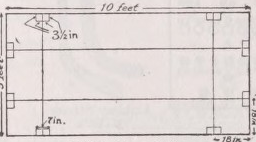
The Table.— The shape of the table has varied from time to time, probably to suit the dimensions of the room in which it was placed. At first it was square, with a hole or pocket at each corner to receive the balls driven forward with a cue or mace; then it was lengthened and provided with two other pockets; and occasionally it has been made round, oval, triangular, or octagonal, with or without pockets according to the game required. The cannon game in France is played on a pocketless table 8 feet by 4; the same game of the United States is played on a table 10 feet by 6, commonly made without pockets; but in England the regular table of the clubs and public rooms is a massive structure of timber, with a bed or surface of slate or metal 12 feet long by 6 feet wide, or two equal squares of 5 feet 10∣ inches across within the cushions. It is covered by a fine green cloth, and surrounded by elastic india-rubber cushions, at the junctions of which are netted pockets—one at each corner, and one midway at each of the longer sides. The table must be perfectly level and sufficiently firm to prevent vibration; and its usual height from the floor to the surface is 3 feet. The space required between table and wall is at least four feet. Smaller tables for use in private houses have lately been introduced. Whether large or small, each table is provided with a baulk line and semicircle and several marks or spots to regulate the mode of play. The baulk line is drawn straight across the table 28 inches from the bottom or lower cushion, and from it is struck a semicircle of from 21 to 23 inches in diameter. In the middle of the baulk line is the baulk spot, and in the middle of the table the centre spot. Thirteen inches from the top cushion is the red-ball spot, and half-way between the centre and the top cushion is the pyramid spot,—all these spots being on a line which, if drawn from end to end, would divide the table into two oblong halves.
Games.— The principal games are three in number,— billiards proper, pyramids, and pool; and from these spring a variety of öthers. The object of the player in each game, however, is to drive one or other of the balls into one or other of the pockets, or to cause the striker’s ball to come into successive contact with two other balls. The one stroke is known as a hazard, the other as a cannon; and from hazards and cannons, together with misses, forfeitures, and foul strokes, are reckoned the points of the game. When the ball is forced into a pocket the stroke is called a winning hazard; when the striker’s ball falls into a pocket after contact with the object ball, the stroke is a losing hazard; and these hazards count two or three to the player’s score according as they are made from the white or the red ball—two points for the white, three for the red. Two points are scored for the cannon, three for a coup —a term used when the player’s ball runs into a pocket without striking a ball; and one point for a miss, whether given purposely or accidentally. These strokes are all made with a cue, which is a long stick, of ash, or other hard wood, gradually tapering to the end, which is tipped with leather and rubbed with chalk to prevent it slipping off the surface of the ball struck. The mace or hammer-headed cue, once common, is no longer used, even by ladies. The cue is taken in the right hand, generally between the fingers and thumb, and not grasped in the palm; and with the left hand the player makes a bridge, by resting the wrist and the tips of the fingers on the table, arching the latter, and extending the thumb in such a way as to allow a passage in which the cue may slide. The player then proceeds with his game, according to the following rules :—
Billiards proper, or the English game, consists of winning and. losing hazards, cannons, and forfeitures. It is usually played 50 or 100 points, reckoned as already explained, three for each red hazard, two for each white hazard, and two for each cannon. Public matches between adepts are played 100, 500, or 1000 up, but the rules which govern them are the same. The remarks within brackets are explanatory.—1. The game of billiards proper commences by stringing for the lead and choice of balls. [The players standing behind the baulk line, strike each a ball from the semicircle up to the top cushion, and he whose ball on its return stops nearest the bottom cushion has the choice of lead and balls.] 2. The red ball is placed, on the spot at the commencement of the game, and replaced when it is pocketed or forced over the table. [“Breaking the balls” is the replacing them as at the beginning of a game. The balls are said to be “broken” when the first player has struck the red or given a miss; and the player’s ball when off the table is said to be “in hand.”] 3. The player who makes one stroke in a game must finish that game or consent to lose it. [Intended to meet cases of dispute.] 4. In the case of foul strokes, the adversary has the option of either allowing the striker to proceed, of having the ball replaced, or of breaking the balls. No score can be reckoned for a foul stroke. [The following are foul strokes :—If the player move a ball in the act of striking; if he play with the wrong ball; if he touch a ball twice in making a stroke; if he play at a ball while it is running; if he touch a ball with his hand, cue, or person, otherwise than is necessary for the stroke; if he in any way touch his opponent’s ball.] 5. If the adversary neglect to observe or to claim a foul stroke, the player proceeds with his game, and all the points he makes are marked. 6. If a ball spring from the table and hit a bystander, so as to prevent it falling to tide floor, it is considered, off the table. [The penalty in such a case is that the other player goes on, or if the ball has not struck another ball before flying off the table, the loss of three points, as for a coup.] 7. Balls lying within the baulk line cannot be played at with a ball in hand, except the player whose ball is in hand first play at a cushion beyond or outside the baulk line. 8. A line-ball cannot be played at by the striker whose ball is in hand, other than by playing his ball out of baulk against a cushion. [A line-ball is when the centre of the ball’s surface lies exactly on the line across the table. The marker or umpire must decide as to whether such ball is within or without the line.] 9. A ball in hand striking a ball in baulk without having been first played out of baulk, must be replaced and played ever again. 10. All misses must be given with the point of the cue. [This rule is sometimes neglected, and the player allowed to give his miss with the butt end of his cue.] 11. Should the spot be occupied so that the red ball cannot be placed on it after being pocketed, it must be placed on the centre spot, or, if that also be occupied, on the pyramid spot. [In some clubs the custom is to place the red ball on the centre spot, or on the baulk line spot, according to agreement.] 12. No points are reckoned for a ball or balls forced off the table after contact with the object-ball, and the adversary goes on without breaking the balls. 13. If the balls be changed in the course of play, no cannon or hazard made with such changed ball can be scored; the balls must be broken,, and all points made with the wrong ball deducted from the striker’s score. [In such case, however, the adversary has the privilege of playing with the changed ball, of re-changing the balls and playing on from their respective positions, or of having the balls broken.] 14. The player whose ball is in hand cannot score, unless he play his ball out of baulk before striking the object-ball. [In such case the stroke must be re-made.] 15. If in drawing back his cue from a ball on the brink of a pocket the striker hole his ball, he loses three points, as for a coup. 16. A ball accidentally moved by the marker or a looker-on must be replaced. 17. A ball wilfully removed or obstructed in its course causes the loss of the offender’s game. 18. If the striker’s ball lie touching his opponent’s ball, or the red ball, no score on that side can follow. [After the stroke the next player proceeds with his game, either by breaking the balls, or playing from the spot where his ball stopped. When balls touch, the player may either run into a pocket, or play on to a third ball; then the red is spotted and the adversary plays on from baulk; or if the first player fail to do either, the balls remain as they fall, and the other goes on.]
These, with the exception of some remarks about the conduct of strangers, the payment of wagers, and so on, are Hie rules by which the English game of billiards is universally governed. The principal modifications of this game are the four-handed game, which is ordinary billiards by four players in sides of two, each player being allowed to instruct his partner; à la royale, or the game of three; the white winning game, consisting entirely of winning hazards; the white losing game; the red winning game; the red losing game; the cannon game; and the American game. This last is played with four balls, two white and two coloured, and consists entirely of winning hazards and cannons. There is also a Russian game, called carline or Caroline, not unlike American billiards; a German game, Wurst-partie, in which a certain number of balls are placed in a row across the table; the Spanish, or «kittle game, which the Germans call Kugd-partie; and French billiards or the cannon game formerly universal on the Continent, and now very popular in the United States, where the best players are Frenchmen or men of French extraction. Of these games, however, it is unnecessary to speak, as they are all much inferior to billiards, and can be easily played by any one familiar with the established English game. The lesser varieties of billiards—choice of balls, in which each player selects the ball he plays with; bricole, in which the player strikes his ball against a cushion and endeavours to reach his opponent’s ball from the rebound; bar-hole, so called from a pocket or pockets being barred or stopped for one of the players; one pocket to five; winning against losing; the nomination game, which is ordinary billiards, in which the player is obliged to name his stroke before attempting it, and failing to make it gains nothing, or gives unnamed cannons and hazards to his opponent; the commanding game; the go-back game, which is played by an adept against a tyro, the latter scoring all he makes and the former going back to nothing every time his adversary makes a winning or losing hazard;—all these are so barren of interest and so seldom played as barely to deserve mention.
As to the science of the game, there is really little to be taught in books; practice and instruction from an adept will better enlighten a tyro as to the mysteries of the sidestroke, the drag, the screw, the following ball, the spotstroke, &c., than any amount of verbal explanation. It may, however, be as well to refer briefly to these several points, in order to render this notice as complete as the space at command will admit.
The side-stroke is made by striking the object-ball on the side with the point of the cue. The effect of such a mode of striking the ball is to make it travel to the right or to the left, according as it is struck with a winding or slightly circular motion; and its purpose is to cause the ball to proceed in a direction more or less slanting than is usual, or ordinary, when the ball is struck in or about the centre of its circumference. Many hazards and cannons, quite impossible to be made with the central stroke, are accomplished with ease and certainty by the side-stroke. In the hands of a dexterous player this stroke is both elegant and effective. The screw, or twist, is made by striking the ball low down, with a sharp, sudden blow. According as the ball is struck nearer and nearer to the cushion, it stops dead at the point of concussion with the objectball, or recoils by a series of reverse revolutions, in the manner familiar to the schoolboy in throwing forward a hoop, and causing it to return to his hand by the twist given to its first impetus. The following-ball is made by striking the ball high, with a flowing or following motion of the cue. Just as the low-stroke impedes the motion of the ball, the follow expedites it. In the drag the ball is struck low without the sudden jerk of the screw, and with less than the onward push of the follow. The spot-stroke is a winning hazard made by pocketing the red ball in one of the corners from the spot. The great art is, first, to make sure of the hazard, and next, to leave the striking ball in such a position as to enable the player to make a similar stroke in one or other of the comer pockets. To such perfection has the spot-stroke been brought, that the winning hazard has been repeated more than two hundred and fifty times consecutively. W. Cook, the finest of English players, on November 29, 1873, in a game with the ex-champion, Joseph Bennett, made a break of 936, the longest on record. In this great performance Cook made, in all, no fewer than 292 spot-hazards, 260 of which were made consecutively. John Boberts, jun., of Manchester, has also made an extraordinary break, 800, the majority by the spotstroke. Without the spot-hazard, the longest break hitherto made is probably less than 200.
The perfection of billiards is to be found in the nice combination of the various strokes, in such fashion as to leave the balls in a favourable position after each individual hazard and cannon; and this perfection can only be attained by the most constant and unremitting practice.
Pyramids is played by two or four persons—in the latter case in sides, two and two. It is played with fifteen balls, placed close together in the form of a triangle or pyramid, with the apex towards the player, and a white striking ball. The centre of the apex ball covers the second or pyramid spot, and the balls forming the pyramid should lie in a compact mass, the base in a straight line with the cushion.
Pyramids is a game entirely of winning hazards, and he who succeeds in pocketing the greatest number of balls wins. Usually the pyramid is made of fifteen red or coloured balls, with the striking ball white. This white ball is common to both players. Having decided on the lead, the first player, placing his ball in the baulksemicircle, strikes it up to the pyramid, with a view either to lodge a ball in a pocket or to get the white safely back into baulk. Should he fail to pocket a red ball, the other player goes on and strikes the white ball from the place at which it stopped. When either succeeds in making a winning hazard, he plays at any other ball he chooses, and continues his break till he ceases to score; and so the game is continued by alternate breaks until the last red ball is pocketed. The game is commonly played for a stake upon the whole, and a proportionate sum upon each ball or life,—as, for instance, 3s. game and Is. balls. The player wins a life by pocketing a red ball or forcing it over the table; and loses a life by running his own, the white, ball into a pocket, missing the red balls, or intentionally giving a miss. In this game the baulk is no protection; that is to say, the player can pocket any ball wherever it lies, either within or without the baulk line, and whether the white be in hand or not. This liberty is a great and certain advantage under many circumstances, especially in the hands of a good player. It is not a very uncommon occurrence for an adept to pocket six or eight balls in a single break. Both Cook and Boberts have been known, indeed, to pocket the whole fifteen. If four persons play at pyramids, the rotation is decided by chance, and each plays alternately,—partners, as in billiards, being allowed to advise each other, each going on and continuing to play as long as he can, and ceasing when he misses a hazard. Foul strokes are reckoned as in billiards, except as regards...