HOOPER, John (c. 1495-1555), bishop and martyr, was a native of Somersetshire, and was born about 1495. He was educated at Merton College, Oxford, and after taking his degree of bachelor of arts in 1518 joined the order of Cistercian monks at Gloucester. Subsequently, “ -while living too much of a court life in the palace of the king,” his attention was directed to the writings of Zwingli, and the result of his perusing them was that after a diligent study of the Scriptures he became a zealous advocate of the principles of the Reformation. For a short time he was chaplain to Sir Thomas Arundel, but, being warned of the danger to which his opinions exposed him, he in 1539 made his escape to France. Returning to England shortly afterwards, he found that plots were again being laid for his life, and escaped to Ireland disguised as a sailor. From Ireland he again went to France, passing thence to Germany, where he married, probably in 1546. After his marriage he settled in Zurich till March 1549, when he set out for England. Immediately on arriving in London he began to apply himself to the work of instructing the masses, and so successful were his labours that the churches in which he lectured were crowded by eager audiences, and that the king specially requested him to remain in London to further the progress of the Reformation. In 1550 he was presented to the bishopric of Gloucester; but, refusing it on account of objections to the oath and vestments, he was summoned before the council, and ultimately was imprisoned for some time in the Fleet, till he intimated that his scruples had been removed. The duties of his episcopate he discharged with a diligence, zeal, and self-sacrifice that have been rarely equalled. He preached three or four times a day in the towns and ...villages of his diocese, and so regardless was he of fatigue that his wife wrote Bullinger to “recommend Master Hooper to be more moderate in his labour,” lest his “overabundant exertions should cause a premature decay;” he made minute inquiry into the knowledge, doctrine, conduct, and worldly condition of his clergy, whose impoverished livings he petitioned the council to be allowed to augment out of his own income; and he supplied a free dinner in his hall to the poor of the city daily, sitting down and sharing it with them. In 1552 he was created bishop of Worcester in comrnendαrn. On the accession of Mary in the following year he was immediately arrested and sent to the Fleet, and after suffering eighteen months’imprisonment he was on January 29, 1555, tried for heresy and condemned to death. The sentence was carried out on February 9th, the martyr enduring the agonies of the stake, which on account of the accidental use of green wood were unusually protracted, with great fortitude. Hooper’s opinions were more decidedly auti-Romish than those of Cranmer or Ridley, and very nearly identical with those afterwards promulgated by the Puritans. He was the author of various sermons and controversial treatises.
His Early Writings, edited for the Parker Society by the Rev. Samuel Carr, appeared in 1843, and his Later Writings, edited for the same society by the Rev. Charles Nevinson, Μ. A., in 1852. A new edition of his works was published at Oxford in 1855.
[565 words — estimated reading time: 4 minutes]
HOOPING-COUGH, or Whooping-Cough (syn. Pertussis, Chin-Cough), an infectious disease of the respiratory mucous membrane, manifesting itself by frequently recurring paroxysms of convulsive coughing accompanied with peculiar sonorous inspirations. It occurs for the most part among children, and only once in a lifetime....
The specific cause of hooping-cough is unknown, but the view which ascribes it to some atmospheric condition appears to derive support from the frequency of this disease as an epidemic; whether, however, that be the presence of a peculiar form of germ, as is held by some, remains as yet undetermined. Although specially a disease of childhood, hooping-cough is by no means limited to that period, but may occur at anytime of life, even to old age, should there have been no previous attack. It is most common between the ages of one and four, and is rare after ten. Dr Edward Smith’s statistics showed that it was the most fatal of all diseases of children under one year, that 68 per cent, of the deaths from hooping-cough occurred under the age of two, and that only 6 per cent, of the deaths were recorded after five years. It has been occasionally observed in newly-born infants. It is more common in female than in male children. Hooping-cough is highly contagious during auy stage of its progress, but apparently more so in its commencement. It is not only communicated by the breath, but may, as has been clearly proved, be conveyed by the medium of clothing and by persons who have been in contact with those affected. It is said to be favoured by cold and damp weather, and to prevail mostly in spring and autumn, doubtless owing to these seasons increasing the predisposition to affections of the respiratory passages. Epidemics of hooping-cough have often been noticed to succeed or even to accompany those of measles or scarlet fever, although no causal connexion between these diseases can be admitted.
With respect to the symptoms of hooping-cough, three stages of the disease are recognized, viz., (1) the catarrhal stage, (2) the spasmodic stage, (3) the stage of decline.
The first stage is characterized by the ordinary phenomena of a catarrh, with sneezing, watering of the eyes, irritation of the throat, feverishness and cough, but in general there is nothing in the symptoms to indicate that they are to develop into hooping-cough. The catarrhal stage usually lasts from ten to fourteen days. The second stage ∖ s> marked by the abatement of the catarrhal symptoms, but at the same time by increase in the cough, which now occurs in irregular paroxysms both by day and by night. Each paroxysm consists in a series of violent and rapid expiratory coughs, succeeded by a loud sonorous or crowing inspiration—the “whoop.” During the coughing efforts the air is driven with great force out of the lungs, and as none can enter the chest the symptoms of impending asphyxia appear. The patient grows deep-red or livid in the face, the eyes appear as if they would burst from their sockets, and suffocation seems imminent till relief is brought by the “whoop ”— the louder and more vigorous the better. Occasionally blood bursts from the nose, mouth, and ears, or is extravasated into the conjunctiva of the eyes. A single fit rarely lasts beyond from half to three-quarters of a minute, but after the “whoop” another recurs, and of these a number may come and go for several minutes. The paroxysm ends by the coughing or vomiting up of a viscid tenacious secretion, and usually after this the patient seems comparatively well, or, it may be, somewhat wearied and fretful. The frequency of the paroxysms varies according to the severity of the case, being in some instances only to the extent of one or two in the whole day, while in others there may be several in the course of a single hour. Slight causes serve to bring on the fits of coughing, such as the acts of swallowing, talking, laughing, crying, &c., or they may occur without any apparent exciting cause. In general children come to recognize an impending attack by a feeling of tickling in the throat, and they cling with dread to their mothers or nurses, or take hold of some object near them for support during the paroxysm; but although exhausted by the severe fit of coughing they soon resume their play, apparently little the worse. The attacks are on the whole most severe at night. This stage of the disease usually continues for thirty to fifty days, but it may be shorter or longer. It is during this time that complications are apt to arise which may become a source of danger greater even than the malady itself. The chief of these are inflammatory affections of the bronchi and lungs, and convulsions, any of which may prove fatal. When, however, the disease progresses favourably, as it usually does, the third or terminal stage is announced by the less frequent paroxysms of the cough, which generally loses in great measure its “whooping” character. The patient’s condition altogether undergoes amendment, and the symptoms disappear in from one to three weeks. It is to be observed, however, that for a long period afterwards in any simple catarrh from which the patient suffers the cough often assumes a spasmodic character, which may suggest the erroneo as notion that a relapse of the hooping-cough has occurred.
In severe cases it occasionally happens that the disease leaves behind it such structural changes in the lungs (emphysema, &c.), as entail permanent shoι tness of breathing or a liability to attacks of asthma. Further, hooping-cough is well known to be one of those diseases of early life which are apt to give rise to a weakened and vulnerable state of the general health, or to call into activity any inherited morbid tendency, such as that towards consumption.
As regards the treatment of hooping-cough in mild cases, little is necessary beyond keeping the patient warm and carefully attending to the general health. The remedies applicable in the case of catarrh or the milder forms of bronchitis are of service here, while gentle counter-irritation to the chest by stimulating liniments may be employed all through the attack. In mild weather the patient may be in the open air. In the more severe forms efforts have to be employed to modify the severity of the paroxysms. Numerous remedies are recommended, the chief of which are the bromides of ammonium or potassium, hydrocyanic acid, chloral, chloric ether, &c. These can only be safely administered under medical advice, and with due regard to the symptoms in individual cases. During convalescence, where the cough still continues to be troublesome, a change of air will often effect its removal. (j. o. A.)

[1,144 words — estimated reading time: 7 minutes]
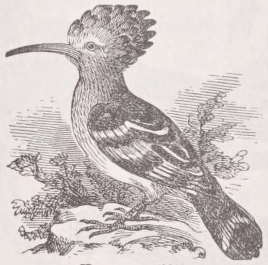
HOOPOE (French Huppe, Latin Upupa, Greek eπ-οψ— all names bestow ed apparently from its cry), a bird long celebrated in literature, and conspicuous by its variegated plumage and its large erectile crest, the Upupa epops of naturalists, which is the type of the very peculiar Family Upupidoe, placed by Prof. Huxley in his group Coccygomorphas i but considered by Dr Murie {Ibis, 1873, p. 208) to deserve separate rank as Epopomorphoe. This species has an exceedingly wide range in the Old World, being a regular summervisitant to the whole of Europe, in some parts of which it is abundant, as well as to Siberia, mostly retiring southwards in autumn to winter in equatorial Africa and India, though it would seem to be resident throughout the year in North-Eastern Africa and in China. Its power of wing ordinarily seems to be feeble; but it is capable of very extended flight, as is testified by its wandering habits (for it occasionally makes its appearance in places very far removed from its usual haunts), and also by the fact that when pursued by a Falcon it will rapidly mount to an extreme height and frequently effect its escape from the enemy. About the size of a Thrush, with a long, pointed, and slightly arched bill, its head and neck are of a golden-buff—the former adorned by the crest already mentioned, which begins to rise from the forehead and consists of broad feathers, gradually increasing in length, tipped with black, and having a subterminal bar of yellowish-white. The upper part of the back is of a vinous-grey, and the scapulars and flight-feathers are black, broadly barred with white tinged in the former with buff. The tail is black with a white chevron, marking off about the distal third part of its length. The legs and feet are as well adapted for running or ...walking as for' perching, and the scutellations are continued round the whole of the tarsi. Chiefly on account of this character, which is also possessed by the Larks, Sundevall {Tentamen, pp. 53-55) united the Upupidoe and Alaudidoe in the same “cohors” Holaspideoe. Comparative anatomy, however, forbids its being taken to signify any real affinity between these groups, and the resemblance on this point, which is by no means so striking as that displayed by the form of the bill and the coloration in certain Larks (of the genus Certhilauda, for instance), must be ascribed to analogy merely, though at present no explanation of the why and the wherefore can be offered.
Pleasing as is the appearance of the Hoopoe as it fearlessly parades its showy plumage, its habits are much the reverse. All observers agree in stating that it delights to find its food among filth of the most abominable description, and this especially in its winter-quarters. But where it breeds, its nest, usually in the hole of a tree or of a wall, is not only partly composed of the foulest material, but its condition becomes worse as incubation proceeds, for the hen scarcely ever leaves her eggs, being assiduously fed by the cock as she sits; and when the young are hatched, their faeces are not removed by their parents, as is the case with most birds, but are discharged in the immediate neighbourhood of the nest, the unsanitary condition of which can readily be imagined. Worms, grubs, and insects generally, form the Hoopoes’ food, and upon it they get so fat in autumn that they are esteemed a delicate morsel in some of the countries of Southern Europe, and especially by the Christian population of Constantinople.
Not a year passes but the Hoopoe makes its appearance in some part or other of the British Islands, most often in spring, and if unmolested would doubtless stop to breed in them, and a few instances are known in which it has done so. But its remarkable plumage always attracts attention, and it is generally shot down so soon as it is seen, and before it has time to begin a nest, which there is reason to think would not in a temperate climate become so offensive a nuisance as it is in more southern latitudes. Eight or nine so-called species of the genus have been described, but of them the existence of five only has been recognized by the writers who have most lately investigated them— Messrs Sharpe and Dresser {Birds of Europe, pt. vii.). Besides the Upupa epops above treated, these are U. indica, resident in India and Ceylon; U. longirostris, which seems to be the form of the Indo-Chinese countries ; U. marginata, peculiar to Madagascar; and U. africana cr J7. minor of some writers, which inhabits South Africa to the Zambesi on the east and Benguela on the west coast. In habits and appearance they all resemble the best-known and most widely-spread species, and their particular differences cannot, for want of space, be here pointed out. (a. n.)
[832 words — estimated reading time: 5 minutes]