
Money; primarily, ready money, money in chest or on hand, in bank or at command. It is properly silver and gold; but since the institution of banks, it denotes also bank notes equivalent to money. To pay in cash is opposed to payment in goods, commodities, or labor, as in barter.
Word of the Day: Catachrestical
1. To turn into money, or to exchange for money; as, to cash a note or an order.
2. To pay money for; as, the clerks of a bank cash notes when presented.
3. To discard.
1. A place where money is kept, or where it is deposited and paid out; a money box.
2. Ready money; especially, coin or specie; but also applied to bank notes, drafts, bonds, or any paper easily convertible into money
3. Immediate or prompt payment in current funds; as, to sell goods for cash; to make a reduction in price for cash.
A Chinese coin.
1. To pay, or to receive, cash for; to exchange for money; as, cash a note or an order.
2. To disband.
An account of money received, paid, or on hand.
A book in which is kept a register or account of money.
One entrusted with the keeping of money.
Cashan
Encyclopedia Britannica
CASHAN, or Kashan, a city of Persia, in the province of Irak, 92 miles north of Ispahan, in a dry and stony plain, in 33° 52' N. lat. and 51° 20' E. long. The city is said to have been founded by Zobeide, wife of Haroun el Raschid. The manufactures are silk-brocades, carpets, cottons, gold and silver articles, and copper kettles. The city has a palace, many fine mosques, bazaars, and caravanseries. At the foot of the neighbouring hills, four miles away, are the villa and beautiful gardens of Feen, the scene of the official murder, 9th January 1852, of Amiru-’n-Nizam, one of the ablest ministers that Persia has had in modern times. The chief pavilion of the villa is in the form of a kiosk, with a projecting portico in front. The interior is decorated with fine arabesques. The vicinity of Cashan is famous for its scorpions. The city suffered from an earthquake in 1853. Population, 25,000.
9th ed. Encyclopædia Britannica, vol. 5, p. 175
[162 words — estimated reading time: 1 minute]
[162 words — estimated reading time: 1 minute]
A book in which is kept a register of money received or paid out.
Cashel
Encyclopedia Britannica
CASHEL, an inland city of Ireland, in the county of Tipperary, 108 miles south-west from Dublin, and within 5 miles of the Great Southern and Western Railway. The town, which lies at the base of the Rock of Cashel, consists for the most part of a wide and well-built main street, and contains several public buildings, such as a court-house, a market-house, a fever hospital, barracks, and an infirmary. There are also the new cathedral, the deanery house (once the bishop’s palace), and a Roman Catholic church, while immediately outside the town there is the union workhouse. Formerly an archiépiscopal see, Cashel was reduced in 1833 to a bishopric, but the bishop does not now reside there. The town’s revenue is derived from landed estates in the neighbourhood, the gift of Bishop Maurianus. It formerly returned one member to Parliament, but was disfranchised in 1870. Population in 1851, 4798, and in 1871, 4562....
The Rock of Cashel is the object of chief interest in the place. This elevation of limestone formation rises abruptly from the plain to a height of about 300 feet, and is a commanding object for many miles around. Its summit is occupied by the most interesting assemblage of ruins in Ireland, consisting of the remains of St Patrick’s Cathedral, a round tower, Cormack’s Chapel, and an ancient cross. The chapel, which is said to have been erected by King Cormack Μ‘Car thy in the 12th century, is considered to be the oldest stone edifice in the country. In its style it combines the high stone roof with the richest Norman decoration. The cathedral is cruciform in its design, and contains many interesting sculptures and tombs. In the adjoining cemetery there stands, on a rude pedestal, the “Cross of Cashel,” with an effigy of St Patrick sculptured on its side. The round tower, situated at the north-east angle of the cathedral, rises about 90 feet, with a circumference of 58 feet, and unlike the neighbouring ruins has been built not of the limestone of the “Rock” but of freestone.
The history of Cashel belongs to the early period of Irish chronology. A stronghold in the time of Brian Boroimhe it afterwards became noteworthy as the place where Henry II. received the homage of O’Brien, king of Limerick, and still later, where Edward Bruce held his Irish parliament. The cathedral was burnt in 1495 by the earl of Kildare. Two other interesting ruins exist at the base of the Rock, viz., Horn Abbey, founded in the 13th century, and the Dominican Priory, belonging to the same period.
9th ed. Encyclopædia Britannica, vol. 5, p. 175
[440 words — estimated reading time: 3 minutes]
[440 words — estimated reading time: 3 minutes]
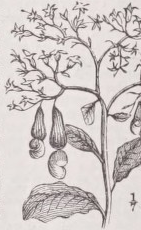
A tree (Anacardium occidentale) of the same family which the sumac. It is native in tropical America, but is now naturalized in all tropical countries. Its fruit, a kidney-shaped nut, grows at the extremity of an edible, pear-shaped hypocarp, about three inches long.
Cashew nut
Encyclopedia Britannica
CASHEW NUT, the fruit of the Cashew, Cadju, or Acajou tree, Anacardium occidentale (Nat. Ord. Anacardiaceoe), a native of the West Indian Islands. The fruit is kidney-shaped, about an inch in length, and the kernel is enclosed in two coverings, the outer of which is smooth, grey, and leathery. Inside this external rind is a darkcoloured layer, containing an excessively acrid juice. The kernels have a bland, oily, pleasant taste. They are much eaten, both raw and roasted, in the tropical regions in which the tree is cultivated, and they yield a light-coloured, sweet-tasted oil, said to be equal to olive oil for culinaιy purposes. The fruit-stalk, immediately under the fruit, is swollen and fleshy, and assumes a pear-like shape. This swollen portion of the stalk has a pleasant acid taste, and is eaten under the name of Cashew Apple. By fermentation it yields an alcoholic beverage, from which a spirit for drinking is distilled in the West Indies and Brazil The tree also yields a gum analogous to gum arabic.
9th ed. Encyclopædia Britannica, vol. 5, p. 175
[177 words — estimated reading time: 2 minutes]
[177 words — estimated reading time: 2 minutes]
A tree of the West-Indies, Anacardium, bearing a kidney-shaped nut. The fruit is as large as an orange, and full of an acid juice, which is often used to make punch. To the apex of this fruit grows a nut, of the size of a hares kidney, the shell of which is hard, and the kernel, which is sweet, is covered with a thin film.
Cashgar
Encyclopedia Britannica
CASHGAR. See Kashgar.
9th ed. Encyclopædia Britannica, vol. 5, p. 176
[3 words — estimated reading time: 1 minute]
[3 words — estimated reading time: 1 minute]
One who has charge of money; as cash-keeper. In a banking institution, the cashier is the officer who superintends the books, payments and receipts of the bank. He also signs or countersigns the notes, and superintends all the transactions, under the order of the directors.
1. To dismiss from an office or place of trust, by annulling the commission; to break, as for mal-conduct, and therefore with reproach; as, to cashier an officer of the army.
2. To dismiss or discard from service or from society.
One who has charge of money; a cash keeper; the officer who has charge of the payments and receipts (moneys, checks, notes), of a bank or a mercantile company.
1. To dismiss or discard; to discharge; to dismiss with ignominy from military service or from an office or place of trust.
2. To put away or reject; to disregard.
One who rejects discards or breaks; as a cashierer of monarchs.
One who rejects, discards, or dismisses; as, a cashierer of monarchs.
Discarding; dismissing from service.
of Cashier
1. A rich stuff for shawls, scarfs, etc., originally made in Cashmere from the soft wool found beneath the hair of the goats of Cashmere, Thibet, and the Himalayas. Some cashmere, of fine quality, is richly embroidered for sale to Europeans.
2. A dress fabric made of fine wool, or of fine wool and cotton, in imitation of the original cashmere.
Cashmere
Encyclopedia Britannica
CASHMERE. See Kashmir.
9th ed. Encyclopædia Britannica, vol. 5, p. 176
[3 words — estimated reading time: 1 minute]
[3 words — estimated reading time: 1 minute]
The juice or gum of a tree in the East Indies.
Money Roget’s Thesaurus §800
N. money, legal tender, money matters, money market, finance, accounts, funds, treasure, capital, stock, assets, wealth, supplies, ways and means, wherewithal, sinews of war, almighty dollar, needful, cash, mammon, dough, cabbage, money-like instruments, m1, m2, sum, amount, balance, balance sheet, sum total, proceeds, currency, circulating medium, specie, coin, piece, hard cash, cold cash, dollar, sterling coin, pounds shillings and pence, ls, d, pocket, breeches pocket, purse, money in hand, cash at hand, ready money, ready cash, slug, wad* wad of bills, wad of money, thick wad of bills, roll of dough, rhino|, blunt|, dust|, mopus|, tin|, salt|, chink|, argent comptant, bottom dollar, buzzard dollar|, checks, dibs*, double eagle, eagle, federal currency, fractional currency, postal currency, federal reserve note, united states note, silver certificate, gold certificate, long bit, short bit, moss, nickel, pile*, pin money, quarter, red cent, roanoke, rock*, seawan, seawant, thousand dollars, grand, single, one-dollar bill, two-dollar bill, five-dollar bill, fiver, fin, lincoln, ten-dollar bill, sawbuck, twenty-dollar bill, jackson, double sawbuck, fifty-dollar bill, hundred-dollar bill, c-note, penny, cent, lincoln cent, indian head penny, copper, two-cent piece three-cent piece, half-dime, nickel, buffalo nickel, v nickel, dime, disme|, mercury dime, quarter, two bits, half dollar, dollar, silver dollar, eisenhower dollar, susan b, anthony dollar, precious metals, gold, silver, copper, bullion, ingot, nugget, petty cash, pocket money, change, small change, small coin, doit, stiver, rap, mite, farthing, sou, penny, shilling, tester, groat, guinea, rouleau, wampum, good sum, round sum, lump sum, power of money, plum, lac of rupees, major coin, crown, minor coin, monetarist, monetary theory, numismatics, chrysology, numismatist, paper money, greenback, major denomination, minor denomination, money order, postal money order, post office order, bank note, bond, bill, bill of exchange, order, warrant, coupon, debenture, exchequer bill, assignat, blueback, hundi, shinplaster*, note, note of hand, promissory note, i o u, draft, check, cheque, back-dated check, negotiable order of withdrawal, now, remittance, credit, liability, drawer, drawee, obligor, obligee, moneyer, coiner, false money, bad money, base coin, flash note, slip|, kite*, fancy stocks, bank of elegance, argumentum ad crumenam, letter of credit, circulation, multiplier effect, inflation, double-digit inflation, hyperinflation, erosion of the currency, debasement of the currency, deflation, stagflation, exchange rate, rate of exchange, floating exchange rates, fixed rates, currency counter, currency exchange, bureau de change, gold-backed currency, gold standard, silver standard, bank account, savings account, checking account, money market account, now account, time deposit, deposit, demand deposit, super now account, certificate of deposit, cd, $, u, s, $, a$, federal reserve bank, central bank, federal reserve board, board of governors of the federal reserve, treasury department, secret service, mint, bureau of engraving, seigniorage, counterfeit, funny money, bogus money, (see falsehood) 545, interest, interest rate, discount rate
V. amount to, come to, mount up to, touch the pocket, draw, draw upon, indorse, issue, utter, discount, back, demonetize, remonetize, fiscalize, monetize, circulate, be in circulation, be out of circulation, mint, coin, print, inflate, deflate, debase, devalue, revalue, circulate, put in circulation, withdraw from circulation, exchange currencies, change money, charge interest, pay interest, lose interest
Adj. monetary, pecuniary, crumenal|, fiscal, financial, sumptuary, numismatic, numismatical, sterling, nummary
Phr. barbarus ipse placet dummodo sit dives, "but the jingling of the guinea helps the hurt that honor feels", gelt regiert die welt, money makes the world go round, nervos belli pecuniam infinitam, redet geld so schweigt die welt, "money is the mother's milk of politics", money is the root of all evil, money isn't everything, "as phony as a three-dollar bill", "don't take any wooden nickels"
Payment Roget’s Thesaurus §807
N. payment, defrayment, discharge, acquittance, quittance, settlement, clearance, liquidation, satisfaction, reckoning, arrangement, acknowledgment, release, receipt, receipt in full, receipt in full of all demands, voucher, salary, compensation, remuneration (reward) 973, repayment, reimbursement, retribution, pay, money paid, ready money, stake, remittance, installment, payer, liquidator, pay cash, pay cash on the barrelhead
V. pay, defray, make payment, paydown, pay on the nail, pay ready money, pay at sight, pay in advance, cash, honor a bill, acknowledge, redeem, pay in kind, pay one's way, pay one's shot, pay one's footing, pay the piper, pay sauce for all, pay costs, do the needful, shell out, fork out, cough up, fork over, come down with, come down with the dust, tickle the palm, grease the palm, expend, put down, lay down, discharge, settle, quit, acquit oneself of, foot the bill, account with, reckon with, settle with, be even with, be quits with, strike a balance, settle accounts with, balance accounts with, square accounts with, quit scores, wipe off old scores, clear off old scores, satisfy, pay in full, satisfy all demands, pay in full of all demands, clear, liquidate, pay up, pay old debts, disgorge, make repayment, repay, refund, reimburse, retribute, make compensation, pay by credit card, put it on the plastic
Adj. paying &c. paid, owing nothing, out of debt, all straight, unowed, never indebted
Adv. to the tune of, on the nail, money down
No Bible verses found for "cash".