
A species of leopard (Cynaelurus jubatus) tamed and used for hunting in India. The woolly cheetah of South Africa is C. laneus.
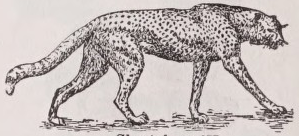
CHEETAH, or Hunting Leopard(Guepαrda jubata), a Carnivorous Mammal belonging to the family Felidoe, but exhibiting in form and habits such a mixture of feline and canine characteristics as have led naturalists to regard it as a transition form between the cat and dog groups. Unlike the typical Felidoe, its head is short and round, its legs elongate and slender, and the flesh tooth of the upper jaw thin and longitudinally compressed. Its claws, being only partially retractile, get blunted by exposure to the surface of the ground, and so are less adapted to the purely feline mode of capturing prey. The cheetah attains a length of 3 to 4 feet, is of a pale fulvous colour, marked with numerous spots of a deep black on the upper surface and sides, and is nearly white beneath. The fur is somewhat crisp, altogether lacking the sleekness which characterizes the fur of the typical cats. Its tail is long and somewhat bushy at the extremity. In confinement it soon becomes fond of those who are kind to it, and gives evidence of its attachment in an open, dog-like manner. According to Mr Bennet (Tower Menageries) “the character of the cheetah seems to be entirely free from that sly and suspicious feeling of mistrust which is so strikingly visible iħ the manner and actions of all the cats, and which renders them so little susceptible of real or lasting attachment;” and it is the opinion of the same writer that the cheetah might be thoroughly domesticated and “rendered nearly as familiar and faithful as the dog himself.” The cheetah is found throughout Africa and Southern Asia, and has been employed for centuries in India and Persia in hunting antelopes and other ruminant game. According to Sir W. Jones, this mode of hunting originated with Hushing, king of Persia, 865 B.C., ...and afterwards became so popular that certain of the Mongol emperors were in the habit of being accompanied in their sporting expeditions by a thousand hunting leopards. In prosecuting this sport at the present day the cheetah is conveyed to the field in a low car without sides, hooded and chained like hunting-birds in Europe in the days of falconry. When a herd of deer or antelopes is seen, the car, which bears a close resemblance to the ordinary vehicles used by the peasants, is usually brought within 200 yards of the game before the latter takes alarm; the cheetah is then let loose and the hood removed from its eyes. No sooner does it see the herd, than dropping from the car on the side remote from its prey, it approaches stealthily, making use of whatever means of concealment the nature of the ground permits, until observed, when making a few gigantic bounds, it generally arrives in the midst of the herd and brings down its victim with a stroke of its paw. The sportsman then approaches, draws off a bowl of the ruminant’s blood, and puts it before the cheetah, which is again hooded and led back to the car. Should it not succeed in reaching the herd in the first few bounds, it makes no further effort to pursue, but retires seemingly dispirited to the car. In Africa the cheetah is only valued for its skin, which is worn by chiefs and other people of rank. It forms an article of export from Senegal