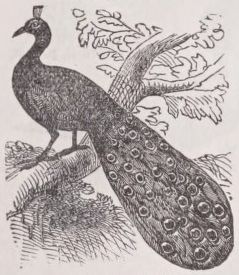
As in most cases of domestic animals, pied or white varieties of the ordinary Peacock, Pavo cristatus, are not unfrequently to be seen; and, though lacking in proportion the gorgeous resplendence for which the common bird stands unsurpassed, they are valued as curiosities. Greater interest, however, attends what is known as the “japanned” Peacock, often erroneously named the Japanese or Japan Peacock, a form which has received the name of P. nigripennis, as though it were a distinct species. In this form the cock, besides other less conspicuous differences, has all the upper wing-coverts of a deep lustrous blue instead of being mottled with brown and white, while the hen is of a more or less greyish-white, deeply tinged with dull yellowish-brown near the base of the neck and shoulders. It “breeds true”; but occasionally a presumably pure stock of birds of the usual coloration throws out one or more having the “japanned” plumage, leading to the conclusion that the latter may be due to “reversion to a primordial and otherwise extinct condition of the species ”, and it is to be observed that the “japanned” male has in the coloration of the parts mentioned no little resemblance to that of the second indubitably good species, the P. muticus (or P. spicifer of some writers) of Burma and Java, though the character of the latter’s crest—the feathers of which are barbed along their whole length instead of at the tip only—and its golden-green neck and breast furnish a ready means of distinction. The late Sir R. Heron was confident that the “japanned” breed had arisen in England within his memory, and Darwin (Anim. and Plants under Domestication, i. pp. 290-292) was inclined to believe it only a variety; but its abrupt appearance, which rests on indisputable evidence, is most suggestive in the light that it may one day throw on the question of evolution as exhibited in the origin of “species ”. It should be stated that the “japanned” bird is not known to exist anywhere as a wild race. The accompanying woodcut is copied from a plate drawn by Mr Wolf, given in Mr Elliot’s Monograph of the Phasianidae.
The Peafowls belong to the group Gallinae, from the normal members of which they do not materially differ in structure; and, though by some systematists they are raised to the rank of a Family, Pavonidae, most are content to regard them as a Subfamily of Phasianidae (Pheasant, g , .u). Akin to the genus Pavo is Poty-plectrτιm, of which the males are armed with two or more spurs on each leg, and near them is generally placed the genus Argusianus, containing the Argus-Pheasants, remarkable for their wonderfully ocellated plumage, and the extraordinary length of the secondary quills of their wings, as well as of the tail-feathers. It must always be remembered that the so-called “tail” of the Peacock is formed not by the rectrices or true tail-feathers, but by the singular development of the tail-coverts, a fact of which any one may be satisfied by looking at the bird when these magnificent plumes are erected and expanded in disk-like form as is his habit when displaying his beauty to his mates. (A. N. )
PEACOCK, George (1791-1858), mathematician, was born at Thornton Hall, Denton, near Darlington, 9th April 1791. He was educated at Richmond, Yorkshire, and entered Trinity College, Cambridge, in 1809. He was second wrangler in the mathematical tripos of 1812 (Sir J. F. W. Herschel being senior), was elected fellow of his college in 1814, and became assistant tutor and lecturer in 1815, full tutor in 1823, and sole tutor of “his side” in 1835. Peacock distinguished himself by his business capacity, and by his broad views of the duties and functions of the educational institution in whose management he had so large a share.
Peacock was all his life an ardent educational reformer. While still an undergraduate he formed a league with Herschel, Babbage, and Maule to conduct the famous struggle of “d-ism versus dot-age,” which ended in the introduction into Cambridge of the Continental notation ιn the infinitesimal calcidus to the exclusion of the fluxional notation (ý) of Newton. This was an important reform, not so much on account of the mere change of notation (for nowadays mathematicians follow Lagrange in using both these notations), but because it signified the opening to the mathematicians of Cambridge of the vast storehouse of Continental discoveries. Up to that time Cambridge mathematicians had been resting supinely under the shadow of Newton, despising the Continental methods, but doing nothing to demonstrate the power of their own. The analytical society thus formed in 1813 published various memoirs, and translated Lacroix’s Differential Calculus in 1816. Peacock powerfully aided the movement by publishing in 1820 A Collection of Examples of the Application of the Differential and Integral Calculus, which remains a valuable text-book to this day. He also took a great interest in the general question of university education. In 1841 he published a pamphlet on the university statutes, in which he indicated the necessity for reform; and in 1850 and 1855 he was a member of the commission of inquiry relative to the university of Cambridge.
In 1837 he was appointed Lowndean professor of astronomy. In 1839 he took the degree of D.D., and the same year was appointed by Lord Melbourne to the deanery of Ely. Without in any way neglecting his university duties, Peacock threw himself with characteristic ardour into the duties of this new position. He improved the sanitation of Ely, published in 1840 Observations on Plans for Cathedral Reform, and carried out extensive works of restoration in his own cathedral. He was twice prolocutor of the lower house of convocation for the province of Canterbury.
This list by no means exhausts the sphere of Peacock’s activity. He was a prime mover in the establishment of the Cambridge Astronomical Observatory, and in the founding of the Cambridge Philosophical Society. He was a fellow of the Royal, Royal Astronomical, Geological, and other scientific societies. In 1838, and again in 1843, he was one of the commissioners for standards of weights and measures; and he also furnished valuable information to the commissioners on decimal coinage, a matter in which he took great interest. He died on the 8th November 1858, before the university commission, in whose work he took so great an'interest, had finished its labours.
It will excite little surprise that a man of so many occupations should have left more mark upon the men of his own day than upon the science of the succeeding generation. Although Peacock was most distinguished and will be longest remembered as a mathematician, it would be difficult to point to much work of his which is of importance at the present day. His original contributions to mathematical science were concerned chiefly with the philosophy of its first principles. He did good service in systematizing the operational laws of algebra, and in throwing light upon the nature and use of imaginaries. His work in this field was, however, thrown into the shade by the later and farther-reaching discoveries of Hamilton and Grassmann. Two great services he did for mathematical education which deserve especial mention. He published, first in 1830, and then in an enlarged form in 1842, a Treatise on Algebra, in which he applied his philosophical ideas concerning algebraical analysis to the elucidation of its elements. This textbook was probably too far ahead of his age, for it does not seem to have come into very general use; at all events, it might with great advantage be studied by the teachers of elementary mathematics at the present day, and is very much superior in method and arrangement to any of the English text-books at present in vogue. The second great service was the publication in the British Association Reports for 1833 of his “Report on the Recent Progress and Present State of certain branches of Analysis.” English mathematicians of this generation will doubtless find on reading this brilliant summary a good many dicta which they will call in question, and they will see a good deal of evidence that Peacock did not always fully appreciate, or perhaps always quite understand, the work of the foremost Continental mathematicians of his time; but they will be ready to condone these shortcomings when they remember that they were carried on the shoulders of Peacock and his “d-istic league” out of the mire into which English mathematics had fallen, and that it ’ is but natural that they should catch a better view of the surrounding scenery than did their bearer. Whatever its defects may be, Peacock’s report remains a work of permanent value, one of the first and one of the best of those valuable summaries of scientific progress which have enriched the annual volumes of the British Association, and which would have justified its existence had it done nothing else for the advancement of science.
PEACOCK, Thomas Love (1785-1866), novelist and poet, was born at Weymouth, 18th October 1785. His father, a glass merchant in London, died soon after his son’s birth, and young Peacock received his education at a private school at Englefield Green, where he distinguished himself by unusual precocity. After a brief experience of business he elected to devote himself to study and the pursuit of literature, living with his mother on their private means. His first books were poetical, The Monks of St Mark (1804), Palmyra (1806), The Genius of the Thames (1810), The Philosophy of Melancholy (1812),— works of no great merit. He also made several dramatic attempts, which did not find their way to the stage. He served for a short time as secretary to Sir Home Popham at Flushing, and paid several visits to Wales. In 1812 he became acquainted with Shelley, who made him his executor together with Lord Byron. In 1815 he evinced his peculiar power by writing Headlong Hall, the prototype of all his subsequent novels. It was published in 1816, and Melincourt followed in the ensuing year. During 1817 he lived at Great Marlow, enjoying the almost daily society of Shelley, and writing Nightmare Abbey and Rhododaphne, by far the best of his long poems. In 1819 he received the appointment of assistant examiner at the India House, at the same time as Mill and Strachey. Peacock’s nomination appears to have been due to the influence of his old schoolfellow Peter Auber, secretary to the East India Company, and the papers he prepared as tests of his ability were returned to him with the high encomium, “Nothing superfluous and nothing wanting.” This was characteristic of the whole of his intellectual work; and equally characteristic of the man was his marriage about this time to a Welsh lady, to whom he proposed by letter, not having seen her for eight years. His official duties greatly interfered with independent composition. Maid Marian nevertheless appeared in 1822, The Misfortunes of Elphin in 1829, and Crotchet Castle in 1831; and he would probably have written more but for the death in 1833 of his mother, to whom he was deeply attached. He also contributed to the Westminster Review and the Examiner. His services to the East India Company, outside the usual official routine, were considerable. He defended it successfully against the attacks of Mr J. S. Buckingham and the Liverpool salt interest, and made the subject of steam navigation to India peculiarly his own. He represented the company before the various parliamentary committees on this question; and in 1839 and 1840 superintended the construction of iron steamers, which not only made the voyage round the Cape successfully, but proved very useful in the Chinese war. He also framed instructions for the Euphrates expedition, pronounced by General Chesney to be models of sagacity. In 1836 he succeeded Mill as chief examiner, and in 1856 he retired upon a pension. During his later years he contributed several papers to Fraser's Magazine, including reminiscences of Shelley. He also wrote in the same magazine his last novel, Gryll Grange (1860), inferior to his earlier writings in humour and vigour, but still a surprising effort for a man of his age. He died 23d January 1866 at Lower Halliford, near Chertsey, where, so far as his London occupations would allow him, he had resided for more than forty years.
Peacock’s position in English literature is unique. There was nothing like his type of novel· before his time; though there might have been if it had occurred to Swift to invent a story as a vehicle for the dialogue of his Polite Conversation. But, while Swift’s interlocutors represent ordinary types, Peacock’s are highly exceptional; while the humour of the former consists in their stereotyped conventionality or unconscious folly, the talk in Peacock’s novels is brilliant; and, while Swift’s characters utter proverbs, Peacock’s are equipped from the author’s own stores of humorous observation or reflexion. He speaks as well in his own person as through his puppets; and perhaps no writer since Pope has enriched English literature with such an abundance of quotable things. This pithy wit and sense, combined with remarkable grace and accuracy of natural description, atone for the primitive simplicity of plot and character. There is just enough of both to keep the story going, and the author’s plan required no more. Of his seven fictions, Nightmare Abbey and Crotchet Castle are perhaps on the whole the best, the former displaying the most vis comica of situation, the latter the fullest maturity of intellectual power, and the most skilful grouping of the motley crowd of “perfectibilians, deteriorationists, statu-quo-ites, phrenologists, transcendentalists, political economists, theorists in all sciences, projectors in all arts, morbid visionaries, romantic enthusiasts, lovers of music, lovers of the picturesque, and lovers of good dinners,” who constitute the dramatis personae of that comedy in narrative, the Pea-cockian novel. Maid Marian and The Misfortunes of Elphin are hardly less entertaining, but are somewhat cramped by the absence of portraiture from the life and the necessity for historical colouring. Both contain descriptive passages of extraordinary beauty. Melincourt is a comparative failure, the excellent idea of an orangoutang mimicking humanity being insufficient as the sole groundwork of a novel. Headlong Hall, though more than foreshadowing the author’s subsequent excellence, is marred by a certain bookish awkwardness characteristic of the recluse student, which reappears in Gryll Grange as the pedantry of an old-fashioned scholar, whose likes and dislikes have become inveterate and whose sceptical liberalism, always rather inspired by hatred of cant than enthusiasm for progress, has petrified into only too earnest conservatism. Pianos and perspective equally with competitive examinations and “panto-pragmatism” are the objects of the writer’s distaste, and for the first time in his career we feel inclined to laugh at him, being no longer able to laugh with him. The book’s quaint resolute paganism, however, is very refreshing in an age eaten up with introspection; it is the kindliest of Peacock’s writings, and contains the most beautiful of his poems, “Years Ago,” the reminiscence of an early attachment. In general the ballads and songs interspersed through his tales are models of exact and melodious diction, and instinct with true feeling. His more ambitious poems are worth little, except Rhododaphne, attractive as a story and perfect as a composition, but destitute of genuine poetical inspiration. His critical and miscellaneous writings are always interesting, especially the restorations of lost classical plays in the Horae Drαmαticae, but the only one of great mark is the witty and crushing exposure in the Westminster Review of Moore’s ignorance of the manners and belief he has ventured to portray in his Epicurean. Peacock resented the misrepresentation of his favourite sect, the good and ill of whose tenets were fairly represented in his own person. Somewhat sluggish and self-indulgent, incapable of enthusiasm or self-sacrifice, he yet possessed a deep undemonstrative kindliness of nature; he could not bear to see any one near him unhappy or uncomfortable; and his sympathy, no less than his genial humour, gained him the attachment of children, dependants, and friends. His feelings were steady rather than acute; he retained throughout life with touching fidelity the memory of an early affection. In official life he was upright and conscientious; his judgment was shrewd and robust, and the quaint crotchets and prejudices which contrasted so curiously with his usual sagacity were in general the exaggeration of .sound ideas held with undue exclusiveness. As a candidate for literary immortality he should be safe. The same causes which restrict his popularity ensure his permanence. His novels depend but slightly on temporary phases of manners, but are vitally associated with standard literature, and with general tendencies innate in the human mind. Neither his intellectual liberalism nor his constitutional conservatism will ever be out of date; and what Shelley justly termed “the lightness, strength, and chastity” of his diction secures him an honourable rank among those English writers whose claims to remembrance depend not only upon matter but upon style.
Peacock’s works were collected, though not completely, and published in three volumes in 1875, at the expense of his friend and former protégé, Sir Henry Cole, with an excellent memoir by his grand-daughter Mrs Clarke, and a critical essay by Lord Houghton. Other criticisms have been written, by Mr Spedding in the Bdin-bιιrgh Review and by James Hannay in the North British Review. For an interesting personal notice, see A Poet’s Sketch Book, by R. W. Buchanan, 1884.