
2. A genus of Monotremata found in Australia, Tasmania, and New Guinea. They are toothless and covered with spines; -- called also porcupine ant-eater, and Australian ant-eater.
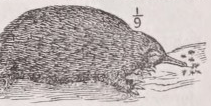
ECHIDNA, or Porcupine Ant-eater{Echidna hystrix), one of the four known species of Monotremata, the lowest order of Mammalia. It is a native of Australia, where it chiefly abounds in New South Wales, inhabiting rocky and mountainous districts, where it burrows among the loose sand, or hides itself in crevices of rocks. In size and appearance it bears a considerable resemblance to the hedgehog, its upper surface being covered over with strong spines directed backwards, and on the back inwards so as to cross each other on the middle line. The spines in the neighbourhood of the tail form a tuft sufficient to hide that almost rudimentary organ. The head is produced into a long tubular snout, covered with skin for the greater part of its length. The opening of the mouth is small, and from it the echidna puts forth its long slender tongue, lubricated with a viscous secretion, by means of which it seizes the ants and other insects on which it feeds. It is entirely destitute of teeth. Its legs are short and strong, and form, with its broad feet and large solid nails, powerful burrowing organs. In common with the other monotremes, the male echidna has its heel provided with a sharp hollow spur, connected with a secreting gland, and with muscles capable of pressing the secretion from the gland into the spur; but as the animal has never been observed to use this in defending itself, the spur probably serves some other purpose than that of offence or defence. It is a nocturnal or crepuscular animal, generally sleeping during the day, but showing considerable activity by night. When attacked it seeks to escape either by rolling itself into a ball, its erect spines proving a formidable barrier to its capture, or by burrowing into the sand, which its powerful limbs enable it to do ...with great celerity. “The only mode of carrying the creature,” says Bennet {Gatherings of a Naturalist in Australasia) “ is by one of the hind legs, when it may be removed to any place with great facility, for an attempt to seize it by any other part of the body, from its powerful resistance and the sharpness of the spines, will soon oblige the captor to relinquish his hold.” They are exceedingly restless in confinement, and constantly endeavour by burrowing to effect their escape. From the quantity of sand and mud always found in the alimentary canal of the echidna, it is supposed that these ingredients must be necessary to the proper digestion of its insect food. The only other members of this family are the Short-spined Echidna {Echidna setosd), cοηhηed to Tasmania, and differing from the former species chiefly in the shortness of its spines, which are nearly hidden by the long harsh fur, and the Echidna Bruijnii—a new species discovered in 1877 in the mountains on the north-east, coast of New Guinea, at an elevation of 3500 feet. By many naturalists the generic term Echidna has lately been abandoned in favour of Tachyglossτι,s of Illiger.