The Hymenopterous insects are distinguished by the possession of four membranous wings, although in certain exceptional instances—as among certain members of the ant community—the wings may be wanting. The organs of the mouth are partly fitted for mastication by the development of jaws, and partly for suctorial purposes by the possession of a proboscis or “antlia.” The females of this order generally possess a terminal abdominal appendage, forming a “sting” {aculeus), or which may be used in the deposition of the eggs, when it is termed an ovipositor. The Hymenoptera, besides, undergo a “complete” metamorphosis,—that is, in their passage from the egg towards adult or mature existence they appear first as grubs, or larvae, then are enclosed in a pupa-case, and finally appear as the perfect, and generally winged insect, or “imago.” The Hymenoptera exhibit, perhaps, the most remarkable development among insects of the faculty of instinct, and constitute excellent examples of so-called “social” insects, living in communities regulated by definite laws, each member of the society bearing a separate and well-defined part in the organisation and arrangement of the colony at large.
From the earliest times ants have attracted the attention, not only of naturalists, but of philosophers and poets. The ancients were familiar with many of the phenomena characteristic of the ant colony. Aristotle and Pliny, for example, inform us that the labours of ants are regulated in a great measure by the phases of the moon. Pliny also makes mention of a species which he alleges is found in Northern India, which were said to equal Egyptian wolves in size, and were supposed to occupy themselves in digging gold from the bowels of the earth, whilst the inhabitants of the country were said to rob the ants in summer of their accumulated winter treasures.
The harvesting and grain-storing habits of ants, so familiar to the popular reader, were at first supposed to be common to all species of ants; but this view has been abundantly proved to be erroneous, whilst the opposite extreme of asserting that no species practise these habits is to be viewed as equally incorrect. In many cases it is probable that observers have been deceived into the supposition that certain species of ants really carried grains of corn in their mouths, whereas the so-called corn grains of these species were in reality the cocoons or pupae-cases containing the young and immature forms. And whilst most species of ants are granivorous, or vegetable feeders, certain species are as decidedly carnivorous. These latter kinds do not, therefore, participate in the frugal and industrious habits of their allies.
The bibliography of ants is very extensive. Dr King, in the 23rd number of the Philosophical Transactions, described the form of the eggs and of the larvae, and also the habits of ants in reference to their care of their young. Leeuwenhoeck, the Dutch naturalist, traced the successive stages of development in the ants, and demonstrated the egg, “larva,” “pupa,” and “imago,” or perfect insect. Swammerdam, with the application of the microscope, further advanced the knowledge of the development and structure of the ants; and Linnaeus (Memoirs of the Royal Academy of Sciences of Stockholm) ascertained many facts relative to the reproduction of these forms, and determined that the winged ants are those which alone exercise the generative functions. A Mr Gould published An Account of English Ants, of which work a notice by the Rev. Dr Miles is given in the Philosophical Transactions for 1747. This account, excellent in many respects, is nevertheless erroneous in certain points,—the result of following too closely the analogy presumed to exist between bees and ants. Geoffroy {Histoire des Insectes qui se trouvent aux Environs de Paris'), a good naturalist otherwise, is a bad authority on the subject of ants. The most complete series of observations on ants, which appeared among the earlier accounts of these forms, are those of De Geer, a Swedish entomologist {Mémoires pour servir d ι Histoire des Insectes), an observer on whose fidelity the utmost reliance may be placed. Olivier, in the Encyclopédie Méthodique (article Fourmi), summarised the knowledge of his own and of preceding times, and described a few new species of ants; and Bonnet, in his Observations sur les Insectes (vol. ii.), has given us some interesting, though by no means extensive information regarding the habits of ants. The “sugar-ant” (Î) forms the subject of a memoir in the Philosophical Transactions for 1790, this latter species having caused much havoc among the sugar-plantations of Grenada over a period of ten years. Latreille, a famous entomologist, in his special monograph {Histoire Naturelle des Fourmis), published at Paris in 1802, gave the most succinct and accurate account of the ant-tribe which had appeared up to that date. His description of the structure and classification of these insects is remarkably clear, and he fully describes one hundred species known to himself, and mentions twenty-four species which he was enabled to describe from the reports of others. He distributed these species among nine families, selecting as the bases of his classification the situation and structure of the “antennae” or “feelers,” and the disposition of the abdominal scales.
The habits of ants receive the fullest attention at the hands of Pierre Huber of Geneva,'who in a treatise {Traité des Moeurs des Fourmis Indigenes) published in 1810, gave a very interesting, lucid, and valuable account of his native ants, drawn from actual observation of the nests and communities. This result he achieved by means of an apparatus which enabled him to view the interior of the nest. Many facts have been added to the history of ants since 1810; the list of works and treatises upon this and allied entomological pursuits having been largely increased, especially of late years.
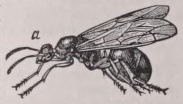
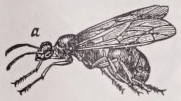
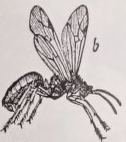
The constitution of an ant-community may be readily appreciated; but it is, at the same time, important to note the distinctions between the various groups or sects into which the curious colony is divided. A threefold distinction of sex, resulting in the production of three kinds of individual forms, is to be perceived in the ant-colony, as well as among other hymenopterous insects (e.g. bees). These three grades of individuals are known respectively as males, females, and neuters. The males and females Fig. 1.—Wood Ant (Formica rufa). 1, Female; 2, Male; 3, Neuter.
are winged,—the former retaining their wings throughout life, and the latter losing these organs after the pairing is over. During the summer the winged males and females are produced in large numbers, and they soon leave the nest to take their “nuptial flight” in the air, in the course of which the females are impregnated. The function of the male ants having been thus performed, they die; the females, after impregnation, lose their wings; and whilst in this comparatively helpless state they are conveyed by the neuters to new situations, where they become the founders of fresh colonies.
Each fertile female or “queen” is carefully attended by a retinue of “neuters,” the latter being simply females the sexual organs of which are undeveloped. The curious experiments of entomologists have proved that, in all probability, the cause of this differentiation of sex is dependent upon the nature of the food with which during the larval state the ant is fed. Exempted thus from all sexual functions, the duties of the neuters are confined to the performance of all the offices which contribute to, or are connected with, the welfare and labour of the ant-community. They thus not only construct and build the nest or home, and keep it in constant and assiduous repair, but they are also the providers of food and sustenance for the community; and they act the part of nurses, in that they carefully attend to the hatching, nutrition, and rearing of the young. They are also the defenders of the colony, in that they protect the nest and its inmates from the attacks and assaults of nearly-related enemies or foreign foes. In connection with the defence of the ant-colony, certain species possess peculiar neuters, termed “soldiers,” upon which the care and protection of the community more especially devolve. These “soldiers” are provided with large mandibles or biting-jaws, which constitute efficient organs of offence or defence; and they are distinguished from the ordinary neuters by several characteristics in addition to this larger development of the jaws.
Regarding the more intimate structural differences which have been ascertained to exist between the various members of the ant-community, it may be remarked that the antennae of the male ants possess thirteen joints each, and those of the female twelve. The antennae of the neuters are composed of twelve joints. The abdomen of the male ant consists of seven joints, and that of the female and neuter of six. The mandibles or large jaws of the female and neuter ants are larger than those of the males, and are frequently found to be serrated or even hooked at their extremities. The external sexual organs of the neuters correspond to those of the females, although, as already remarked, the essential internal reproductive organs are wholly undeveloped in the neuter ants; and to this most important distinction there is added the absence of wings, the neuters being thus distinguished from the females by a variety of characters, while the near relation is at the same time shown of the one series of truly sexual forms to those in which the sex is undeveloped. The neuters, it may lastly bo remarked, conform to the female characteristics, in having the abdomen provided with a sting, the male ants being destitute of this appendage.
The nervous system of the ants conforms to the ordinary insect-type; but in these and other insect forms, we find the highest development of those faculties to which the general name of Instinct is applied. By instinctive acts, in their simplest sense, we mean those acts which an animal performs chiefly from impressions made by surrounding objects upon its nervous or sensory apparatus. These are very different in character and origin from the actions of the higher vertebrate animals, in which the independent faculty of mind operates as the direct source of action, in place of the surrounding circumstances of the lower form. Thus, in the case of ants, bees, &c., wonderful as their operations may appear, and regular and methodical as the manner in which they are performed may seem, it will be found that a marked uniformity and likeness of conditions exist, which tend to produce a corresponding similarity of effects. The same external conditions thus tend to induce undeviatingly similar series of phenomena, and under the operation of these acts the animal exercising them may justly be compared to an automatic machine, or to a piece of mechanism, self-directing only in so far as it is directed by external .circumstances and outside conditions. Hence we find certain species of ants or bees invariably constructing similar series of cells or habitations, and engaging in the same labours as their predecessors, which labours or operations will be faithfully and exactly repeated by succeeding generations. And the automatic and mechanical nature of instinctive acts may be clearly viewed when we contrast them in their essential nature with the directing intelligence and guiding impulse of mind, as we find these qualities exercised in the highest vertebrates. In the latter case, the mental impulse itself directs alike the physical and psychical operations, and so far from the animal being merely automatic, it assumes the higher phase of nervous action involved in self-originating mental impulse. The actions of the intelligent being are self-determined: those of the instinctive being originate from the outer world. Through the higher nervous centres the intelligent being first appreciates the outward circumstances, and then reacts upon them; the nervous centres of the lower being are, in the first instance, acted upon by the outer world, and then in their turn react upon the organism. Lastly, and in accordance with the more perfect appreciation of external objects through sensations and perceptions, we have to note in the higher being the operation of the educative power we entitle experience. The ant or bee, when first introduced into the special sphere of its labours, assumes its functions, and performs its duties as perfectly as if it had been engaged in their performance for a lengthened period. And the long-continued performance of these duties will in no degree tend to make the ant or bee a more perfect or more skilful worker than when the performance of the duties first commenced. Here, again, we observe the operation of the automatic powers; the lower animal, like the perfected machine, operates at once and without any previous experience as perfectly as after a lengthened period of working. But, in the higher operations directed by intelligence, the being acquires in a gradual manner, and only after a lengthened experience, the perfect manner of working. In the one case instinct incites the being automatically, or through the excitory outward impressions, to perform the acts; in the other, an intelligent mind first appreciates the impressions, and, through the educative training of experience, is enabled to perform the acts, and to understand in a greater or less degree the reasons which prompt and justify them.
Apart from the possession of high instincts, however, we find ants, in common with many other insects, to be possessed of very perfect senses. In addition to the large compound eyes with which most insects are provided, they possess simple organs of vision. The sense of smell also appears to be represented in the ants and insects generally, but the seat of this sense has not been well or satisfactorily determined. Judging from analogy, however, the olfactory apparatus has been supposed to reside in the basal joints of the feelers or antennae. Ants have been long observed to follow accurately the track of their companions. Bonnet concluded that they were enabled to follow up this line of march by their scent, and in proof of this he repeatedly drew his finger at various parts across the line of march. The ants, on arriving at the interrupted spots, seemed to lose scent, and directed their steps in an irregular and hesitating manner, but having once crossed the interrupted space of the finger track, they resumed their journey once more in a regular manner along the line of march. Latreille, with the view of ascertaining if the sense of smell resided in the antennae, cut off these organs in several ants, when he found that they appeared to lose their way, and to be incapable of directing their further steps. It may, however, on obvious grounds be doubted whether this experiment may be deemed at all satisfactory or conclusive on the point. In this experiment it was noticed that the neighbouring ants appeared to observe the distress of their mutilated companions, and they seemed to stanch the wounds of the sufferers by an application of the organs of the mouth to the wounded surface.
The antennae in insects are certainly the organs of touch, but in ants these organs appear to subserve some undetermined function, in that through their agency communication may be made from one ant to the other. Μ. Huber was so strongly impressed with this latter fact, that he applied the term langage antennal to the intercourse which he supposed took place between ants through the media of the antennae. For example, by each ant striking its head against its neighbour, and by the transmission of this impulse, the whole ant-community appeared to be warned of danger, and in other ways, but chiefly through the antennae, the sense of danger appears to be appreciated by each member of the colony.
The food of ants has formed a debatable point ever since the attention of naturalists was directed to the investigation of their economy. As already remarked, many species are truly carnivorous, and prey upon the soft parts of other insects, and particularly of larvae, which they are enabled to seize and capture with little danger and trouble. The well-known partiality of ants for animal food is taken advantage of by those who wish to obtain the hard parts or skeletons of animal forms; since by placing an animal body within reach of an ant-colony, the soft parts are gradually eaten away, and the harder portions are left intact. In tropical climates, rats, mice, and poultry, even in a living state, are said to succumb to the attack of these creatures; and man himself, as related by Prévost in his Histoire Général des Voyages, is even subject to the attacks of ants. Prévost relates that an Italian missionary in Congo was awakened from sleep by his negroes, with the intelligence that an immense horde of ants was invading his house. Before he could rise they had already covered his legs, and the floor of his house was carpeted by a thick layer of the invading forms. Fire seemed to be the only preventive to their onward march; and it was stated that cows were known to be devoured in their stalls by these creatures. These remarks may be viewed as applying more particularly to the white ants or termites, of which an account will be given, afterwards. For sugar ants seem to have a special predilection; and they appear not only to obtain the saccharine matter from vegetables, but also to abstract it from animal sources. The aphides, or plant lice, become in this way the subjects of very extraordinary attentions on the part of ants. The plant lice possess a glandular structure, situated at the extremity of the abdomen, which communicates with the external surface by two small ducts. This gland secretes a sweet or saccharine liquid of viscous nature, of which ants are extremely fond, and the aphides appear to be literally “milked” by their smaller neighbours. The antennae of the ants in this case also appear to be the media of intercourse between the aphides and themselves, and by touching the abdomen of the plant lice with the antennae, a drop of the saccharine liquid exudes from the gland, which is eagerly seized upon by the ants; and in th13 fashion the milking process is continued until the ant is satisfied. The aphides, in this instance, appear voluntarily to surrender themselves for the purpose of affording the saccharine matter; but it has been also alleged that certain species of ants keep aphides within their nests for the purpose of affording the desired matter. Whether or not this alleged domestication of the aphides by ants is to be deemed worthy of belief yet remains to be proved. A single aphis may be occasionally seen surrounded by three or four ants, —the latter ordinarily finding the aphides on the leaves of plants and in their natural habitat. The association of ants and aphides, strange as it may seem, is not, however, without its parallels in the history of the ant-colony. Thus wood-lice are not infrequently found as apparently normal guests within the ant-nest; and Siva of Pisa observed a species of grasshopper, to which he has given the name Gryllus myrmecophilus, which inhabits the nest of an Italian ant. The ant-nest, in fact, appears to be the normal habitation of this grasshopper.
The ant-nest forms a very interesting subject for consideration, and the various groups of ants differ widely in the outward form and internal plan according to which the nests are constructed, as well as in the materials of which the habitations are built Clay, earth, and vegetable matters form the chief sources of supply, and excavations in the ground, or erections above ground, in trees, walls, and houseroofs, may be mentioned as the most common situations for the nests. The internal arrangement also varies even to a greater extent than the external appearance or materials. The general plan of the nest shows an arrangement of flats or stories, connected throughout by passages, and supported by definite pillars or partitions. The chief ends and objects in the construction of the nest appear to be directed to the preservation of the larvae, and to their protection from changes of temperature. During the night the larvae are placed in the furthest chambers of the nest, the entrance to the nest being carefully secured for warmth and for ensuring...