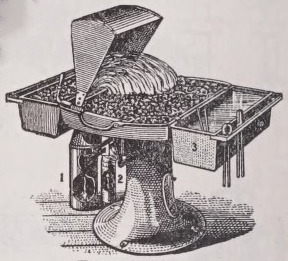
1. A furnace in which iron or other metal is heated and hammered into form. A larger forge is called with us iron-works. Smaller forges consisting of a bellows so placed as to cast a stream of air upon ignited coals, are of various forms and users. Armies have travelling forges, for repairing gun-carriages, etc.
2. Any place where any thing is made or shaped.
3. The act of beating or working iron or steel; the manufacture of metalline bodies.
1. To form by heating and hammering; to beat into any particular shape, as a metal.
2. To make by any means.
3. Names that the schools forged, and put into the mouths of scholars.
4. To make falsely; to falsify; to counterfeit; to make in the likeness of something else; as, to forge coin; to forge a bill of exchange or a receipt.
1. A place or establishment where iron or other metals are wrought by heating and hammering; especially, a furnace, or a shop with its furnace, etc., where iron is heated and wrought; a smithy.
2. The works where wrought iron is produced directly from the ore, or where iron is rendered malleable by puddling and shingling; a shingling mill.
3. The act of beating or working iron or steel; the manufacture of metalic bodies.
4. To form by heating and hammering; to beat into any particular shape, as a metal.
5. To form or shape out in any way; to produce; to frame; to invent.
6. To coin.
7. To make falsely; to produce, as that which is untrue or not genuine; to fabricate; to counterfeit, as, a signature, or a signed document.
2. To move heavily and slowly, as a ship after the sails are furled; to work one's way, as one ship in outsailing another; -- used especially in the phrase to forge ahead.
3. To impel forward slowly; as, to forge a ship forward.
FORGE, a fire urged by a blast for the purposes of the smith. Of late years many improvements have been made in its construction. Formerly the forge was almost made entirely of bricks, and many so constructed exist still. From the attention of engineers having been called to the special requirements and increasing wants of the day, the old forge has undergone many changes. Undoubtedly these changes are for the better. The modern forge leaves little to be desired. It is only in cases where the metal is of small dimensions, and the work of rare occurrence, that the old method of building them in brick is still resorted to. The forge seen in country smithies and in small shops is made entirely of bricks. It is generally built against a wall upon arches to a convenient height. The hearth, which should be made with fire-bricks, is sunk to a depth of three inches or more, according to the nature of the w ork for which it is constructed; so that the upper and outer course of brickwork forms a rim. About 2 feet 6 inches, more or less, above the hearth is placed the hood. This is also made of brick, and is built upon a flat iron rim. It is cone shape, and at the apex is an orifice leading into a flue for the escape of the smoke. In front of the forge is placed a water tank for quenching the work, tools, &c. The tuyere or tweer is placed at the back of the hearth, as well as a small water tank for keeping the nozde from burning under the action of the severe heat to which it is submitted. A pair of bellows, either single or double, worked by a rocking staff or lever is placed on one side of the forge in a convenient position. The bellows are placed on each side, if the forge be provided with two fires; when this is the case it is called a double forge. Modern or the· latest ...constructed forges are made almost entirely of cast or wrought iron. The wrought iron forges are as a rule portable for the purpose of ships, dockyards, <fcc, They are constructed with sheet iron of a suitable gauge, the pieces being riveted together, and generally have the· bellows placed underneath the hearth so that it may be out of the way. This particularly applies to portable forges of any description. Cast iron forges (either single or double) are cast in one or two pieces, and are of superior thickness, so as to give strength and solidity. They are used as fixed hearths in shops. They are bricked up when the work is of a very heavy nature so as to support the weight. The hoods of these forges are also made of cast iron, and are bolted on to the main casting. They vary in shapes and sizes. Messrs Handyside of Derby have designed some which have found much favour in the English Government and other works. Some of the smaller forges are now fitted with a fan blast—to be worked by hand. These are very powerful, and give a very uniform current of air. They also have the advantage of being made entirely of metal, which adds considerably to their strength and lightness. The exertion in blowing is much less with them than with the ordinary bellows, from the motion being circular and the fan running between centres. At the Paris Exhibition (1878) there were several forges constructed upon an improved method. The blast was obtained by a pump, a reservoir being attached for maintaining the current—which was very easy to keep up.
In large smithies the hearths are all placed in a row or scattered about the shops in convenient situations, each having a flue passing through the roof. They are worked by a powerful air blast situated at one end of the building. The air is conveyed by a series of main pipes sunk to the depth of a few feet under the ground. Smaller tubes are employed tô convey the blast to the hearths. Under these circumstances the smith has but to turn a small lever, in order to open or close the air-valve which is placed in a small standard at the side of each hearth. By this means the workman is saved much labour and consequently much time. Steam has also been adopted as a means of forcing air into the forge. With special apparatus for drying the eteam it is very successful. It is, however, more adapted to large blast furnaces than those of the smithy. Another description of the forge is the battery forge. This is used in military service. It is constructed somewhat like a caisson. The bellows are situated in the place usually occupied by the ammunition chests. A box to contain coal, a set of tools, horse shoes, iron, and steel is attached to the body of the carriage, which is mounted on a pair of wheels.
The forge gives its name to “Forging,” one of the most important arts connected with engineering work. The strength and durability of engines and other machinery in general depends to a very great extent upon the art and care bestowed upon those parts which have to sustain great weight, much strain, and an amount of wear and tear. Thus the smith holds in engineering shops a very important place. He has to depend upon his eye and judgment in many cases where the fitter and turner is assisted by drawings setting forth every detail. The smith, however, of the present day is not such an adept as his predecessor. The introduction of the steam hammer, stamps, àc., have to a great extent rendered his work nothing more than mechanical. To meet the urgent requirements of the present day, he has to study the engine and machine; that he has succeeded is evident, and the manufacturer can produce more work in less time than he could formerly. But though this is undoubtedly a. ^ain, it has unfortunately been the means of rendering skilled manual labour in many branches of our industries almost superfluous. This being the case, the skill on which the older workmen so much prided themselves is slowly disappearing, and indeed has become almost extinct.
One great change in the history of forging was the introduction of the steamhammer in 1833 by Mr Nasmyth. By the means of that machine, the welding and forging of pieces of metal of any size has become comparatively easy. Mr Nasmyth’s steam hammer has been improved upon by himself from that time, and is now to be seen in almost all engineering shops throughout the world. The tilt hammer is still in use, and for various purposes may be said to be of great utility. But the smaller sizes of steam hammer are more convenient and manageable, and as a natural consequence are rapidly taking its place. To the steam hammer we are indebted for the Y anvil, which is used in the forging of rods and bar iron. Rolling mills are, however, much quicker, and are used in preference.
A forging machine, invented by Mr Ryder many years back, and still in full operation, possesses many qualities unattainable by any other known means. It consists of a series of small anvils of various sizes. These are held by set screws passing through the frame of the machine, which allow of the anvils being raised or lowered, so that a perfect adjustment might be obtained. The hammers are placed over the anvils, and work up and down in bearings, moved by an eccentric. This is worked by a cradle upon the head; the hammer is raised by a strong spiral spring. The strokes made by this machine vary from 600 to 1200 per minute. According to Mr Platt (of Platt Brothers, Oldham), one of the original makers of the machine, it is rather a squeeze than a blow which does the work. Many improvements have been added to it by Mr Platt’s firm; and the Boltonblacksmith, as it is commonly called, is now being extensively used in the Government workshops for the manufacture of bayonets, <fcc. The tools used are wedge-shaped, and the surface of the iron after forging, or rather squeezing, is said to be anything but hard or difficult to file up. The spindles of mules (cottonspinning machines) are now forged by this tool, and indeed every description of small work. The contour produced by it is such that the work is almost as true as though it had been surfaced in the lathe. There have been several other machines upon Ryder’s principle brought out, but none appear to answer so well as that designed by the original inventor.
Another invention, the steam stamp, is now most extensively used. This is similar to a steam hammer; in place of the anvil and hammer head is placed a pair of dies, in which is cut the form of work necessary. The iron is placed over the die, the stroke is delivered, and the iron is forced into the shape of the die. Machinery and separate tools are now often forged in this hammer.
The quality of the coals used in forging is of the utmost importance; the coal preferred by smiths is that which makes plenty of coke, and which leaves after being burnt a quantity of white ashes.
The art of forging is by no means easy to acquire. Great practice is necessary to arrive at excellence in this important branch of our great industries.
See The Forge (published by the Society for Promoting Christian Knowledge), W. Harrison’s Light of the Forge, and The Smith's and Metal Worker’s Director. (D. A. A. )
9th ed. Encyclopædia Britannica, vol. 9, p. 412 [1,641 words — estimated reading time: 10 minutes]
1. The act of forging or working metal into shape. In this sense, rarely or never now used.
2. The act of falsifying; the crime of counterfeiting; as the forgery of coin, or of bank notes, or of a bond. forgery may consist in counterfeiting a writing, or in setting a false name to it, to the prejudice of another person.
2. The act of forging, fabricating, or producing falsely; esp., the crime of fraudulently making or altering a writing or signaturepurporting to be made by another; the false making or material alteration of or addition to a written instrument for the purpose of deceit and fraud; as, the forgery of a bond.
FORGERY, in English law, is defined as “the fraudulent making or alteration of a writing to the prejudice of another man’s right,” or “as the false making, or making malo animo, of any written instrument for the purpose of fraud or deceit.” This definition, it will be seen, comprehends all fraudulenttampering with documents. “Not only the fabrication and false making of the whole of a written instrument, but a fraudulentinsertion, alteration, or erasure, even of a letter, in any material part of a true instrument whereby a new operation is given to it, will amount to forgery,—and this though it be afterwards executed by another person ignorant of the deceit” (Russell on Crimes and Misdemeanours, vol. ii. p. 619). Changing the word Dale into Sale in a lease, so that it appears to be a lease of the manor of Sale instead of the manor of Dale, is a forgery. And when a country banker’s note was made payable at the house of a banker in London who failed, it was held to be forgery to alter the name of such London banker to that of another London banker with whom the country banker had subsequently made his notes payable. As to the fraud, “an intent to defraud is presumed to exist if it appears that at the time when the false document was made there was in existence a specific person, ascertained or unascertained, capable of being defrauded thereby; and this presumption is not rebutted by proof that the offender took or intended to take measures to prevent such person from being defrauded in fact, nor by the fact that he had or thought he had a right to the thing to be obtained by the false document” (Stephen’s Digest of the Criminal Law, c. 43). Thus when a man makes a false acceptance to a bill of exchange, and circulates it, intending to take it up ...and actually taking it up before it is presented for payment, he is guilty of forgery. Even if it be proved as a matter of fact that no person could be defrauded (as when A forges a cheque in B’s name on a bank from which B had withdrawn his account), the intent to defraud will be presumed. But it would appear that if A knew that B had withdrawn his account, the absence of fraudulent intention would be inferred. A general intention to cheat the public is not the kind of fraud necessary to constitute forgery. Thus if a quack forges a diploma of the college of surgeons, in order to make people believe that he is a member of that body, he is not guilty of forgery. The crime of forgery in English law has been from time to time dealt with in an enormous number of statutes. “Mr Hammond, in the title Forgery of his Criminal Code, has enumerated more than 400 statutes which contain provisions against the offence” (Sir J. T. Coleridge’s notes to Blackstone). Blackstone notices the increasing severity of the legislature against forgery, and says that “through the number of these general and special provisions there is now hardly a case possible to be conceived wherein forgery that tends to defraud, whether in the name of a real or fictitious person, is not made a capital crime.” These Acts were consolidated by 1 Will. IV. c. 66, now repealed. The later statutes, fixing penalties from penalservitude for life downwards, were consolidated by the 24 and 25 Vict. c. 98 (the Forgery Act). It would take too much space to enumerate all the varieties of the offence with their appropriate punishments. The following condensed summary is based upon chapter xxiv. of Sir J. Stephen’s Digest of the Criminal Law.
(<Z) Drawing bill of exchange, &c., on account of another, per procuration or otherwise, without authority.
(e) Obtaining property by means of a forged instrument, knowing it to be forged, or by probate obtained on a forged will, false oath, &c.
3. Forgeriespunishable with seven years’ penalservitude :— Forgeries of seals of courts, of the process of courts, of certificates, and of documents to be used in evidence, &c.
A small herb, of the genus Myosotis (M. palustris, incespitosa, etc.), bearing a beautiful blue flower, and extensively considered the emblem of fidelity.
FORGET-ME-NOT, or Scorpion-Grass (German Vergissmeinnicht ’ 3 French, grémillet, scorpionne), the name popularly applied to the small annual or perennial herbs forming the genus Myosotis of the natural order Boraginaceae, so called from μ⅛ a mouse, and oυς, an ear, on account of the shape of the leaves. The genus is represented in Europe, North Asia, North America, and Australia, and is characterized by oblong or linear stemleaves; flowers in terminal scorpioid cymes (see Botany, vol. iv. p. 125, fig. 169); small ebracteate blue, pink, or white flowers; a five-cleftpersistentcalyx; a salver or funnel-shaped corolla, having its mouth closed by five short scales; and hard, smooth, and shining nutlets. The common or true Forget-me-not, the Water Myosote, Μ. palustris, With., is a perennial plant growing to a height of 6 to 18 inches, with rootstockcreeping; stem clothed with lax spreading hairs; leaves light green, and somewhat shining; buds pink, becoming blue as they expand; corollarotate, broad, with retuse lobes, and bright blue with a yellow centre. The divisions of the calyx extend only about one-third the length of the corolla, whereas in the other British species of Myosotis it is deeply cleft. The forget-me-not, a favourite with poets, and the symbol of constancy, is a frequent ornament of brooks, rivers, and ditches, and, according to an old German tradition, received its name from the last words of a knight who was drowned in the attempt to procure the flower for his lady. It attains its greatest perfection'under cultivation, and, as it flowers throughout the summer, is used with good effect for garden borders. A variety, Μ. strτgulosa, is more hairy and erect, and its flowers are smaller. The species Μ. versicolor bears both blue and yellow ...flowers.
9th ed. Encyclopædia Britannica, vol. 9, p. 414 [299 words — estimated reading time: 2 minutes]
Until thy brother’s anger turn away from thee, and he forget that which thou hast done to him: then I will send, and fetch thee from thence: why should I be deprived also of you both in one day?
until your brother’s rage against you wanes and he forgets what you have done to him. Then I will send for you and bring you back from there. Why should I lose both of you in one day?”
Only take heed to thyself, and keep thy soul diligently, lest thou forget the things which thine eyes have seen, and lest they depart from thy heart all the days of thy life: but teach them thy sons, and thy sons’ sons;
Only be on your guard and diligently watch yourselves, so that you do not forget the things your eyes have seen, and so that they do not slip from your heart as long as you live. Teach them to your children and grandchildren.
Take heed unto yourselves, lest ye forget the covenant of the LORD your God, which he made with you, and make you a graven image, or the likeness of any thing, which the LORD thy God hath forbidden thee.
Be careful that you do not forget the covenant of the LORD your God that He made with you; do not make an idol for yourselves in the form of anything He has forbidden you.
(For the LORD thy God is a merciful God;) he will not forsake thee, neither destroy thee, nor forget the covenant of thy fathers which he sware unto them.
For the LORD your God is a merciful God; He will not abandon you or destroy you or forget the covenant with your fathers, which He swore to them by oath.
And it shall be, if thou do at all forget the LORD thy God, and walk after other gods, and serve them, and worship them, I testify against you this day that ye shall surely perish.
If you ever forget the LORD your God and go after other gods to worship and bow down to them, I testify against you today that you will surely perish.
Remember, and forget not, how thou provokedst the LORD thy God to wrath in the wilderness: from the day that thou didst depart out of the land of Egypt, until ye came unto this place, ye have been rebellious against the LORD.
Remember this, and never forget how you provoked the LORD your God in the wilderness. From the day you left the land of Egypt until you reached this place, you have been rebelling against the LORD.
When thou cuttest down thine harvest in thy field, and hast forgot a sheaf in the field, thou shalt not go again to fetch it: it shall be for the stranger, for the fatherless, and for the widow: that the LORD thy God may bless thee in all the work of thine hands.
If you are harvesting in your field and forget a sheaf there, do not go back to get it. It is to be left for the foreigner, the fatherless, and the widow, so that the LORD your God may bless you in all the work of your hands.
Therefore it shall be, when the LORD thy God hath given thee rest from all thine enemies round about, in the land which the LORD thy God giveth thee for an inheritance to possess it, that thou shalt blot out the remembrance of Amalek from under heaven; thou shalt not forget it.
When the LORD your God gives you rest from the enemies around you in the land that He is giving you to possess as an inheritance, you are to blot out the memory of Amalek from under heaven. Do not forget!
And she vowed a vow, and said, O LORD of hosts, if thou wilt indeed look on the affliction of thine handmaid, and remember me, and not forget thine handmaid, but wilt give unto thine handmaid a man child, then I will give him unto the LORD all the days of his life, and there shall no razor come upon his head.
And she made a vow, pleading, “O LORD of Hosts, if only You will look upon the affliction of Your maidservant and remember me, not forgetting Your maidservant but giving her a son, then I will dedicate him to the LORD all the days of his life, and no razor shall ever come over his head.”
The womb shall forget him; the worm shall feed sweetly on him; he shall be no more remembered; and wickedness shall be broken as a tree.
The womb forgets them; the worm feeds on them; they are remembered no more. So injustice is like a broken tree.
This site uses cookies to remember your display preferences (search sources and editions, Bible version, auto-link, images, light/dark theme). No personal data whatsoever is collected. Privacy Policy