
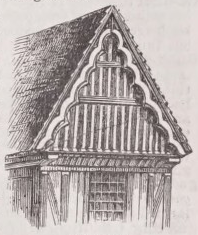
The triangular end of a house or other building, from the cornice or eaves to the top. In America, it is usually called the gable-end.
GABLER, Georg Andreas (1786-1853), a German philosophical writer of the school of Hegel, was born at Altdorf, in Bavaria, where his father was professor, on the 30th of July 1786. In 1804, when his father was translated to Jena, he accompanied him to that university, where he completed his studies in philosophy and law, and became one of the most enthusiastic of the hearers and disciples of Hegel. After holding successive educational appointments at Weimar, Nuremberg, and Ansbach, he, in 1817, became one of the masters in the gymnasium at Baireuth. In 1821 he was appointed rector, and in 1830 general superintendent of schools. In 1827 he brought out the first volume of a Lehrbuch der philosophischen Propädeutik als Einleitung zur Wissenschaft, in which his design was to give a popular exposition of the Hegelian philosophy, which he himself regarded as fitted to give “absolute satisfaction to the faculties of thinking and knowing.” In 1835 he succeeded Hegel in the Berlin chair. His other works were a treatise De veroe philosophiae erga religionem Christianam pietate (1836), and Die HegeVsche Philosophie, a defence of the Hegelian philosophy against Trendelenburg, which was published in 1843. He died at Teplitz, September 13, 1853....
GABLER, Johann Philipp (1753-1826), a learned Protestant theologian of the school of Griesbach and Eichhorn, was born at Frankfort-on-the-Main, June 4, 1753. He had already acquired an extensive acquaintance with the ancient languages and their literatures, as well as with the philosophy of Wolf and the theology of Baumgarten, when, in his nineteenth year, he entered the university of Jena as a divinity student. In 1776 he was on the point of abandoning theological pursuits, when the arrival of Griesbach inspired him with new ardour. After having been successively repetent in Göttingen and teacher in the public schools of Dortmund (Westphalia) and Altdorf (Bavaria), he was, in 1793, appointed second professor of theology in the university of the last-named city, whence he was translated to a chair in Jena in 1804. At Altdorf he published (1791-93) a new edition, with introduction and notes, of Eichhorn’s Urgeschichte ; this, was followed, two years afterwards, by a supplement entitled Neuer Versuch uber die mosaische Sclι0]f'ungsgeschichte. He was also the author of several original works which were characterized by much critical acumen, anà which had considerable influence on the course of German thought on theological and biblical questions. From 1798 to 1811 he was editor of the Theologisches Journal, first conjointly with Hänlein, Ammon, and Paulus, and afterwards unassisted. He died at Jena, February 17, 1826.