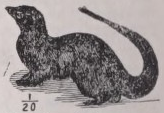
1. An animal of the genus Viverra, or weasel kind. It has a tail tapering to a point, and its toes are distant from each other. It inhabits Egypt, Barbary and India. It destroys the most venomous serpents, and seeks the eggs of the crocodile, digging them out of the sand, eating them and destroying the young. In India and Egypt, this animal is domesticated and kept for destroying rats and mice.
2. Ichneumon-fly, a genus of flies, of the order of hymenopters, containing several hundred species. These animals have jaws, but no tongue; the antennae have more than thirty joints, and are kept in continual motion. The abdomen is generally petiolated, or joined to the body by a pedicle. These animals are great destroyers of caterpillars, plant-lice and other insects, as the ichneumon is of the eggs and young of the crocodile.
1. Any carnivorousmammal of the genus Herpestes, and family Viverridae. Numerous species are found in Asia and Africa. The Egyptian species(H. ichneumon), which ranges to Spain and Palestine, is noted for destroying the eggs and young of the crocodile as well as various snakes and lizards, and hence was considered sacred by the ancient Egyptians. The common species of India (H. griseus), known as the mongoose, has similar habits and is often domesticated. It is noted for killing the cobra.
2. Any hymenopterous insect of the family Ichneumonidae, of which several thousand species are known, belonging to numerous genera.
ICHNEUMON(Herpestes'), a genus of small carnivorous mammals belonging to the family Viverridoe, and resembling the true civets in the elongated weasel-like form of the body and iu the shortness of the limbs. There are, according to Gray (British Museum Catalogue, 1869), 22 species of ichneumons, the great majority of which are confined to the African continent, the remainder occurring in Persia, India, and the Malay archipelago, and one, the Andalusian ichneumon (H. Widdringtonii, Gray), in the Sierra Morena of Spain, the last probably an African straggler. The Egyptian and Indian ichneumons are the forms best known. The former (Herpestes ichneumon, L.) is an inhabitant of Egypt and the north of Africa, where it is known to foreign residents as “Pharaoh’s rat.” When full grown it is about the size of the domestic cat. It is covered with a fur of long harsh hairs of a tawny grey colour, darker on the head and along the middle of the back, its legs reddish and its feet and tail black. It feeds on rats and mice, birds and reptiles, and for this reason is occasionally domesticated. Its fondness for eggs leads it to search for those of the crocodile, buried as these usually are beneath a thin covering of sand on the river banks; and its services in thus checking the multiplication of those reptiles were so appreciated bythe ancient Egyptians that they regarded the ichneumon as a sacred animal, and when it died buried it, says Herodotus, “in holy repositories.” It is, however, equally fond of poultry and their eggs, and its depredations among fowls considerably detract from its undoubted merits as a vermin-killer. During the inundations of the.Nile it is said to approach the habitations of man, but at other seasons it keeps to the fields and to the banks of the ...crocodile-frequented river. The Indian ichneumon or mungoos (Heτpestes griseus, Desm.) is considerably smaller than the Egyptian form; its fur is of a pale grey colour, the hairs being largely white-ringed, while the cheeks and throat are more or less reddish. Like the preceding species, it is frequently domesticated, and is then put to a similar use. It is especially serviceable in India as a serpent killer, destroying not only the eggs and young of these creatures, but attacking without hesitation and killing the most venomous adult snakes. The fact that it invariably survives those encounters has led to the belief that it either enjoys immunity from the effects of snake poison, or that after being bitten it has recourse, as the Hindoos have always maintained, to the root of a plant as an antidote. Neither of these suppositions has stood the test of scientific examination, for it has been found that when actually bitten it falls a victim to the poison as rapidly as other mammals, while there is no trustworthy evidence of its seeking a vegetable antidote. The truth seems to be that the mungoos by its exceeding agility and quickness of eye avoids the fangs of the snake while fixing its own teeth in the back of the reptile’s neck. The whole Thanatophidia of India stand in awe of this tiny but tenaciousmammal, and seek to escape from its presence. The mungoos, on the other hand, never hesitates to attack; the moment he sees his enemy, “his whole nature,” says a recent spectator of one of those fights, “appears to be changed. His fur stands on end, and he presents the incarnation of intense rage. The snake invariably attempts to escape, but, finding it impossible to evade the rapid onslaught of the mungoos, he raises his crest and lashes out fiercely at his little persecutor, who seems to delight in dodging out of the way just in time. This goes on until the mungoos sees his opportunity, when like lightning he rushes in and seizes the snake with his teeth by the back of the neck close to the head, shaking him as a terrier does a rat. These tactics are repeated until the snake is killed.” The mungoos is equally dexterous in killing rats and other four-footed vermin.
9th ed. Encyclopædia Britannica, vol. 12, p. 629 [694 words — estimated reading time: 4 minutes]
ICHNEUMON-FLY is a general name applied to parasitic insects of the section Pupivora (or Entomophaga), order Hymenoptera, from the typical genus Ichneumon, belonging to the chief family of that section,—itself fancifully so called after the Egyptian mammal (Herpestes'), notorious for its habit of destroying the eggs of reptiles. The species of the families Ichneumonidoe, Braconidoe, Evaniidae, Proctotrypidoe, and Chalcididoe are often indiscriminately called “Ichneumons,” but the term is perhaps properly applicable only to the first and second of these, which are respectively equivalent to the Ichneumones genuini and I. adsciti of older naturalists, chiefly differing in the former having two recurrent nerves to the anterior wing, whilst the latter has only one such nerve. The Ichneumonidoe proper are one of the most extensive groups of insects, and have been much studied by entomologists since the time of Linnaeus and Gravenhorst. Their sexual differences of colour, &c., are, however, often so great that fresh discoveries are constantly being made with regard to their true specific relations, as well as new species detected by biological observers. Gravenhorst described some 1650 European species, to which considerable subsequent additions have been made; and at the latest computation of the English Ichneumonidoe (in 1872, by the Rev. T. A. Marshall), 1186 species, contained in 136 genera, were recognized,—439 Braconidoe being also enumerated. There are 6 subfamilies of the Ichneumonidoe, viz., the Ichneu-moηides, Cryptides, Agriotypides, Ophionides, Trgphonides, and Pimplides, differing considerably in size and facies, but united in the common attribute of being in their earlier stage parasitic upon other insects. They have all long narrow bodies; a small free ...head with long filiform or setaceousantennae, which are never elbowed, and have always more than sixteen joints; the abdomen attached to the thorax at its hinder extremity between the base of the posterior coxae, and provided in the female with a straight ovipositor often exserted and very long; and the wings veined, with perfect cells on the disk of the front pair.
The parasitic habits above alluded to render these flies of very great importance in the economy of nature, as they effectually serve to check any inordinate increase in the numbers of injurious insects. Without their aid, indeed, it would in many cases be impossible for the agriculturist to hold his own against the ravages of his minute hexapod foes, whose habits are not sufficiently known to render artificial checks or destroying agents available. The females of all the species are constantly on the alert to discover the proper living food for their own larvae, which are hatched from the eggs they deposit in or on the eggs, larvae, or pupae of other insects of all orders, chiefly Lepidoptera, the caterpillars of butterflies and moths being specially attacked (as also are spiders). Any one who has watched insect life, even in a suburban garden, during summer, can hardly have failed to notice the busy way in which the parent ichneumon, a small four-winged fly, with constantly vibratingantennae, searches for her prey; and the clusters of minute cocoons round the remains of some unfortunate cabbage-butterflycaterpillar, which has had just enough vitality left in it to crawlinstinctively to a proper place for undergoing that change to pupa which it will never make, must also have been observed by many. This is the work of Apanteles (or Microgaster) glomeratus, one of the Braconidoe, which in days past was a source of disquietude to naturalists, who believed that the life of the one defunctlarva had transmigrated into the numerous smaller flies reared from it. Ichneumon-flies which attack external feeders have a short ovipositor; but those attached to wood-feeding insects have that organ of great length, for the purpose of reaching their concealed prey. Thus a species from Japan {Bracon penetrator) has its ovipositor nine times the length of the body; and the large species of Rhyssa and Ephialtes, parasitic on Sirex and large woodboring beetles in temperate Europe, have very long instruments (with which when handled they will endeavour to sting, sometimes penetrating the skin), in order to get at their secreted victims. This length of ovipositor is, in the female of a species of Peleeinus, common in the borealparts of North America in pine forests, replaced by an excessively attenuated development of abdomen, causing the insect to resemble a small dragon-fly, and fulfilling the same mechanical purpose. A common reddish-coloured species of Ophion (0. obscurum), with a sabre-shaped abdomen, is noteworthy from the fact of its eggs being attached by stalks outside the body of the caterpillar of the puss-moth (Diranura vinula). Lepidopterists wishing to breed the latter cut off the eggs of the parasite with scissors.
The larvae of the ichneumon-flies are white fleshy cylindrical footless grubs; the majority of them spin silk cocoons before pupating, often in a mass (sometimes almost geometrically), and sometimes in layers of different colours and texture.
The reader desirous of investigating more fully the structure and habits of this interesting family will, in addition to the older works of Gravenhorst, Esenbeck, Wesmael, and Haliday, find much matter in the recent writings of Brischke, Cresson, Provancher, Holmgren, Woldstedt, Tischbein, Vollenhoven, Forster, Kriechbaumer, Taschenberg, F. Smith, C. G. Thomson, and Rondani. The last-mentioned author has published (in the Bulletin of the Italian Entomological Society, 1871-78) a valuable list of parasitic insects and the species to which they are attached.
9th ed. Encyclopædia Britannica, vol. 12, p. 629 — signed E. C. R. [907 words — estimated reading time: 6 minutes]
This site uses cookies to remember your display preferences (search sources and editions, Bible version, auto-link, images, light/dark theme). No personal data whatsoever is collected. Privacy Policy