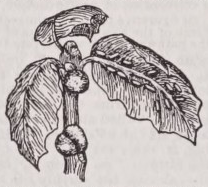
Like other members of the group to which it belongs, the female kermes insect is wingless, and furnished with a beak or sucker attached to its breast, by which it fixes itself immovably on its food plant, and through which it draws its nourishment. The male insect is unknown, two insects mistaken for it being, according to Planchon, parasitic hymenoptera of the chalcidian group, living in the kermes grains. In the month of May, when full grown, the insects are globose, 6 to 7 millim. in diameter, of a reddish-brown colour, and covered with an ash-coloured powder. They are found attached to the twigs or buds by a circular lower surface 2 millim. in diameter, and surrounded by a narrow zone of white cottony down. At this time there are concealed under a cavity, formed by the approach of the abdominal wall of the insect to the dorsal one, thousands of eggs of a lively red colour, and smaller than poppy seed, which are protruded and ranged regularly beneath the insect. At the end of May or the beginning of June the young escape by a small orifice, near the point of attachment of the parent. They are then of a fine red colour, elliptic and convex in shape, but rounded at the two extremities, and bear two threads half as long as their body at their posterior extremity. At this period they are extremely active, and swarm with extraordinary rapidity all over the food plant, and in the course of two or three days attach themselves to fissures in the bark or buds, but rarely to the leaves. In warm and dry summers the insects breed again in the months of August and September, according to Eméric, and then they are more frequently found attached to the leaves. Usually, however, they remain immovable and apparently unaltered until the end of the succeeding March, when their bodies become gradually distended and lose all trace of abdominal rings. They then appear full of a reddish juice resembling discoloured blood. In this state, or when the eggs are ready to be extruded, the insects are collected. In some cases the insects from which the young are ready to escape are dried in the sun on linen cloths—care being taken to prevent the escape of the young from the cloths until they are dead. The young insects are then sifted from the shells, made into a paste with vinegar, and dried on skins exposed to the sun, and the paste packed in skins is then ready for exportation to the East under the name of “pâte d’écarlate.”
In the pharmacopoeia of the ancients kermes triturated with vinegar was used as an outward application, especially in wounds of the nerves. From the 9th to the 16th century this insect formed an ingredient in the “confectio alkermes,” a well known medicine, at one time official in the London pharmacopoeia as an astringent and corroborant in doses of 20 to 60 grains or more. Syrup of kermes was also prepared. Both these preparations have now fallen into disuse, the latter being replaced by the syrup of cochineal.
To dye spun worsted with kermes, the material is first boiled for half an hour with bran in water, and then for two hours in a fresh bath containing one-fifth of Roman alum and one-fifth of tartar, to which “souι∙ water” is commonly added. It is then taken out and laid in a linen bag for some days in a cool place. In order to obtain a full colour it is then put in a warm bath as at the first boiling, the bath containing as much kermes as is equal to three-fourths or even the whole weight of the worsted used. For cloth one-fourth less of the salt and kermes was required. The colour imparted by kermes has much less bloom than the scarlet made with cochineal, hence the former has fallen into disuse.
Mineral kermes is an amorphous tersulphide of antimony, prepared by a variety of processes, and containing a variable proportion of teroxide of antimony and sometimes a little alkaline antimonite. The oldest method consists in boiling the finely powdered sulphide with a solution of an alkaline carbonate and leaving the hot filtered solution to cool, the kermes being deposited on cooling. In another method dilute nitric acid was added to the alkaline solution to precipitate the kermes mineral. Mineral kermes is a brown red powder becoming blackish-grey when washed with boiling water. By fusion and slow cooling it is converted into a day-like mass devoid of crystalline structure, in which it differs essentially from the pure amorphous sulphide.
See G. Planchon, Le Kermes du Chêne, Montpellier, 1864; Watts’s Dictionary of Chemistry, i. p. 830-33, iii. p. 446; Gmelin, Handbook of Chemistry, iv. p. 340-49; Lewis, Materia Medica, 1784, pp. 71, 365; Memorias sobre la grana Kermes de Espana, Madrid, 1788; Adams, Paulus Aegineta, iii. 180; Beckmann, History of Inventions.