
Alt. of Lewisson
Word of the Day: Catachrestical
Lewis
Encyclopedia Britannica
LEWIS and HARRIS form together an island of the Outer Hebrides, nearly separated into two parts by the inlets of Loch Reasort and Seaforth,—the northern part, Lewis or the Lews, being in Ross-shire, and the southern part, Harris, in Inverness. The island is situated about 30 miles from the mainland, between 57° 40' and 58° 32' N. lat., and 6’ and 7° W. long. Its length is 60 miles, the average breadth 15, and the extreme breadth 30. The area is 770 square miles, of which 575 are comprised in Lewis. The greater part of the surface is composed of gneiss rocks, which in Ben More attain a height of 1750 feet, but there is also a large breadth of peat and swamp, with remains of an ancient forest. The coast is much indented by bays. The climate is very moist and unsuitable for tillage. Agriculture is in a backward condition, but much has been done in draining, reclamation, and planting of trees by the late proprietor of Lewis, Sir James Matheson. Barley and potatoes are the principal crops, and a large number of black cattle are reared. Kelp making is also carried on, but one of the chief supports of the inhabitants is fishing, Stornoway being the largest station for the herring fishing in Scotland, and employing over 1000 boats with nearly 4000 men and boys. The town was made a burgh of barony by James VI. It has a commodious harbour with a patent slip suitable for vessels of 1000 tons. On a height overlooking the bay is the beautiful residence of the proprietor of the island. The most remarkable archaeological remains in Lewis are the druidical stones of the temple of Callernish. There are also a large number of old obelisks, and at Mealista in Uig the remains of an old monastery. Six miles from Stornoway there is a huge cave covered with stalactites. See Hebrides....
LEWIS, Sir George Cornewall, Bart. (1806-1863), statesman and man of letters, was born in London on 21st April 1806. l·Iis father, Thomas F. Lewis of Harpton Court, Radnorshire, after holding subordinate office in various administrations became a poor-law commissioner. He was made a baronet in 1846. Lewis was educated at Eton, and at Christ Church, Oxford, where in 1828 he took a first-class in classics and a second-class in mathematics. He then entered the Middle Temple, and was called to the bar in 1831. In the year before he had, with John Romilly and John Stuart Mill, attended the celebrated lectures on jurisprudence delivered by John Austin at London University. In 1832 he undertook his first public work as one of the commissioners to inquire into the condition of the poor Irish residents in the United Kingdom. Again, in 1834, Lord Althorp included him in the commission to inquire into the state of church property and church affairs generally in Ireland. To this fact we owe his work on Local Disturbances in Ireland, and the Irish Church Question (London, 1836), in which he condemned the existing connexion between church and state, proposed a state provision for the Catholic clergy, and maintained the necessity of an efficient workhouse organization. During this period of apprenticeship to politics Lewis’s mind was much occupied with the phenomena of language. Before leaving college he had published some observations on Whately’s doctrine of the predicables, and soon afterwards he assisted Thirlwall and Hare in starting the Philological Museum. Its successor, the Classical Museum, he also supported by occasional contributions. In 1835 he published an Essay on the Origin and Formation of the liomance Languages (re-edited in 1862), which, though anticipated by Schlegel, may be taken as the first effective criticism in England of Raynouard’s theory of a uniform romance tongue, represented by the poetry of the troubadours. He also set an excellent example to county gentlemen by compiling a glossary of provincial words used in Herefordshire and the adjoining counties. But the most important work of this earlier period was one to which his logical and philological tastes both contributed. The Remarks on the Use and Abuse of some Political Terms (London, 1832) may have been suggested by Bentham’s Look of Parliamentary Fallacies, but it shows all that power of clear sober original thinking which marks his larger and later political works. And yet this original mind did more than most scholars in the humbler walk of useful translation. He translated Boeckh’s Public Economy of Athens and Miiller’s History of Greek Literature, and he assisted Tufnell in the translation of Miiller’s Dorians. Some time afterwards he edited a text of the Fables of Babrius. While his friend Hayward conducted the Law Magazine, he wrote in it frequently on such subjects as secondary punishments and the penitentiary system. In 1836, at the request of Lord Glenelg, he accompanied John Austin to Malta, where they spent nearly two years reporting on the condition of the island and framing a new code of laws. One leading object of both commissioners was to associate the Maltese in the responsible government of the dependency. On his return to England Lewis succeeded his father as one of the principal poor-law commissioners. But his literary activity did not cease. In 1841 appeared the Essay on the Government of Dependencies, a systematic statement and discussion of the various relations in which colonies may stand towards the mother country. In 1844 Lewis married Lady Maria Theresa Lister, sister of Lord Clarendon, and a lady of literary tastes. Much of their married life was spent in Kent House, Knightsbridge. They had no children. In 1847 Lewis resigned his office. He was then returned for the county of Hereford, and Lord John Russell appointed him secretary to the Board of Control, but a few months afterwards he became under secretary to the Home Office. In this capacity he introduced two important bills, one for the abolition of turnpike trusts and the management of highways by a mixed county board, the other for the purpose of defining and regulating the law of parochial assessment. On the latter subject his evidence before the select committee (Lords) of 1850 is the clearest statement of general results which we have. In that year he succeeded Hayter as financial secretary to the Treasury. About this time, also, appeared his Essay on the Influence of Authority in Matters of Opinion. Lewis seems to have thought that authority was too much divided to be of much use in theological matters, while in the world of science he found sufficient authority for declaring that homoeopathy, mesmerism, and phrenology were all impostures. On the dissolution of parliament which followed the resignation of Lord John Russell’s ministry in 1852, Lewis was defeated for Herefordshire and then for Peterborough. Excluded from parliament he accepted the editorship of the Edinburgh Review, which the death of Empson had left vacant. Lord Halifax offered him, in 1853, the governorship of Bombay, but he remained editor until 1855. During this period he did some public work on the Oxford commission, and on the commission to inquire into the government of London. But its chief fruits were the Treatise on the Methods of Observation and Reasoning in Politics, and the Enquiry into the Credibility of the Early Roman History, in which he vigorously attacks the theory of epic lays and other theories on which Niebuhr’s reconstruction of that history had proceeded. In 1855 Lewis succeeded his father in the baronetcy. He was at once elected member for the Radnor boroughs, and Lord Palmerston made him chancellor of the exchequer. The position was difficult, for he had a war loan to contract and heavy additional taxation to impose. But his industry, method, and clear vision carried him safely through. His financial statement of 13th February 1857, and his speech on 12th February
1858 on the bill for the better government of India were most successful efforts. After the change of ministry in
1859 Sir George became home secretary under Lord Palmerston, and in 1861, much against his wish, he succeeded Sidney Herbert (Lord Herbert of Lea) at the War Office. The closing years of his life were marked by increasing intellectual vigour. In 1859 he published an able Essay on Foreign Jurisdiction and the Extradition of Criminals, a subject to which the attempt on Napoleon’s life, the discussions on the Conspiracy Bill, and the trial of Bernard, had drawn general attention. He advocated the extension of extradition treaties, and condemned the principal idea of Weltrechtsordnung which Mohl of Heidelberg had proposed. His two latest works were the Survey of the Astronomy of the Ancients, in which, without professing any knowledge of Oriental languages, he applies a sceptical analysis to the ambitious Egyptology of Bunsen; and the Dialogue on the Best Form of Government, in which, under the name of Crito, the author points out to the supporters of the various systems that there is no one abstract government which is the best possible for all times and places. An essay on the Characteristics of Federal, National, Provincial, and Municipal Government does not seem to have been published. Sir George died in April 1863. A marble bust by Weekes stands in Westminster Abbey. He has two other monuments—the reprint from the Edinburgh Review of his long series of papers on the Administrations of Great Britain (1864), and his Letters to various Friends (1870), edited by his brother, who succeeded him in the baronetcy.
Lewis was a man of mild and affectionate disposition, much beloved by a large circle of friends, among whom were Sir E. Head, the Grotes, the Austins, Lord Stanhope, J. S. Mill, Dean Milman, the Duff Gordons. In public life he was distinguished, says Lord Aberdeen, “for candour, moderation, love of truth.” He had a passion for the systematic acquirement of knowledge, and a keen and sound critical faculty. Nothing is more remarkable than the practical good sense of his speculative writings. Sometimes he betrayed a slight intellectual impatience: but this was merely the passing irritation of a healthy and modest judgment.
LEWIS, Matthew Gregory (1775 -1818),often referred to as “Monk” Lewis, was born in London on July 9, 1775. He was educated for a diplomatic career at Westminster School and at Christ Church, Oxford, spending most of his vacations abroad in the study of modern languages; and in 1794 he proceeded to the Hague as attaché to the British embassy. His stay there lasted only a few months, but was marked by the composition, in ten weeks, of Ambrosio, or the Monk, which was published in the summer of the following year. It immediately achieved extensive celebrity; but some passages it contained were of such a nature that about a year after its appearance an injunction to restrain its sale was moved for and a rule nisi obtained. Lewis published a second edition from which he had expunged, as he thought, all the objectionable passages, but the work still remains of such a character as almost to justify the severe language in which the author of English Bards and Scotch Reviewers addresses—
“Wonder-working Lewis, Monk or Bard,
Who fain would’st make Parnassus a churchyard; Even Satan’s self with thee might dread to dwell, And in thy skull discern a deeper hell.”
Whatever its demerits, ethical or aesthetic, may have been, The Monk did not interfere with the reception of Lewis into the best English society; he was favourably noticed at court, and almost as soon as he came of age he obtained a seat in the House of Commons as member for Hindon, Wilts. After some years, however, during which he never ventured to address the House, he finally withdrew from a parliamentary career. His tastes lay wholly in the direction of literature, and The Castle Spectre (1796, a musical drama of no great literary merit, but which enjoyed a long popularity on the stage), The Minister (a translation from Schiller’s Kabale u. Liebe), Rolla (1797, a translation from Kotzebue), with numerous other operatic and tragic pieces, appeared in rapid succession. The Bravo of Venice, a romance translated from the German, was published in 1804, and has since been reprinted; next to The Monkù is the work connected with the name of Lewis which has been most extensively read. By the death of his father he succeeded to a large fortune, and in 1815 embarked for the West Indies to visit his estates; in the course of this tour, which lasted four months, the Journal of a West Indian Proprietor, published posthumously in 1833, was written. A second visit to Jamaica was undertaken in 1817, in order that he might become further acquainted with, and able to ameliorate, the condition of the slave population; but the fatigues to which he exposed himself in the tropical climate brought on a fever which terminated fatally on the homeward voyage, May 14,1818. The Life and Correspondence of JL G. Lewis, in two volumes, was published anonymously in 1839; compiled by friendly hands, it makes it sufficiently plain that, whatever may have been the errors of judgment and taste displayed in the writings of his precocious youth, he was nevertheless a man of more than ordinary discretion, good feeling, and generosity.
LEWIS, Meriwether (1774-1809), American explorer, was born near Charlottesville, Virginia, August 18, 1774. In 1794 he volunteered with the troops called out to suppress the “whisky insurrection,” was commissioned as ensign in the regular army in 1795, and as captain in 1800, and was President Jefferson’s private secretary from 1801 to 1803. On Jefferson’s recommendation he was appointed by Congress to conduct, in connexion with Captain William Clarke, an expedition to the headwaters of the Missouri river, and thence across the mountains to the Pacific Ocean—the first extended exploration of the north-western portion of the *United States. The States had as yet acquired no claim to this region, and the exploration was designed by Jefferson in the interests not only of geographical science but of territorial acquisition. Lewis and Clarke, setting out late in 1803 with twenty-eight men, spent the winter at the mouth of the Missouri. Early in the spring the party embarked in several boats, and during the summer made the difficult ascent of the Missouri as far as 47° 2Γ N. lat., where the second winter was passed among the Mandan Indians. In 1805 the ascent of the Missouri was continued as far as the tributary which they named Jefferson river, which was followed to its source in the south-western part of what is now Montana territory. Procuring a guide and horses from the Shoshone Indians, they pushed westward through the mountains, and on October 7 embarked in canoes on a tributary of the Columbia river, the mouth of which they reached on November 15. They had travelled upwards of 4000 miles from their starting point, had encountered various Indian tribes never before seen by whites, had made scientific collections and observations, and were the first explorers to reach the Pacific by crossing the continent north of Mexico. After spending the winter upon the Columbia, they made the return journey across the mountains and down the Missouri, reaching the Mississippi in September 1806. The reports of the Lewis and Clarke expedition attracted great attention at the time, and it has scarcely been exceeded in romantic interest by later explorations in any quarter of the globe. The leaders and men of the exploring party were rewarded with liberal grants of land, and Lewis was made governor of the territory of Missouri. In the unwonted quiet of his new duties his mind, always subject to melancholy, became unbalanced, and, while on his way to Washington, he committed suicide near Nashville, Tennessee, October 11, 1809.
Jefferson wrote a memoir of Lewis, published in 1814 in connexion with Biddle and Alien’s Narrative of the Lewis and Clarke Expedition. A new edition by M i Vickar was published at New York in 1843.
9th ed. Encyclopædia Britannica, vol. 14, p. 492
[321 words — estimated reading time: 2 minutes]
[321 words — estimated reading time: 2 minutes]
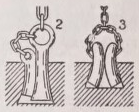
1. An iron dovetailed tenon, made in sections, which can be fitted into a dovetail mortise; -- used in hoisting large stones, etc.
Lewiston
Encyclopedia Britannica
LEWISTON, a city of the United States, in Androscoggin county, Maine, is situated 36 miles north of Portland, on the left bank of the Androscoggin, and is connected by several bridges with Auburn, a city of 9556 inhabitants, and the capital of the county. As the river at this point breaks over a ledge of mica schist and gneiss, and the natural fall of 40 feet has been raised to 50 feet by a strong granite dam, Lewiston commands an abundant supply of water-power. Cotton and woollen goods (shirtings, sheetings, cassimeres, beavers, tweeds, cloakings), twine, boots and shoes, machinery, <fcc., are produced to the annual value of $11,000,000—there being nine considerable manufacturing corporations in the city besides the Franklin Company, which owns the entire water-power. The city hall (1872) is a very fine building; and a public library (over 6000 volumes in 1880) was founded by the corporation in 1861. Bates College, founded by the Free Baptists in 1863-64, and named in honour of Benjamin F. Bates of Boston, possessed in 1880 11 professors, 161 students, and a library of 5537 volumes.
Lewiston dates from 1770. In 1795 it was incorporated as a town, and in 1861 as a city. The population was 3584 in 1850, 7424 in 1860, 13,600 in 1870, and 19,083 in 1880.
9th ed. Encyclopædia Britannica, vol. 14, p. 494
[224 words — estimated reading time: 2 minutes]
[224 words — estimated reading time: 2 minutes]
No thesaurus entries found for "lewis".
No Bible verses found for "lewis".