
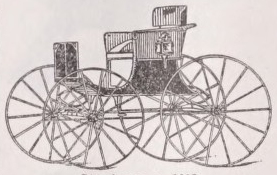
A light two-wheeled, or sometimes four-wheeled, carriage, without a top; -- so called from Lord Stanhope, for whom it was contrived.
STANHOPE, Charles Stanhope, Third Earl (1753- 1816), was born on 3d August 1753, and educated under the opposing influences of Eton and Geneva, devoting himself whilst resident in the Swiss city to the study of mathematics, and acquiring from the associations connected with Switzerland an intense love of liberty. He contested the representation of the city of Westminster without success in 1774, when only just of age; but from the general election of 1780 until his accession to the peerage on the 7th of March 1786 he represented through the influence of Lord Shelburne the Buckinghamshire borough of High Wycombe, and during the sessions of 1783 and 1784 he gave his support to the administration of William Pitt, whose sister Lady Hester Pitt he married on 19th December 1774. When Pitt ceased to be inspired by the Liberal principles of his early days, his brother-in-law severed their political connexion and opposed with all the impetuosity of his fiery heart the arbitrary measures which the ministry favoured. Lord Stanhope’s character was without any taint of meanness, and his conduct was marked by a lofty consistency never influenced by any petty motives; but his speeches, able as they were, had no weight on the minds of his compeers in the upper chamber, and, from a disregard of their prejudices, too often drove them into the opposite lobby. He was the chairman of the “Revolution Society," founded in honour of the Revolution of 1688, the members of which in 1790 expressed their sympathy with the aims of the French republicans. He brought forward in 1794 the case of Muir, one of the Edinburgh politicians who were transported to Botany Bay, and in 1795 he introduced into the Lords a motion deprecating any interference with the internal affairs of France. In all of ...these points he was hopelessly beaten, and in the last of them he was in a “minority of one ”—a sobriquet which stuck to him throughout life,—whereupon he seceded from parliamentary life for five years. The lean and awkward figure of Lord Stanhope figured in a host of the caricatures of Sayers and Gillray, reflecting on his political opinions and his personal relations with his children. His first wife died on 20th July 1780, and he married on 17th March 1781 Louisa, daughter and sole heiress of the Hon. Henry Grenville (governor of Barbados in 1746 and ambassador to the Porte in 1762), a younger brother of the first Earl Temple and George Grenville. Through his union with this lady, who survived until March 1829, he was doubly connected with the family of Grenville. By his first wife he had three daughters, one of whom was Lady Hester Stanhope (see below), and his second wife was the mother of three sons. Lord Stanhope died at the family seat of Chevening, Kent, on 15th December 1816.
Earl Stanhope was elected a fellow of the Royal Society so early as November 1772, and devoted a large part of his income to experiments in science and philosophy. He invented a method of securing buildings from fire (which, however, proved impracticable), the printing press and the lens which bear his name, and a monochord for tuning musical instruments, suggested improvements in canal locks, made experiments in steam navigation in 1795-97, and contrived two calculating machines. When he acquired an extensive property in Devonshire, he projected a canal through that county from the Bristol to the English Channel and took the levels himself. Electricity was another of the subjects which he studied, and the volume of Principles of Electricity which he issued in 1779 contained the rudiments of his theory on the “return stroke” resulting from the contact with the earth of the electric current of lightning, which were afterwards amplified in a contribution to the Philosophical Transactions for 1787. His principal labours in literature consisted of a reply to Burke’s Reflections on the French Revolution (1790) and an Essay on the rights of juries (1792), and he long meditated the compilation of a digest of the statutes. His scientific theories, his mechanical experiments, and his studies in music absorbed all his thoughts, and for them he neglected his wives and his children. His youngest daughter, Lady Lucy Rachael Stanhope, eloped with Mr Thomas Taylor of Sevenoaks, the family apothecary, and her father refused to be reconciled to her, an inconsistency in a republican which subjected him to a caricature from Gillray. Lady Hester Stanhope abandoned her home and went to live with her mother’s relations. Lord Stanhope’s high qualities were marred by an impracticable disposition.
STANHOPE, Lady Hester Lucy (1776-1839), the eldest child of the third Earl Stanhope (noticed above), by his first wife Lady Hester Pitt, eldest daughter of the first earl of Chatham, lived for the earlier part of her life amid the surroundings of a noble mansion, or in close communion with her uncle William Pitt, the most prominent minister of his age, and on his early death withdrew whilst still young to brood over the past in the solitudes of Palestine. She was born on 12th March 1776, and dwelt at her father’s seat of Chevening in Kent until early in 1800, when his excitable and wayward disposition drove her to her grandmother’s house at Burton Pynsent. A year or two later she travelled abroad, but her cravings after distinction were not satisfied until she became the chief of her uncle’s household in August 1803. She sat at the head of his table and assisted in welcoming his guests, gracing the board with her stately beauty and enlivening the company by her quickness and keenness of conversation. Although her brightness of style cheered the declining days of Pitt and amused most of his political friends, her satirical remarks sometimes created enemies when more consideration for the feelings of her associates would have converted them into friends. Lady Hester Stanhope possessed great business talents, and when Pitt was out of office she acted as his private secretary. She was with him in his dying illness, and some of his last thoughts were concerned with her future, but any anxiety which might have arisen in her mind on this point was dispelled through the grant by a nation grateful for her uncle’s qualities of a pension of £1200 a year, dating from 30th January 1806, which Lady Hester Stanhope enjoyed for the rest of her days. On her uncle’s death she lived in Montague Square, London, but life in London without the interest caused by associating with the principal politicians of the Tory party proved irksome to her, and she sought relief from lassitude in the fastnesses of Wales. Whilst she remained on English soil happiness found no place in her heart, and her native land was finally abandoned for the East in February 1810. After many wanderings she settled on Mount Lebanon, and from this solitary position she wielded an almost absolute authority over the surrounding districts. Her control over the natives was sufficiently commanding to induce Ibrahim Pasha, when about to invade Syria in 1832, to solicit her neutrality, and this supremacy was maintained by her commanding character and by the belief that she possessed the gift of divination. Her cherished companion Miss Williams, and her trusted physician Dr Charles Lewis Meryon, dwelt with her for some time; but the former died in 1828, and the latter was not with Lady Hester when she died. In this lonely residence, the villa of Djoun, 8 miles from Sidon, in a house “hemmed in by arid mountains,” and with the troubles of a household of twenty-three servants, unregulated by a single English attendant or friend and only waiting for her death to plunder the house, Lady Hester Stanhope’s strength slowly wasted away, and at last she died on 23d June 1839, aged sixty-three. The disappointments of her life, and the necessity of overaweing her servants as well as the chiefs who surrounded Djoun, had intensified a temper naturally imperious. In appearance as in voice she resembled her grandfather, the first Lord Chatham, and like him she domineered over the circle, large or small, in which she was placed.
Some years after her death there appeared three volumes of Memoirs of the Lady Hester Stanhope as related by herself in Conversations with her Physician (j.e., Dr Meryon), 1845, and these were followed in the succeeding year by three volumes of Travels of Lady Hester Stanhope, forming the Completion of her Memoirs narrated by her Physician. They presented a lively picture of this strange woman’s life and character, and contained many anecdotes of Pitt and his colleagues in political life for a quarter of a century before his death,
STANHOPE, Philip Dormer, fourth earl of Chesterfield. See Chesterfield.