
Like; even; equal. obsolete
Word of the Day: Catachrestical
1. In botany, the name for an extensive division of cryptogamian plants, constituting a genus in the order of Algae, in the Linnean system, but now forming a distinct natural order. They appear in the form of thin flat crust, covering rocks and the bark of trees, or in foliaceous expansions, or branched like a shrub in miniature, or sometimes only as a gelatinous mass, or a powdery substance. They are called rock moss and tree moss, and some of the liverworts are of this order. They also include the Iceland moss and the reindeer moss; but they are entirely distinct from the true mosses (Musci.)
2. In surgery, a species of impetigo, appearing in the form of a red, dry, rough, and somewhat prurient spot, that gives off small furfuraceous scales.
1. One of a class of cellular, flowerless plants, (technically called Lichenes), having no distinction of leaf and stem, usually of scaly, expanded, frond-like forms, but sometimes erect or pendulous and variously branched. They derive their nourishment from the air, and generate by means of spores. The species are very widely distributed, and form irregular spots or patches, usually of a greenish or yellowish color, upon rocks, trees, and various bodies, to which they adhere with great tenacity. They are often improperly called rock moss or tree moss.
2. A name given to several varieties of skin disease, esp. to one characterized by the eruption of small, conical or flat, reddish pimples, which, if unchecked, tend to spread and produce great and even fatal exhaustion.
Having the form of a lichen.
LICHENOGRAPH'IC ,
Pertaining to lichenography.
Alt. of Lichenographical
Of or pertaining to lichenography.
One who describes the lichens.
One who describes lichens; one versed in lichenography.
One versed in lichenology.
The science which treats of lichens.
Lichens
Encyclopedia Britannica
LICHENS(Lichenes) may briefly be defined as cellular perennial plants, furnished with a vegetative system containing gonidia, and with a reproductive system consisting of female thecasporous fruits and male spermo-gonous organs. They constitute a distinct class of cellular cryptogams, intermediate between algae and fungi, to both of which in some respects they present certain affinities. By the earlier authors they were regarded as being Aerophycx or terrestrial algae, while of recent years they have been viewed by some writers as being Ascomycetous fungi. From both of these, however, they are sufficiently distinguished and separated by the special structure of their thallus, by the presence of certain immediate principles proper to their tissues, and by their mode of life and nutrition. Their relations to these neighbouring classes, and their true systematic place, will be best elucidated on considering their structure and its bearings upon some recent speculations.
Structure of Lichens.
A complete lichen consists of a nutritive and vegetative system termed the thallus, and of reproductive bodies borne upon it in the form of apothecia and spermogones. Occasionally, however, there is no thallus present (e.g., Sphinctrina, various Lecidex, Endococcus), in which case the fructification is parasitical on the thalli of other lichens.
I. Vegetative System.— The thallus is very variable in external form and colour, as also in internal structure....
1. In external form it presents the following modifications. (a) The foliaceous thallus, which may be either peltate, i.e., rounded and entire, as in Umbilicaria, &c., or variously lobed and laciniated, as in Sticta, Parmelia, &c. This is the highest type of its development, and is sometimes very considerably expanded, (b) The fruticulose thallus, which sometimes is filamentose, as in Ephebe, and may be either erect, becoming pendulous, as in Usnea, Pamalina, &c., or prostrate, as in Alectoria jubata, var. chalybeiformis. It is usually divided into branches and branchlets, bearing some resemblance to a miniature shrub amongst the Phanerogamia. An erect cylindrical thallus terminated by the fruit is termed a ρodetium, as in Cladoηia. (c) The crustaceous thallus, which is the most common of all, forms a mere crust on the substratum, varying in thickness, and may be squamose (in Squamaria), radiate (in Placodium), areolate, granulose, or pulverulent (in various Lecanorx and Lecidex). In its pulverulent state it is either the rudimentary or the abortive condition of many species, (d) The hypophloeodal thallus is often concealed beneath the bark of trees (as in some Verrucarix and Arthonix), or enters into the fibres of wood (as in Xylographa and Agyrium), being indicated externally only by a very thin film or macula. To this may also be referred the evanescent thallus which is denoted solely by gonidia sparingly scattered on the stone or wood (as in some Caliciei and Lecidex:). This is the simplest form under which lichenose vegetation occurs. These two latter forms of thalli may be either determinate, i.e., of a definite shape with a distinct margin or boundary, or effuse, i,e., spreading extensively over the substratum with no visible limits. The differences in these forms are no doubt connected with differences in the chemical composition of the thallus. In colour also the thallus externally is very variable. In the dry and more typical state it is most frequently white or whitish, and almost as often greyish or greyish glaucous. Less commonly it is of different shades of brown, red, yellow, and black. These various colours do not originate from any colouring matters contained in the cells themselves, but, according to investigations made by Nylander (see Flora, 1879, p. 558) they depend upon such as are deposited in the granulations and cellular walls, whence they appear on the epithallus. In the moist state of the thallus these colours are much less apparent, as the textures then become more or less translucent, and the epithallus usually presents the greenish colour of the gonidia (e.g., Parmelia Borreri, Peltidea aphthosa, Umbilicaria pustulata, and pulverulent Lecidex).
2. The internal structure of the thallus presents two principal modifications, viz., the stratified thallus, having its different elements (hyphae and gonidia) arranged in layers, and the unstratified thallus, in which these different elements are confused in a homogeneous tissue.
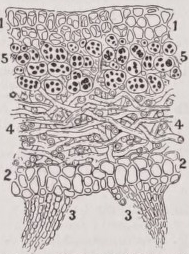
A. The stratified thallus. —On making a vertical section this is seen in a foliaceous lichen to consist of three layers constituting a cortical, a gonidial, and a medullary system, to which in the case of many cnrsta-ceous lichens is to be added a fourth, viz., a hypothalline stratum.
(a) The cortical stratum occupies the whole of the external surface of filamentose and fruticulose lichens, both the upper· and under surfaces of some foliaceous and squamulose species, while it is found only on the upper surface of crustaceous lichens. It usually consists of a colourless cellular tissue, in which the cellules are closely compacted and form a pseudo-parenchyma. Its most superficial portion, termed by Nylander the epithallus, a sort of cuticle, is amorphous, often more indurated and coloured. In some lichens (e.g., Collenia) it is the only portion of the cortex present, while in pulverulent crustaceous thalli it is entirely wanting, (ό) The gonidial stratum is situated immediately beneath the cortical stratum, and consists usually of greenish spherical cellules, or of granules destitute of a cellular membrane. It is not always continuous, but is often interrupted,'the gonidia occurring in dissociated masses. Sometimes it is situated on the upper part of the medullary stratum, in which case the gonidia are arranged either between or amongst its exterior elements. In general its limits may readily be distinguished from the others by its peculiar colour. Various important matters relating to the gonidia will more appropriately be afterwards discussed at length, (c) The medullary stratum is more variable in its constituent elements, but, being always colourless, is easily recognized. It presents the three following principal modifications, (a) The woolly medulla consists of simple or branched filaments, which in foliaceous species are loosely intersected and entangled, and in fruticulose species are more or less congluti-nated, assuming a longitudinal direction, and constituting, as in Usnca, a kind of solid axis for the support of the thallus, (β) The cretaceous medulla occurs only in crustaceous lichens, and is generally characterized by its tortareous appearance. It is more compact than the preceding, and consists for the most part of molecular granulations often intermixed with octahedral crystals of lime, and presenting but few traces of filamentose elements, (γ) The cellulose medulla consists of a tissue of angular, rounded, or oblong cellules containing gonidia in their interior or in their interstices (e.g., Pannaria, Endocarpon). In some species (e.g., Verrucaria fuseula) the cellules have a tendency to reunite into filaments and then to separate again into rows of cellules, (d) The hypothalline stratum is the inferior one of the thallus and that upon which the other strata are developed, though it is not always visible, and is sometimes entirely wanting. - It usually presents itself under a twofold aspect, viz., the hypothallus and rhizinae. ( α ) The hypothallus proper, which is immediately developed upon the prothallus (Le., the filaments of the germinating spore), is a horizontal stratum consisting of interlacing filaments or of elongated, short, or rounded cellules, and is sometimes of a white or whitish colour, but usually dark or blackish. In many crustaceous lichens it is represented only by a black or dark-coloured border limiting the thallus (c.g. Lecidca geographica, &c.). (β) The rhizinae consist of vertical rhizoid fibrillae, usually branching and tufted at their extremities, blackish or greyish in colour, rarely white, which occur on the lower surface of foliaceous lichens. They consist of several filamentose elements which are most frequently articulated and agglutinated (e.g., Parrnclia, Physcia), or sometimes simple and then always articulated (e.g., Sticta). It is to be observed that the hypothallus and the rhizinae serve merely as bases of attachment for the lichens to the substratum, and do not in any way aid in its nutrition.
B. The unstratified tluillus.— This occurs amongst the Lichenacci (which, however, are most frequently stratified as above), and in various species belonging to the inferior genera, which have a pulverulent or hypophloeodal thallus. In these the constituent elements are more or less mixed together, though the gonidial stratum generally remains distinct, and is often visible when the others are absent. It is, however, the families of the Byssacei and Collemacei that are more especially characterized by an unstratified thallus. Here the cortical stratum is chiefly represented by a greenish (vn. Collema), rarely brown (in Synalissa, &c.). non-cellular epithallus, or in others (Leptogium) by a thin stratum of angulose cellules distinct from the other elements of the thallus. The gonidial granules are also disposed in a different manner to those of the Lichenacei. In the majority of the Collemacei they are strung together moniliformly, and distributed without order in a gelatinous pellucid substance; while sometimes they are agglomerated into small groups, and situated for the most part next to the epithallus. In Ephebacei they are not moniliformly arranged, but are tunicated or involved in a gelatinous cellulose stratum. The rest of the thallus consists of the medullary system (except in Ephebacei, in which there is no medulla), and is composed of tubular or hollow filaments, with roundish cavities containing the gonidial granules, and imbedded in the gelatinous substance, which very readily imbibes water. There are a few lichens in which there is no trace whatever of stratification, as the genus Canogonium, in which the entire thallus is composed of filamentose membranous elements, and the peculiar family of the Myriangiacei (doubtfully, however, referable to lichens), in which it is equally cellulose throughout.
In addition to the hyphal and gonidial anatomical elements which thus enter into the structure of the thallus, there is another to be 'noticed, which, however, is to be regarded rather as an immediate principle. This is the molecular granulations, which are extremely small and (in form) irregular corpuscles, OO01-0 ’ 002 millim. in diameter, and visible only when very highly magnified (300-400 diameters). They occur in all parts of the thallus, especially in the younger cellules, from the epithallus to the hypothallus, being especially abundant in the medulla of crustaceous species. In the epithallus they are variously coloured according to the colours which it presents, but in all other parts they are colourless. They occur also in the apotheca, in the epithecium, the thecae, and the spores, and constitute the famous “microgonidia” of Dr Minks. By the application of sulphuric acid many of them are transformed into small acicular crystals, and in the spores they are frequently agitated by a Brownian movement.
We may here also, in connexion with the vegetative system of lichens, refer to certain peculiar excrescences which are sometimes presented by the upper or under surface of the thallus. Of these the principal are the following. (1) Sorcdia are pulverulent eruptions on the cortical stratum, varying in form, being rounded or diffuse, and either are scattered upon the upper surface of the thallus or border its margins. They are of a lighter colour than the thallus, and consist of a mass of gonidia and of molecular granulations intermingled with filamentose elements. They occur in many frιιticulose, foliaceous, and crustaceous lichens, and their protrusion through the cortical stratum is owing most probably to an excessive development of the gonidial element. Occasionally also they appear on the disk of apothecia (in Pcrtusaria), which they render abortive, and in this case constitute the pseudo-genus Variolaria of older authors. When detached from the thallus they are capable under certain favourable circumstances of giving rise to new plants, and thus act the part of bulbils in the Phancrogamia. It is no doubt by their means that many species which are never-found in a fertile state (e.g., Thamnolia vermicularis) are propagated. (2) Cyphcllae are small, urceolate, pale excavations which occur abundantly on the under surface of many species of Sticici. They are generally naked, but are often also pul vendent or sorediiferous, in which latter case they are called pseudo-cyphellae. Their physiological function is not definitely known, but they are most likely connected with the nutrition of the plants. (3) Isidia constitute an exuberant condition of some foliaceous and crustaceous thalli. They consist of elevated, coralloid, stipitate excrescences, which are sometimes branched, and which are always of the same colour and texture as the thallus itself. This isidioid condition in crustaceous thalli is the basis of the old pseudo-genus Isidium, which is merely an anomalous state of some species of Pertusaria. Isidia have the same functions as the soredia, and serve as pro-pagula. (4) Cephalodia are orbicular and flattened or globular tubercles of a peculiar texture which occur on the thallus of many species belonging to different genera. They are usually epigenous, as in Stereocaulon, Usnea, Lecanora gelida, Leddea panaeola, &c. In a few species, however, they are hypogenous, as in Peltidea venosa and Psoroma euphyllum, while in various Stictei, Nephroma expallidum, &c., they are endogenous, forming pyrenoid protuberances on the lower surface. Recently Nylander has detected both epigenous and hypogenous cephalodia on Psoroma arenariu/m and Lecanora allorhiza. They are of a paler colour than the rest of the thallus, from which they differ also in structure, being confusedly cellulose, and containing gonidial granules. According to Th. Μ. Fries (in Flora, 1866, p. 19) they are only morbid excrescences caused by algals intruding themselves under the cortex; but this is at once refuted by the fact of their forming constant characters of so many different species occurring in various situations. In these they evidently constitute normal organs, the use of which, however, is unknown.
II. Reproductive System.— Thia consists of apotlceda or the female organs, of sρermogones or the presumed male organs, and probably also of ρycnides or a secondary kind of fructification.
1. The apothecia, like the thallus, are very variable in external form and colour, as also in their internal structure. In external form they present three principal modifications, viz., (1) disciform (or gymnocarpous), in which the shape is that of a disc (as in all the higher genera); (2) nucleiform (or angiocarpous), in which the shape is that of a rounded tubercle with an apical ostiole (as in Endocarpon, Verruearia) ; and (3) ρeridiiform, similar in shape to the preceding, but closed, with no ostiole (as in Thelocarρon, Endococcus). The last two are but little variable in figure, and consequently do not in this respect admit of different designations. The disciform apothecia, however, present various shapes, of which the following are the principal :—(a) peltate, which are large, rounded, without any distinct thalline margin (e√7∙, Usnea, Peltigera) · (b) lecaηoriηe, or scutelliform, which are orbicular and surrounded by a distinct, more or less prominent thalline margin (e.g., Parmelia, Lecanora), having sometimes also in addition a proper one {e.g., Thelotrema, Urceolaria) ; (c) lecideine, or patelliform, which are typically orbicular, with only a proper margin (e.g., Lecidea), sometimes obsolete, and which are occasionally irregular in shape, angular or flexuose {e.g., Lecidea jurana, L. myrmeciηa), or complicated and gyrose (e.y., Gyrophora) i and even stipitate (e.g., Baeomyces) ; (d) lirelliform, which are of very irregular figure, elongated, branched or flexuose, with only a proper margin (e.g., Xylographa, Graphis, &c.) or none {e.g., some Arthoniae), and are often very variable even in the same species. It may be here observed that young disciform apothecia are more or less nucleiform. In colour the apothecia are extremely variable, and it is but rarely that they are concolorous or subconcolorous with the thallus (p.g., Usnea, Ramalina). Usually they are discolorous, and may be black, brown, yellowish, or also less frequently rose-coloured, rusty-red, orange-reddish, saffron, or of various intermediate shades. Occasionally in the same species their colour is very variable (e.g., Lecanora metaboloides, Lecidea decolorans), while sometimes they are white or glaucous, rarely greenish, pruinose. Lecideine apothecia, which are not black, but otherwise variously coloured, are termed biatorine.
The two principal parts of which an apothecium consists are the hypothecium and the thecium.
(1) The hypothecium, which corresponds to the hypothallus, is the conceptacle of the^apothecia. It is composed of cellular tissue, generally very dense, *and often presenting an indistinct stratification. This tissue may in general be distinguished from that of the neighbouring parts of the thallus by its cellules being smaller, more compact, and differently coloured, though in some instances (as in certain Pannariae) the limits are not determinable. In the apothecia of such genera as Calidum, Baeomyces, &c., the hypothecium te composed of hollow cemented filaments arranged longitudinally and constricted into a stipe for the support of the fruit. The hypothecium in disciform apothecia is usually termed the excipulum proper, while in nucleiform apothecia it is termed the pyrenium, and in peridiiform apothecia the peridium. When the pyrenium quite covers the nucleus it is said to be entire, dimidiate when it covers only the upper portion. The hypothecium is either colourless or dark, or reddish or yellowish, according as its cellules are tinged.
(2) The thecium, or as it is more frequently termed the hymenium, is that part of the apothecium which contains the organs of the fruit, viz., the thalamium and the thecae, which are placed perpendicularly to the hypothecium. It is penetrated by an amyloid substance, colourless and very greedy of water, termed the hyrnenial gelatine, formed of the lichenine, which becomes bluish or wine-reddish when tinged with iodine. The thecium itself corresponds to the gonidial-medullary stratum, while its superficial portion, termed the epithe∙ cium, corresponds to the epithallus, (a) The thalamium generally consists of paraphyses which are erect colourless filaments arising from the hypothecium, and whose function is to aid in the expulsion of the spores by the pressure which they exercise upon the thecae. They are of nearly equal height, closely placed together, usually very slender, though slightly variable in thickness, frequently articulated, and rarely branched or anastomosing. Internally they are hollow and filled with protoplasm, which sometimes is separated into little globules. Their apices are generally coloured, in most instances dilated, sometimes clavate, and are cemented together by gelatin. They are frequently confused together; occasionally they are but little evolute; while in many of the Pyrenocarpei they are entirely wanting, though in these the ostiolar filaments of the hypothecium have sometimes been mistaken for them, (b) The thecae are large, oblong, cylindrical or ovoid cellules or vesicles containing the spores, and are usually more or less attenuated towards the base. In size and shape they vary considerably in the different genera and species according to the size, number, form, and arrangement of their spores. They differ also in the same species, within certain limits, according to age, the young theca being more slender than those which are older. In some genera which have very large spores (e.g., Variedlaria, Pertusaria) the thecae are distended in proportion, and generally present a saccate or oblongo-ventricose form. The theca itself is a thin membranous cellule, the walls of which are at first of an equal thickness throughout, but in process of development they become gradually thinner, except at the summit, where they retain their original thickness. In some species the wall is remarkably thick at the apex {e. g., Arthonia), and in others it is invested throughout with a kind of external cuticle {e.g., Pertusaria). The thecae are resorbed after the expulsion of the spores; though where their walls are extremely thin (as in Calidum) they are ruptured and disappear at a very early stage. The spores are the special reproductive organs of lichens, and are produced in the thecae by free cell-formation, i.e., by the separation and subsequent condensation of the protoplasm of the fully developed theca around certain points in its interior, corresponding in number to that of the spores to be formed. After the formation of the external spore-wall has taken place, the spores have a definite outline, and may consist of only one cellule or loculus {simple spores), or may be divided by one or more transverse partitional membranes {septate spores). Sometimes the loculi are restricted to the two ends or poles of the spore (one in each) and are said to be polari-bilocular, the two loculi being occasionally united by a longitudinal tube. At other times the transverse partitions are further divided by several longitudinal partitions, in which case the spore is said to be murali-diwted, from the resemblance it then bears to the stones in a wall. The contents of the spores are a homogeneous protoplasm, molecular granulations (often abundant), and a pale-yellow oily substance, which in the fully developed spore often becomes condensated into one or more globules, visible generally near its ends or in the middle. The number of the spores in each theca varies very much in different species, being in most lichens 8, occasionally 6, 4 or 2, or rarely only 1. In some species, however, they are 20-100, when the thecae are said to be polysporcd. In form they are also very variable, the principal shapes assumed by them in order of frequency being ellipsoid, fusiform, oblongo-cylindrical, sphaeroid, and acicular, with several intermediate forms. They are still more variable as...
9th ed. Encyclopædia Britannica, vol. 14, p. 552
[14,726 words — estimated reading time: 1.5 hours]
[14,726 words — estimated reading time: 1.5 hours]
Lichfield
Encyclopedia Britannica
LICHFIELD, a city and municipal and parliamentary borough of Staffordshire, England, is situated in a pleasant and fertile valley, on a small tributary of the Trent, and on the South Staffordshire Railway, 16 miles north from Birmingham. The town is well built, and contains many handsome houses. Of the old Norman cathedral there are now no remains. The present building is supposed to belong to the end of the 12th or beginning of the 13th century. Its style is Early English approaching to Decorated, and it possesses an imposing central tower 285 feet in height, with two western spires 183 feet. The transepts, which contain some portions of Norman architecture, are richly ornamented, and adorned with windows of beautiful tracery. The total length of the building from east to west is 403 feet. The damage which it suffered during the civil wars was repaired by Bishop Hackett in 1671, and at present (1882) it is undergoing extensive restorations. A new building for the King Edward’s grammar school was erected in 1850. In the market-place is a statue of Dr Johnson, facing the house where he was born. A guild-hall, a market-hall, a corn exchange, and a public library and museum are the principal buildings of a secular character. There are several charitable institutions. The industries of the town include brewing and coach-building; and in the neighbourhood there are large nurseries and market gardens. The municipal and parliamentary boroughs have the same area (3416 acres); the population in 1871 was 7347, and in 1881 8360....
Lichfield is spelt by Bede Licidfeld, the word being supposed to mean “Field of the Dead,” from a massacre which took place near it of a large number of Christians. It was made an episcopal see in 669, St Chad being its first bishop. In the reign of Offa it was promoted to be an archbishopric, but in 803 the primacy was restored to Canterbury. In 1075 the see of Lichfield was transferred to Chester, and thence, a few years afterwards, to Coventry, but it was restored in 1148. The town has returned members to parliament since 1305, at which time it also received a charter of incorporation. Since 1867 it has returned only one member. It was made a city by Edward VI. in 1549.
Seethe historiesof Lichfield by Jackson (1805)and Harwood (1806), and histories of the cathedral by Britton (1820) and Stone (1870).
9th ed. Encyclopædia Britannica, vol. 14, p. 563
[405 words — estimated reading time: 3 minutes]
[405 words — estimated reading time: 3 minutes]
Lichtenberg
Encyclopedia Britannica
LICHTENBERG, formerly a small German principality on the west bank of the Rhine, enclosed by the Nahe, the Blies, and the Gian, now forms the circle of St Wendel in the government district of Treves, Rhenish Prussia. T,he principality was constructed of parts of the old electorate of Treves, Pfalz-Zweibrücken, and Salm, and lay between Rhenish Bavaria and the old Prussian province of the Rhine. Originally called the lordship of Baumholder, it owed the name of Lichtenberg and its elevation to a principality to Ernest, duke of Saxe-Coburg, to whom it was presented by Prussia in 1815 in accordance with terms agreed upon at the congress of Vienna. The duke, however, restored it to Prussia in 1834, in return for an annual pension of £26,000 sterling. The area is 210 square miles, and the population 45,000.
LICHTENBERG, Georg Christoph (1744-1799), physicist and satirical writer, was born at Oberramstadt, near Darmstadt, July 1, 1744. In 1763 he entered Göttingen university, where in 1770, after spending several years in England, he became extraordinary professor of physics, and five years later ordinary professor. This post he continued to hold till his death, February 24, 1799. As a physicist he is best known for his investigations in electricity, more especially as to the so-called Lichtenberg figures (see vol. viii. p. 66), which are fully described in two memoirs De nova methodo naturam ac motum fluidi electrici investigandi (Göttingen, 1778-79). He sent many excellent contributions to the Göttingen Τasch j enkalender from 1778 onwards, and to the G'ottingische Magazin der Literatur und Wissenschaft, which he edited for three years (1780-82) along with J. G. A. Forster....
His various scientific writings occupy the latter part of his Vermischte Schriften, edited by Kriess (9 vols., Göttingen, 1800-5; new edition, 6 vols., Gotha, 1844-46). The earlier volumes of these collected writings contain his satirical and humorous productions. His keen satire involved him in many a literary controversy with well-known contemporaries, such as Lavater, whose science of physiognomy he wittily ridiculed, and Voss, whose views on Greek pronunciation called forth a powerful satire Ueber die Pronunciation der Schlipse des alten Griechenlandes (1782). Notes of his lectures on natural philosophy, astronomy, and physical geography were published by Gamauf (Vienna, 1808-12, 1813, 1819); and more recently some of his brilliant sayings have been collected by Grisebach in one volume, Lichtenberg' 's Gedanken und Maximen : Licld- Strahlen aus seinen Werken (Leipsic, 1871).
9th ed. Encyclopædia Britannica, vol. 14, p. 563
[142 words — estimated reading time: 1 minute]
[142 words — estimated reading time: 1 minute]
No thesaurus entries found for "lich".
No Bible verses found for "lich".