Lung
[Noun]
Webster's Dictionary 1828
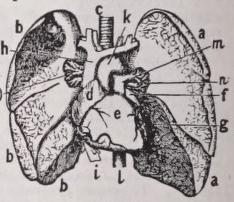
1. The lungs are the organs of respiration in man and many other animals. There are two of these organs, each of which occupies its cavity in the thorax. They alternately
inhale and
expel the air, by means of which the necessary function of respiration is carried on.
2. Each lung fills completely the cavity in which it is placed.
3. Formerly, a person having a strong voice, and a sort of servant.
Lung
[Noun]
Webster's Dictionary 1913
An organ for
aerial respiration; -- commonly in the plural.
Lunge
[Noun]
Webster's Dictionary 1913
1. A sudden thrust or pass, as with a sword.
Lunge
[Verb transitive]
Webster's Dictionary 1913
To cause to go round in a ring, as a horse, while holding his
halter.
Lunged
[Adjective]
Webster's Dictionary 1828
1. Having lungs, or the nature or resemblance of lunged; drawing in and
expelling air.
Lunged
[Adjective]
Webster's Dictionary 1913
Having lungs, or breathing organs similar to lungs.
Lungfish
[Noun]
Webster's Dictionary 1913
Any fish belonging to the
Dipnoi; -- so called because they have both lungs and gills.
Lungoor
[Noun]
Webster's Dictionary 1913
A long-tailed
monkey (Semnopithecus schislaceus), from the mountainous districts of India.
Lungworm
[Noun]
Webster's Dictionary 1913
Any one of several species of parasitic
nematoid worms which
infest the lungs and air passages of cattle, sheep, and other animals, often proving fatal. The lungworm of cattle (Strongylus micrurus) and that of sheep (S.
filaria) are the best known.
Lungwort
[Noun]
Webster's Dictionary 1828
A plant of the genus Pulmonaria.
Lungwort
[Noun]
Webster's Dictionary 1913
1. An
herb of the genus Pulmonaria (P. officinalis), of Europe; -- so called because the
spotted appearance of the leaves resembles that of a diseased
lung.
2. Any plant of the genus Mertensia (esp. M. Virginica and M. Sibirica) plants nearly related to Pulmonaria. The American lungwort is Mertensia Virginica, Virginia
cowslip.