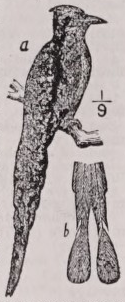
MOTMOT, according to Hernandez in his Historia Avium Novae Hispaniae (p. 52), published at Rome in 1651, was the Mexican name of a bird which he described well enough to leave no doubt as to what he meant; but the word being soon after printed Momot by Nieremberg and others gave rise to the Latinized Momotus, invented by Brisson as a generic term, which has since been generally adopted by ornithologists, though Motmot has been retained as the English form. Linnaeus knew of only one species of Motmot, and referred it to his genus Ramphastos (properly Rhamphastus') under the name of R. momota. This is the Momotus brasiliensis of modern ornithologists, and from its geographical range cannot be the original Motmot of Hernandez, but is most likely the “Guira guainumbi ” of Marcgrave....
The Motmots have been for many years recognized as forming a distinct family, Momotidae or Prionitidae, of the heterogeneous assemblage known as Picariae or Coccygomorphae∙, and the only question among systematists has been as to their position in that group. This has been discussed and illustrated with his usual assiduity by Dr Murie (Ibis, 1872, pp. 383-412, pls. xiii.-xv.), who conclusively showed that the Tody (g-.v.) was the Motmot’s nearest existing relative, while he believed that both Momotidae and Todidae might be placed in one section (Serratirostres') with the Coraciidae (Roller, q.v.~), Mero- pidae, and Alcedinidae (cf. Kingfisher, vol. xiv. p. 81). To the latter allocation Garrod (Proc. Zool. Society, 1878, pp. 100-102) has since partly demurred, though admitting the Kingfisher affinity, while upholding the former, and even declaring that Motmots and Todies form but a single family. As the conclusions of both these investigators are based on the sure ground of anatomical structure, they are of incomparably greater value than most of those arrived at by prior systematists who judged from external characters alone.
In outward appearance the Motmots have an undoubted resemblance to Bee-eaters, but, though beautiful birds, various shades of blue and green predominating in their plumage, they do not exhibit such decided and brilliant colours; and, while the Bee-eaters are only found in the Old World, the Motmots are a purely Neotropical form, extending from southern Mexico to Paraguay, and the majority of species inhabit Central America. They are said to be solitary birds, or at most living in pairs, among the gloomy forests, where they sit on the underwood nearly motionless, or only jerking their long tail as the cry “houtou” (or something like it) is uttered. Their ordinary food is small reptiles, insects, and fruits. The nest of one species, as observed by Mr Robert Owen, is at the end of a hole bored in the bank of a watercourse, and the eggs are pure white and glossy (Ibis, 1861, p. 65). Little else has been recorded of their ways.
The Momotidae form but a small group, containing, according to the latest enumeration of them in 1873 by Messrs Sclater and Salvin (Nomenclator, pp. 102, 103), but seventeen species, distributed into six genera, of which last, however, Dr Murie (l.cf would only recognize four— Momotus, Baryphthengus, Hylomanes, and Eumomota —the second including Urospatha, and the last Priono-rhynchus. The distinctions between these groups would require more space to indicate than can here be allowed; but it may be stated that, while all have a general resemblance in the serrated edges of the bill and many other characters, Momotus has the normal number of twelve rectrices, while the rest have only ten, which in Hylomanes have the ordinary configuration, but in adult examples of all the others the shaft of the median pair is devoid of barbs for the space of about an inch a little above the extremity, so as to produce a spatulate appearance, such as is afforded by certain humming-birds known as “Racquettails” (Humming-bird, vol. xii. p. 357), Kingfishers of the genus Tangsiptera (Kingfisher, vol. xiv. p. 82), and Parrots of the group Prioniturus. Waterton (Wanderings, Journey 2, chap, iii.), mentioning the species Μ. brasiliensis by its native name “Houtou,” long ago asserted that this peculiarity was produced by the Motmot itself nibbling off the barbs, and this extraordinary statement, though for a while doubted, has since been shown by Mr Salvin {Proc. Zool. Society, 1873, pp. 429-433), on Mr Bartlett’s authority, to be perfectly true. The object with which the operation is performed is wholly unknown. It is sometimes incompletely executed, and the tail has then an asymmetrical form. This must have been the case with the example that Hernandez described (Z.c.), and brought on himself the criticism of Willughby {Ornithologia, p. 298) for so doing. Much of the bibliography of the family is given in Dr Murie’s paper already quoted; and it may be remarked that in 1734 Seba, probably misled by wrong information, figured {Herum Nat. Thesaur., tab. 67, fig. 2) under the name of “Motmot” a bird which has been identified with a species of Guan (vol. xi. p. 232), and is the Ortalis motmot of modern ornithology. (a. n.)