
A genus of insectivorous birds, of the order of Picae; natives of warm climates.
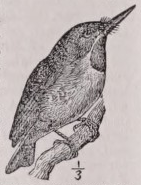
TODY, Pennant’s rendering (Gen. Pirds, pp. 15, 61) through the French Todier of Brisson (Ornithologie, iv. p. 528) of the somewhat obscure Latin word Todus , talis, cum todillis [todinis] crusculis”; but the passage is held by scholars to be corrupt. Among naturalists Gesner in 1555 gave currency (Hist. Animalium, iii. p. 719) to the word as a substantive, and it is found in Levins’s Manipulus Vocabulorum of 1570 (ed. Wheatley, 1867, col. 225) as the equivalent of the English “Titmouse.” Ducange allows the existence of the adjective todinus. Stephanus suggests that todi comes from τυτθo ἰ , but his view is not accepted. The verb todere may perhaps be Englished to “toddle”! ] not unhappily applied in 1756 by Patrick Browne (Civ. and Hat. Hist. Jamaica, p. 476) to a little bird remarkable for its slender legs and small feet, the “Green Sparrow” or “Green Humming-Bird” of Sloane (Voyage, ii. p. 306). The name, having been taken up by Brisson (loc. cit.) in 1760, was adopted by Linnaeus, and has since been recognized by ornithologists as that of a valid genus, though many species have been referred to it which are now known to have no affinity to the type, the Todus viridis of Jamaica, and accordingly have since been removed from it. The genus Todus was at one time placed among the Muscicapidae (cf. Flycatcher, vol. ix. p. 351); but Dr Murie’s investigations (Proc. Zool. Society, 1872, pp. 664-680, pl. Iv.) have conclusively proved that it is not Passerine, and is nearly allied to the Momotidae (cf. Motmot, vol. xvii. p. 3) and Alcedinidae (cf. Kingfisher, vol. xiv. p. 81), though it should be regarded as forming a distinct Family Todidae, peculiar to the Greater Antilles, each of which islands has its own species, all of small size, the ...largest not exceeding four inches and a half in length.
Of the species already named, T. viridis, Mr Gosse (Ä Jamaica, pp. 72-80) gives an interesting account, “Always conspicuous from its bright grass-green coat and crimson-velvet gorget, it is still a very tame bird; yet this seems rather the tameness of indifference than of confidence; it will allow a person to approach very near, and, if disturbed, alight on another twig a few yards distant .... commonly it is seen sitting patiently on a twig, with the head drawn in, the beak pointing upwards, the loose plumage puffed out, when it appears much larger than it is. It certainly has an air of stupidity when thus seen. But this abstraction is more apparent than real; if we watch it, we shall see that the oddlooking grey eyes are glancing hither and thither, and that ever and anon the bird sallies out upon a short feeble flight, snaps at something in the air, and returns to his twig to swallow it.” Mr Gosse goes on to describe the engaging habits of one that he for a short time kept in captivity, which, when turned into a room, immediately began catching all the insects it could, at the rate of about one a minute. The birds of this Family also shew their affinity to the Kingfishers, Motmots, and Bee-eaters by burrowing holes in the ground in which to make their nest, and therein laying eggs with a white translucent shell. The sexes differ little in plumage.
All the four species of Todus, as now restricted, present a general similarity of appearance, and, it may be presumed, possess very similar habits. The genus has been monographed by Mr Sharpe (His, 1874, pp. 344-355); but he was unfortunately misled by an exceptionally bright-
coloured specimen to add a fifth and bad species to those that exist—and even these, by some ornithologists, might be regarded as geographical races. The Cuban form is T. multicolor·, that of Hispaniola is T. subulatus or dominicensis ; and that of Porto Rico, originally named in error T. mexicanus, has since been called hypochondriacus. Apart from their structural peculiarities, one of the chief points of interest attaching to the Todidae is their limitation, not only to the Antillean Sub-region, but, as is now believed, to its greater islands. (a. n.)