
An aquatic fowl of the genus Procellaria.
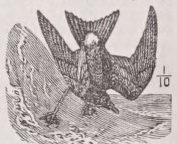
PETREL, the name applied in a general way to a group of Birds (of which more than 100 species are recognized) from the habit which some of them possess of apparently walking on the surface of the water as the apostle St Peter (of whose name the word is a diminutive form) is recorded (Matt. xiv. 29) to have done. For a long while the Petrels were ranked as a Family, under the name of Procell- ariidae, and thought to be either very nearly allied to the Gulls, Lañdae, or intermediate between that Family and the Steganapodes ; but this opinion has gradually given way, and it is now hard to resist the conclusion that they have to be regarded as an “Order,” to which the name Tubinares has been applied from the tubular form of their nostrils, a feature possessed in greater or less degree by all of them, and by which each may at a glance be recognized. They have usually been subdivided into three groups or Subfamilies, (1) Pelecanoidinae (or Halodrominae), containing some three or four species known as Diving-Petrels, with habits very different from others of the Family, and almost peculiar to high southern latitudes from Cape Horn to New Zealand; (2) Procellariinae, or Petrels proper; and (3) Diomedeinae, or Albatrosses (cf. Mallemuck, vol. xv. p. 334). Recently, however, the anatomy of the group has been subjected to very close examination by Garrod and W. A. Forbes, the latter of whom has summed up the results obtained by himself and his predecessor in an elaborate essay, forming part ix. of the Zoology of the voyage of the “Challenger,” which shew determinations that differ greatly from any that had been reached by prior systematists. According to these investigators, the Tubinares are composed of two Families, Procellariidae and Oceanitidae, whose distinctness had ...never before been suspected —the latter consisting of four genera not very much differing in appearance from many others, while the former includes as Subfamilies the Albatrosses, Diomedeinae, with three genera, Diomedea, Thalassiarche, and Phaebetña, and the true Petrels, ProceUañinae, in which last are combined forms so different externally and in habit as the Diving-Petrels, above noticed, the Storm-Petrels, Procellaña, the Flat-billed Petrels, Prion, the Fulmar (vol. ix. p. 817), the Shearwaters (q.vf, and others. Want of space forbids us here dwelling on the characters assigned to these different groups, or the means which have led to this classification of it, set forth at great length in the essay cited, where also will be found copious references to previous studies of the Petrels, among which may here be especially mentioned those of MM. Hombron and Jacquinot (Comptes Rendus, 1844, pp. 353-358, and Zool. Voy. au Pol Sud, vol. iii.), Prof. Coues (Proc. Acad. Philadelphia, 1864, pp. 72-91, 116-144, and 1866, pp. 25-33, 134-197), and Mr Salvin (Orn. Miscellany, ii. pp. 223-238, 249-257; and Zoology, Voy. “Chall eng erf pt. viii. pp. 140-149).
Petrels are dispersed throughout all the seas and oceans of the world, and some species apparently never resort to land except for the purpose of nidification, though nearly all are liable at times to be driven ashore, and often very far inland, by gales of wind. It would also seem that during the breeding-season many of them are wholly nocturnal in their habits, passing the day in holes of the ground, or in clefts of the rocks, in which they generally nestle, the hen of each pair laying a single white egg, sparsely speckled in a few species with fine reddish dots. Of those species that frequent the North Atlantic, the common Storm-Petrel, Procellaña pelagica, a little bird which has to the ordinary eye rather the look of a Swift or Swallow, is the “Mother Carey’s chicken” of sailors, and is widely believed to be the harbinger of bad weather; but seamen hardly discriminate between this and others nearly resembling it in appearance, such as Leach’s or the
Fork-tailed Petrel, Cymochorea leucorrhoa, a rather larger but less common bird, and Wilson’s Petrel, Oceanites océaniens, the type of the Family Oceanitidae mentioned above, which is more common on the American side. But it is in the Southern Ocean that Petrels most abound, both as species and as individuals. The Cape-Pigeon or Pintado Petrel, Daption capeηsis, is one that has long been well known to mariners and other wayfarers on the great waters, while those who voyage to or from Australia, whatever be the route they take, are certain to meet with many more species, some, as Ossifraga gigantea, as large as Albatrosses, and several of them called by sailors by a variety of choice names, generally having reference to the strong smell of musk emitted by the birds, among which that of “Stink-pot” is not the most opprobrious. None of the Petrels are endowed with any brilliant colouring—sooty-black, grey of various tints (one of which is often called “blue”), and white being the only hues their plumage exhibits; but their graceful flight, and their companionship when no other life is visible around a lonely vessel on the widest of oceans, give them an interest to beholders, though this is too often marred by the wanton destruction dealt out by brutal or thoughtless persons who thus seek to break the tediousness of a long voyage. The distribution of the several species of Petrels in the Southern Ocean has been ably treated by Prof. A. Milne-Edwards in the Annales des Sciences Naturelles for 1882 (ser. 6, Zoologie, vol. xiii. art. 4, pp. 1-22), of which essay a translation will be found in the Mitthñlungen des Ornithologischen Vereins in Wien for 1884. (a. n.)