
Word of the Day: Catachrestical
1. Any one of numerous species of passerine birds of the family Hirundinidae, especially one of those species in which the tail is deeply forked. They have long, pointed wings, and are noted for the swiftness and gracefulness of their flight.
2. Any one of numerous species of swifts which resemble the true swallows in form and habits, as the common American chimney swallow, or swift.
3. The aperture in a block through which the rope reeves.
4. The act of swallowing.
6. Taste; relish; inclination; liking.
7. Capacity for swallowing; voracity.
8. As much as is, or can be, swallowed at once; as, a swallow of water.
9. That which ingulfs; a whirlpool.
To perform the act of swallowing; as, his cold is so severe he is unable to swallow.
1. To take into the stomach; to receive through the gullet, or esophagus, into the stomach; as, to swallow food or drink.
3. To receive or embrace, as opinions or belief, without examination or scruple; to receive implicitly.
4. To engross; to appropriate; -- usually with up.
5. To occupy; to take up; to employ.
7. To retract; to recant; as, to swallow one's opinions.
Swallow
Encyclopedia Britannica
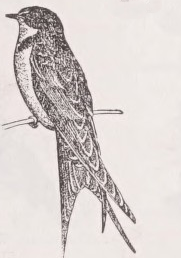
SWALLOW (A.-S. Swalewe, Icel. Scala, Dutch Zwaluw, Germ. Schwalbe), the bird which of all others is recognized as the harbinger of summer in the northern hemisphere; for, though some slight differences, varying according, to the meridian, are constantly presented by the birds which have their home in Europe, in northern Asia, and in North America respectively, it is difficult to allow to them a specific value; and consequently a zoologist of wide views, while not overlooking this local variation, will regard the Swallow of all these tracts as forming a single species, the Hirundo rustica of Linnaeus. Returning, usually already paired, to its summer-haunts, after its winter-sojourn in southern lands, and generally reaching England about the first week in April, it at once repairs to its old quarters, nearly always around the abodes of men; and, about a month later, the site of the nest is chosen, resort being had in most cases to the very spot that has formerly served the same purpose—the old structure, if still remaining, being restored and refurnished. So trustful is the bird that it commonly establishes itself in any of men’s works that will supply the necessary accommodation, and a shed, a barn, or any building with an open roof, a chimney that affords a support for the nest, or even the room of an inhabited house—if chance should give free access thereto, —to say nothing of extraordinary positions, may be the place of its choice. Wheresoever placed, the nest is formed of small lumps of moist earth, which, carried to the spot in the bird’s bill, are duly arranged and modelled, with the aid of short straws or slender sticks, into the required shape. This is generally that of a half-saucer, but it varies according to the exigencies of the site. The materials ...dry quickly into a hard crust, which is lined with soft feathers, and therein are laid from four to six white eggs, blotched and speckled with grey and orange-brown deepening into black. Two broods are usually reared in the season, and the young on leaving the nest soon make their way to some leafless bough, whence they try their powers of flight, at first accompanying their parents in short excursions on the wing, receiving from them the food themselves are as yet unable to capture, until able to shift for themselves. They collect in flocks, often of many hundreds, and finally leave the country about the end of August or early in September, to be followed, after a few weeks, by their progenitors. The Swallows of Europe doubtless pass into Africa far beyond the equator, and those of Northern Asia, though many stop in India or Burmah, even further to the southward, occasionally reaching Australia, while those of North America extend their winter-wanderings to southern Brazil; but, whithersoever they then resort, they during that season moult their feathers, and this fact affords one of the strongest arguments against the popular belief (which, curious to say, is still partly if not fully entertained by many who should know better) of their becoming torpid in winter, for a state of torpidity would suspend all animal action. The chestnut forehead and throat, the shining steel-blue upper plumage, and the dusky-white—in some cases reddening so as almost to vie with the frontal and gular patches—of the lower parts are well known to every person of observation, as is the markedly forked tail, which is become proverbial of this bird.
Taking the word Swallow in a more extended sense, it is used for all the members of the Family Himndinidae, excepting a few to which the name Martin (vol. xv. p. 581) has been applied, and this Family includes from 80 to 100 species, which have been placed in many different genera. The true Swallow has very many affines, some of which range almost as widely as itself docs, while others seem to have curiously restricted limits, and much the same may be said of several of its more distant relatives. But altogether the Family forms one of the most circumscribed and therefore one of the most natural groups of Oscines, having no near allies; for, though in outward appearance and in some habits the Swallows bear a considerable resemblance to Swifts (q. v. ), the latter belong to a very different Order, and are not Passerine birds at all, as their structure, both internal and external, proves. It has been sometimes stated that the Hirundinidae have their nearest relations in the Flycatchers (vol. ix. p. 351); but the assertion is very questionable, and the supposition that they are allied to the Ampelidae (cf . Waxwing), though possibly better founded, has not as yet been confirmed by any anatomical investigation. An affinity to the Indian and Australian Artamus (the species of which genus are often known as Wood-Swallows, or Swallow-Shrikes) has also been suggested; and it may turn out that this genus, with its neighbours, may be the direct and less modified descendants of a generalized type, whence the Hirundinidae have diverged; but at present it would seem as if the suggestion originated only in the similarity of certain habits, such as swift flight and the capacity of uninterruptedly taking and swallowing insect-food on the wing.
Swallows are nearly cosmopolitan birds, inhabiting every considerable country except New Zealand, wherein only a stray example, presumably from Australia, occasionally occurs. (a. n.)
9th ed. Encyclopædia Britannica, vol. 22, p. 729
[910 words — estimated reading time: 6 minutes]
[910 words — estimated reading time: 6 minutes]
A sea fish of the genus Trigla, called in Cornwall, tub-fish; remarkable for the size of its gill-fins. It is called also the sapphirine gurnard.
The name of the chelidonius, a fly remarkable for its swift and long flight.
Chelidonius lapis, a stone which Pliny and other authors affirm to be found in the stomachs of young swallows.
A plant, a species of willow.
1. Having a tail like that of a swallow; hence, like a swallow's tail in form; having narrow and tapering or pointed skirts; as, a swallow-tailed coat.
2. United by dovetailing; dovetailed.
1. A plant of the genus Asclepias; hirundinaria. It grows in the southern part of Europe, and is said to have been successfully used as a medicine, chiefly in dropsical cases.
3. The gullet or oesophagus; the throat.
4. Voracity.
5. As much as is swallowed at once.
1. To take into the stomach; to receive through the gullet or oesophagus into the stomach; as, to swallow food or drink. Food should be well chewed before it is swallowed.
2. To absorb; to draw and sink into an abyss or gulf; to ingulf; usually followed by up. The Malstrom off the coast of Norway, it is said, will swallow up a ship.
3. In bogs swallow'd up and lost.
4. The earth opened and swallowed them up. Numbers 16:1 .
5. To receive or embrace, as opinions or belief, without examination or scruple; to receive implicitly.
6. To engross; to appropriate.
7. Homer--has swallowed up the honor of those who succeeded him.
8. To occupy; to employ.
9. The necessary provision of life swallows the greatest part of their time.
10. To seize and waste.
11. Corruption swallow'd what the liberal hand
14. The priest and the prophet have erred through strong drink; they are swallowed up of wine. Isaiah 28:1 .
The act of taking into the stomach or of absorbing; the act of receiving implicitly; the act of engrossing.
Taking into the stomach; absorbing; ingulfing; receiving implicitly; engrossing; wasting; exhausting.
of Swallow
Swallows
Watson's Biblical & Theological Dictionary
סיס, a bird too well known to need description. Our translators of the Bible have given this name to two different Hebrew words. The first, דרור, in Psalm lxxxiv, 3, and Prov. xxvi, 2, is probably the bird which Forskal mentions among the migratory birds of Alexandria, by the name of _dururi_; and the second, עגור, Isa. xxxviii, 14, and Jer. viii, 7, is the crane; but the word סיס, in the two last places rendered in our version “crane,” is really the swallow. So the Septuagint, Vulgate, and two ancient manuscripts, Theodotion, and Jerom, render it, and Bochart and Lowth follow them. Bochart assigns the note of this bird for the reason of its name, and ingeniously remarks that the Italians about Venice call a swallow _zizilla_, and its twittering _zizillare_. The swallow being a plaintive bird, and a bird of passage, perfectly agrees with the meaning of Isaiah and Jeremiah. The annual migration of the swallow has been familiarly known in every age, and perhaps in every region of the earth. In Psalm lxxxiv, 3, it is said, “The sparrow hath found a house, and the swallow a nest for herself, where she may lay her young, even thine altars, O Lord of hosts.” By the altars of Jehovah we are to understand the temple. The words probably refer to the custom of several nations of antiquity,--that birds which built their nests on the temples, or within the limits of them, were not suffered to be driven away, much less killed; but found a secure and uninterrupted dwelling. Hence, when Aristodicus disturbed the birds’ nests of the temple of Kumæ, and took the young from them, a voice, according to a tradition preserved by Herodotus, is said to have spoken these words from the interior of the temple: “Most villainous of men, how darest thou to drive away ...such as seek refuge in my temple?” The Athenians were so enraged at Atarbes, who had killed a sparrow which built on the temple of Æsculapius, that they killed him. Among the Arabs, who are more closely related to the Hebrews, birds which build their nests on the temple of Mecca have been inviolable from the earliest times. In the very ancient poem of a Dschorhamidish prince, published by a Schulten, in which he laments that his tribe had been deprived of the protection of the sanctuary of Mecca, it is said, “We lament the house, whose dove Was never suffer’d to be hurt: She remain’d there secure; in it, also, The sparrow built its nest.” In another ancient Arabian poet, Nabega, the Dhobianit swears “by the sanctuary which affords shelter to the birds which seek it there.” Niebuhr says, “I will observe, that among the Mohammedans, not only is the _kaba_ a refuge for the pigeons, but also on the mosques over the graves of Ali and Hassein, on the Dsjamea, or chief mosque, at Helle, and in other cities, they are equally undisturbed.” And Thevenot remarks: “Within a mosque at Oudjicum lies interred the son of a king, called Schah-Zadeh-Imam Dgiafer, whom they reckon a saint. The dome is rough cast over; before the mosque there is a court, well planted with many high plane trees, on which we saw a great many storks, that haunt thereabout all the year round.” See SPARROW.
Watson's Biblical & Theological Dictionary
[555 words — estimated reading time: 4 minutes]
[555 words — estimated reading time: 4 minutes]
2. A species of willow.
3. An outwork with converging sides, its head or front forming a reentrant angle; -- so called from its form. Called also priestcap.
4. A swallow-tailed coat.
5. An arrow.
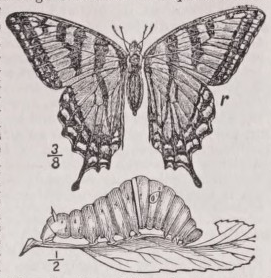
6. Any one of numerous species of large and handsome butterflies, belonging to Papilio and allied genera, in which the posterior border of each hind wing is prolongated in the form of a long lobe.
Reception Roget’s Thesaurus §296
N. reception, admission, admittance, entree, importation, introduction, intromission, immission, ingestion, imbibation, introception, absorption, ingurgitation, inhalation, suction, sucking, eating, drinking, insertion, interjection, introit
V. give entrance to, give admittance to, give the entree, introduce, intromit, usher, admit, receive, import, bring in, open the door to, throw in, ingest, absorb, imbibe, inhale, breathe in, let in, take in, suck in, draw in, readmit, resorb, reabsorb, snuff up, swallow, ingurgitate, engulf, engorge, gulp, eat, drink
Adj. admitting, admitted, admissable, absorbent
Food Roget’s Thesaurus §298
N. eating, deglutition, gulp, epulation, mastication, manducation, rumination, gluttony, hippophagy, ichthyophagy, [CAUSED BY: appetite &c. 865], mouth, jaws, mandible, mazard, chops, drinking, potation, draught, libation, carousal, drunkenness, food, pabulum, aliment, nourishment, nutriment, sustenance, sustentation, sustention, nurture, subsistence, provender, corn, feed, fodder, provision, ration, keep, commons, board, commissariat, prey, forage, pasture, pasturage, fare, cheer, diet, dietary, regimen, belly timber, staff of life, bread, bread and cheese, comestibles, eatables, victuals, edibles, ingesta, grub, grubstake, prog, meat, bread, bread stuffs, cerealia, cereals, viands, cates, delicacy, dainty, creature comforts, contents of the larder, fleshpots, festal board, ambrosia, good cheer, good living, beef, bisquit, bun, cornstarch, cookie, cooky, cracker, doughnut, fatling, hardtack, hoecake, hominy, mutton, pilot bread, pork, roti, rusk, ship biscuit, veal, joint, piece de resistance, roast and boiled, remove, entremet, releve, hash, rechauffe, stew, ragout, fricassee, mince, pottage, potage, broth, soup, consomme, puree, spoonmeat, pie, pasty, volauvent, pudding, omelet, pastry, sweets, kickshaws, condiment, appetizer, hors d'oeuvre, main course, entree, alligator pear, apple &c, apple slump, artichoke, ashcake, griddlecake, pancake, flapjack, atole, avocado, banana, beche de mer, barbecue, beefsteak, beet root, blackberry, blancmange, bloater, bouilli, bouillon, breadfruit, chop suey, chowder, chupatty, clam, compote, damper, fish, frumenty, grapes, hasty pudding, ice cream, lettuce, mango, mangosteen, mince pie, oatmeal, oyster, pineapple, porridge, porterhouse steak, salmis, sauerkraut, sea slug, sturgeon ("albany beef"), succotash, supawn, trepang, vanilla, waffle, walnut, table, cuisine, bill of fare, menu, table d'hote, ordinary, entree, meal, repast, feed, spread, mess, dish, plate, course, regale, regalement, refreshment, entertainment, refection, collation, picnic, feast, banquet, junket, breakfast, lunch, luncheon, dejeuner, bever, tiffin, dinner, supper, snack, junk food, fast food, whet, bait, dessert, potluck, table d'hote, dejeuner a la fourchette, hearty meal, square meal, substantial meal, full meal, blowout*, light refreshment, bara, chotahazri, bara khana, mouthful, bolus, gobbet, morsel, sop, sippet, drink, beverage, liquor, broth, soup, potion, dram, draught, drench, swill*, nip, sip, sup, gulp, wine, spirits, liqueur, beer, ale, malt liquor, sir john barleycorn, stingo, heavy wet, grog, toddy, flip, purl, punch, negus, cup, bishop, wassail, gin, coffee, chocolate, cocoa, tea, the cup that cheers but not inebriates, bock beer, lager beer, pilsener beer, schenck beer, brazil tea, cider, claret, ice water, mate, mint julep, near beer, 3, 2 beer, non-alcoholic beverage, eating house, diner, hippophage, glutton
V. eat, feed, fare, devour, swallow, take, gulp, bolt, snap, fall to, despatch, dispatch, discuss, take down, get down, gulp down, lay in, tuck in*, lick, pick, peck, gormandize, bite, champ, munch, cranch, craunch, crunch, chew, masticate, nibble, gnaw, mumble, live on, feed upon, batten upon, fatten upon, feast upon, browse, graze, crop, regale, carouse, eat heartily, do justice to, play a good knife and fork, banquet, break bread, break one's fast, breakfast, lunch, dine, take tea, sup, drink in, drink up, drink one's fill, quaff, sip, sup, suck, suck up, lap, swig, swill*, chugalug, tipple, empty one's glass, drain the cup, toss off, toss one's glass, wash down, crack a bottle, wet one's whistle, purvey
Adj. eatable, edible, esculent, comestible, alimentary, cereal, cibarious, dietetic, culinary, nutritive, nutritious, gastric, succulent, potable, potulent|, bibulous, omnivorous, carnivorous, herbivorous, granivorous, graminivorous, phytivorous, ichthyivorous, omophagic, omophagous, pantophagous, phytophagous, xylophagous phr, "across the walnuts and the wine", "blessed hour of our dinners!", "now good digestion wait on appetite, and health on both!", "who can cloy the hungry edge of appetite?"
Belief Roget’s Thesaurus §484
N. belief, credence, credit, assurance, faith, trust, troth, confidence, presumption, sanguine expectation, dependence on, reliance on, persuasion, conviction, convincement, plerophory, self- conviction, certainty, opinion, mind, view, conception, thinking, impression, surmise, conclusion, tenet, dogma, principle, way of thinking, popular belief, firm belief, implicit belief, settled belief, fixed rooted deep-rooted belief, staunch belief, unshaken belief, steadfast belief, inveterate belief, calm belief, sober belief, dispassionate belief, impartial belief, well-founded belief, firm opinion, implicit opinion, settled opinion, fixed rooted deep-rooted opinion, staunch opinion, unshaken opinion, steadfast opinion, inveterate opinion, calm opinion, sober opinion, dispassionate opinion, impartial opinion, well-founded opinion &c, uberrima fides, system of opinions, school, doctrine, articles, canons, article of faith, declaration of faith, profession of faith, tenets, credenda, creed, thirty-nine articles, catechism, assent, propaganda, credibility
V. believe, credit, give faith to, give credit to, credence to, see, realize, assume, receive, set down for, take for, have it, take it, consider, esteem, presume, count upon, depend upon, calculate upon, pin one's faith upon, reckon upon, lean upon, build upon, rely upon, rest upon, lay one's account for, make sure of, make oneself easy about, on that score, take on trust, take on credit, take for granted, take for gospel, allow some weight to, attach some weight to, know, know for certain, have know, make no doubt, doubt not, be, rest assured, persuade oneself, assure oneself, satisfy oneself, make up one's mind, give one credit for, confide in, believe in, put one's trust in, place in, repose in, implicit confidence in, take one's word for, at one's word, place reliance on, rely upon, swear by, regard to, think, hold, take, take it, opine, be of opinion, conceive, trow, ween, fancy, apprehend, have it, hold a belief, possess, entertain a belief, adopt a belief, imbibe a belief, embrace a belief, get hold of a belief, hazard, foster, nurture a belief, cherish a belief, have an opinion, hold an opinion, possess, entertain an opinion, adopt an opinion, imbibe an opinion, embrace an opinion, get hold of an opinion, hazard an opinion, foster an opinion, nurture an opinion, cherish an opinion, view as, consider as, take as, hold as, conceive as, regard as, esteem as, deem as, look upon as, account as, set down as, surmise, get it into one's head, take it into one's head, come round to an opinion, swallow, cause to be believed, satisfy, persuade, have the ear of, gain the confidence of, assure, convince, convict|, convert, wean, bring round, bring over, win over, indoctrinate, cram down the throat, produce conviction, carry conviction, bring home to, drive home to, go down, find credence, pass current, be received, be current, possess, take hold of, take possession of the mind
Adj. believing, certain, sure, assured, positive, cocksure, satisfied, confident, unhesitating, convinced, secure, under the impression, impressed with, imbued with, penetrated with, confiding, suspectless, unsuspecting, unsuspicious, void of suspicion, credulous, wedded to, believed, accredited, putative, unsuspected, worthy of, deserving of, commanding belief, credible, reliable, trustworthy, to be depended on, satisfactory, probably, fiducial, fiduciary, persuasive, impressive, relating to belief, doctrinal
Adv. in the opinion of, in the eyes of, me judice, meseems, methinks, to the best of one's belief, i dare say, i doubt not, i have no doubt, i am sure, sure enough, depend upon, rely upon it, be assured, rest assured, i'll warrant you
Phr. experto crede, fata viam invenient, justitiae soror incorrupta fides, "live to explain thy doctrine by thy life", "stands not within the prospect of belief", tarde quae credita laedunt credimus, vide et crede
Credulity Roget’s Thesaurus §486
N. credulity, credulousness, cullibility|, gullibility, gross credulity, infatuation, self delusion, self deception, superstition, one's blind side, bigotry, hyperorthodoxy, misjudgment, credulous person
V. be credulous, jurare in verba magistri, follow implicitly, swallow, gulp down, take on trust, take for granted, take for gospel, run away with a notion, run away with an idea, jump to a conclusion, rush to a conclusion, think the moon is made of green cheese, take for granted, grasp the shadow for the substance, catch at straws, grasp at straws, impose upon
Adj. credulous, gullible, easily deceived, simple, green, soft, childish, silly, stupid, easily convinced, over-credulous, over confident, over trustful, infatuated, superstitious, confiding
Phr. the wish the father to the thought, credo quia impossibile, all is not gold that glitters, no es oro todo lo que reluce, omne ignotum pro magnifico
Inexcitability Roget’s Thesaurus §826
N. inexcitability, imperturbability, inirritability, even temper, tranquil mind, dispassion, tolerance, patience, coolth, passiveness, hebetude, hebetation, impassibility, stupefaction, coolness, calmness, composure, placidity, indisturbance, imperturbation, sang froid, tranquility, serenity, quiet, quietude, peace of mind, mental calmness, staidness, gravity, sobriety, quakerism, philosophy, equanimity, stoicism, command of temper, self-possession, self-control, self-command, self-restraint, ice water in one's veins, presence of mind, submission, resignation, sufferance, supportance, endurance, longsufferance, forbearance, longanimity, fortitude, patience of job, patience "on a monument", patience "sovereign o'er transmuted ill", moderation, repression of feelings, subjugation of feeling, restraint, tranquillization
V. be composed, laisser faire, laisser aller, take things easily, take things as they come, take it easy, rub on, live and let live, take easily, take cooly, take in good part, aequam servare mentem, bear the brunt, bear well, go through, support, endure, brave, disregard, tolerate, suffer, stand, bide, abide, aby, bear with, put up with, take up with, abide with, acquiesce, submit, submit with a good grace, resign oneself to, reconcile oneself to, brook, digest, eat, swallow, pocket, stomach, make light of, make the best of, make "a virtue of necessity", put a good face on, keep one's countenance, check check oneself, compose, appease, propitiate, repress, render insensible, overcome one's excitability, allay one's excitability, repress one's excitability, master one's feelings, make oneself easy, make one's mind easy, set one's mind at ease, set one's mind at rest, calm down, cool down, gentle, thaw, grow cool, be borne, be endured, go down
Adj. inexcitable, unexcitable, imperturbable, unsusceptible, unpassionate, dispassionate, cold-blooded, irritable, enduring, stoical, platonic, philosophic, staid, stayed, sober, sober minded, grave, sober as a judge, grave as a judge, sedate, demure, cool-headed, easy-going, peaceful, placid, calm, quiet as a mouse, tranquil, serene, cool as a cucumber, cool as a custard, undemonstrative, temperate, composed, collected, unexcited, unstirred, unruffled, undisturbed, unperturbed, unimpassioned, unoffended, unresisting, meek, tolerant, patient, patient as job, submissive, tame, content, resigned, chastened, subdued, lamblike, gentle as a lamb, suaviter in modo, mild as mothers milk, soft as peppermint, armed with patience, bearing with, clement, long-suffering
Adv. "like patience on a monument smiling at grief", aequo animo, in cold blood, more in sorrow than in anger
Phr. "cool calm and collected", keep calm in the midst of a storm, "adversity's sweet milk, philosophy", mens aequa in arduis philosophia stemma non inspecite, quo me cumque rapit tempestas deferor hospes, "they also serve who only stand and wait", section ii, personal affections 1, passive affections
Int. patience, and shuffle the cards
King James Bible KJV Bible
Berean Standard Bible BSB Bible
52 KJV and 41 BSB verses contain “Swallow” — showing the first 20. Show all 59 verses (searchable)
But if the LORD make a new thing, and the earth open her mouth, and swallow them up, with all that appertain unto them, and they go down quick into the pit; then ye shall understand that these men have provoked the LORD.
But if the LORD brings about something unprecedented, and the earth opens its mouth and swallows them and all that belongs to them so that they go down alive into Sheol, then you will know that these men have treated the LORD with contempt.”
And all Israel that were round about them fled at the cry of them: for they said, Lest the earth swallow us up also.
At their cries, all the people of Israel who were around them fled, saying, “The earth may swallow us too!”
I am one of them that are peaceable and faithful in Israel: thou seekest to destroy a city and a mother in Israel: why wilt thou swallow up the inheritance of the LORD?
I am among the peaceable and faithful in Israel, but you are trying to destroy a city that is a mother in Israel. Why would you swallow up the LORD’s inheritance?”
That which he laboured for shall he restore, and shall not swallow it down: according to his substance shall the restitution be, and he shall not rejoice therein.
He must return the fruit of his labor without consuming it; he cannot enjoy the profits of his trading.