
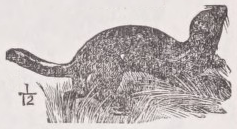
POLECAT. This name is applied to one of the English members of the large Family Mustelidae, which contains besides the Martens, Weasels, Otters, and Badgers (see Mammalia, vol. XV. p. 439, and the separate articles under these names).
In this family the Polecats, while belonging, with the stoats, weasels, and many others, to the nearly cosmopolitan genus Putorius, form by themselves a small group confined to the northern hemisphere, and consisting of four species, of which the best known and most widely distributed, is the common polecat of Europe {Putorius foetidus). This animal, at least so far as its disposition, size, and proportions are concerned, is well known in its domesticated condition as the ferret, which is but a tamed albino variety of the true polecat. The colour of the latter, however, instead of the familiar yellowish white of the ferret is of a dark brown tint above, and black below, the face being variegated with dark brown and white markings. Its skull is rough, strongly ridged, and altogether of a far more powerful type than those of the stoats, weasels, or martens; the skull of the female is very much smaller and lighter than that of the male. Its fur is long, coarse, and of comparatively small value, and changes its colour very little, if at all, at the different seasons of the year....
The distribution and habits of the common polecat have been well described by Blasius in his Säugethiere Deutschlands, and the following is an abstract of his account. The polecat ranges over the greater part of Europe, reaching northwards into southern Sweden, and in Russia to the region of the White Sea. It does not occur in the extreme south, but is common everywhere throughout central Europe. In the Alps it ranges far above the tree-line during the summer, but retreats in winter to lower ground. In fine weather it lives either in the open air, in holes, fox-earths, rabbit-warrens, under rocks, or in woodstacks; while in winter it seeks the protection of deserted buildings, barns, or stables. During the day it sleeps in its hiding place, sallying forth at night to plunder dovecots and hen-houses. It climbs but little, and shows far less activity than the marten. It feeds ordinarily on small mammals, such as rabbits, hamsters, rats, and mice, on such birds as it can catch, especially poultry and pigeons, and also on snakes, lizards, frogs, fish, and eggs. Its prey is devoured only in its lair, but, even though it can carry away but a single victim, it commonly kills everything that comes in its way, often destroying all the inhabitants of a hen-house in order to gratify its passion for slaughter. The pairing time is towards the end of the winter, and the young, from three to eight in number, are born in April or May, after a period of gestation of about two months. The young, if taken early, may be easily trained, like ferrets, for rabbit-catching. The polecat is very tenacious of life and will bear many severe wounds before succumbing; it is also said to receive with impunity the bite of the adder. Its fetid smell has become proverbial. To this it is indebted for its generic name Putorius (derived, as are also the low Latin putacius, the French putois, and the Italian puzzola, from puteo), as well as the designation foumart (i.e. foul marten), and its other English names fitchet, fitchew. Attempts to account for the first syllable of the word polecat rest entirely on conjecture.
The other species of the polecat group are the following
The Siberian Polecat (Putorius eυersmanni), very like the European in size, colour, and proportions, but with head and back both nearly or quite white, and skull more heavily built and sharply constricted behind the orbits, at least in fully adult individuals. It inhabits the greater part of south-western Siberia, extending from Tibet into the steppes of south-eastern European Russia.
The Black-footed or American Polecat (Putorius nigripes), a native of the central plateau of the United States, and extending southwards into Texas. It is very closely allied to the last species, hut has nevertheless been made the type of a special sub-genus named Cynomyonax, or “King of the Prairie Marmots,” a name which expresses its habit of living in the burrows of, and feeding upon, the curious prairie marmots (Cynomys} of the United.States. An excellent account of this species may be found in Dr Elliott Coues’s Fur-bearing Animals of North America.
Lastly, the Mottled Polecat {Putorius sarmaticus), a rare and peculiar species occurring in southern Russia and south-western Asia, extending from eastern Poland to Afghanistan. It differs from the other polecats both by its smaller size and its remarkable coloration, the whole of its upper parts being marbled with large irregular reddish spots on a white ground, and its underside, limbs, and tail being deep shining black. Its habits, which seem to be very much those of the common polecat, have been studied in Kandahar by Captain Thomas Hutton, who has given a vivid description of them in the Journal of the Asiatic Society of Bengal for 1843.
[872 words — estimated reading time: 5 minutes]