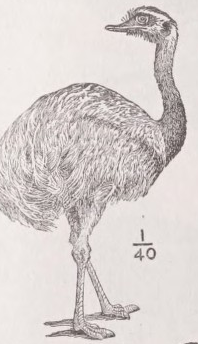
RHEA the name given in 1752 by Mühring to a South-American bird which, though long before known and described by the earlier writers—Nieremberg, Marcgrave, and Piso (the last of whom has a recognizable but rude figure of it)—had been without any distinctive scientific appellation. Adopted a few years later by Brisson, the name has since passed into general use, especially among English authors, for what their predecessors had called the American Ostrich; but on the European continent the bird is commonly called Nandu, a word corrupted from a name it is said to have borne among the aboriginal inhabitants of Brazil, where the Portuguese settlers called it Ema (cf. Emeu, vol. viii. p. 171). The resemblance of the Rhea to the Ostrich (vol. xviii. p. 62) was at once perceived, but the differences between them were scarcely less soon noticed, for some of them are very evident. The former, for instance, has three instead of two toes on each foot, it has no apparent tail nor the showy wing-plumes of the latter, and its head and neck are clothed with feathers, while internal distinctions of still deeper significance have since been dwelt upon by Prof. Huxley (Proc. Zool. Society, 1867, pp. 420-422) and the late Mr W. A. Forbes (fip. cit., 1881, pp. 784-787), thus justifying the separation of these two forms more widely even than as Families; and there can be little doubt that they should be regarded as types of as many Orders— Stmdhioηes and Rheae— of the SubclassRatitae. Structural characters no less important separate the Rheas from the Emeus, and, apart from their very different physiognomy, the former can be readily recognized by the rounded form of their contour-feathers, which want the hyporrhachis or after-shaft that in the Emeus and Cassowaries is so long as ...to equal the main shaft, and contributes to give these latter groups the appearance of being covered with shaggy hair. Though the Rhea is not decked with the graceful plumes which adorn the Ostrich, its feathers have yet a considerable market value, and for the purpose of trade in them it is annually killed by thousands, so that it has been already extirpated from much of the country it formerly inhabited, and its total extinction as a wild animal is probably only a question of time. Its breeding habits are precisely those which have been already described in the case of other Ratite birds. Like most of them it is polygamous, and the male performs the duty of incubation, brooding more than a score of eggs, the produce of several females—facts known to Nieremberg more than two hundred and fifty years since, but hardly accepted by naturalists until recently. From causes which, if explicable, do not here concern us, no examples of this bird seem to have been brought to Europe before the beginning of the present century, and accordingly the descriptions previously given of it by systematic writers were taken at second hand and were mostly defective if not misleading. In 1803 Latham issued a wretched figure of the species from a half-grown specimen in the Leverian Museum, and twenty years later said he had seen only one other, and that still younger, in Bullock’s collection {Ge)i. Hist. Birds, viii. p. 379). , ] A bird living in confinement at Strasburg in 1806 was, however, described and figured by Hammer in 1808 ( Ann. du Museum, xii. pp. 427-433, pl. 39), and, though he does not expressly say so, we may infer from his account that it had been a captive for some years. In England the Report of the Zoological Society for 1833 announced the Rhea as having been exhibited for the first time in its gardens during the preceding twelvemonth. Since then many other living examples have been introduced, and it has bred both there and elsewhere in Britain, but the young do not seem to be very easily reared.
Though considerably smaller than the Ostrich, and, as before stated, wanting its fine plumes, the Rhea in general aspect far more resembles that bird than the other Ratitae. The feathers of the head and neck, except on the crown and nape, where they are dark brown, are dingy white, and those of the body ash-coloured tinged with brown, while on the breast they are brownish-black, and on the belly and thighs white. In the course of the memorable voyage of the “Beagle,” Darwin came to hear of another kind of Rhea, called by his informants Avestruz petise, and at Port Desire on the east coast of Patagonia he obtained an example of it, the imperfect skin of which enabled Mr Gould to describe it {Proc. Zool. Society, 1837, p. 35) as a second species of the genus, naming it after its discoverer. Rhea daηvini differs in several well-marked characters from the earlier known R. americana. Its bill is shorter than its head; its tarsi are reticulated instead of scutellated in front, with the upper part feathered instead of being bare; and the plumage of its body and wings is very different, each feather being tipped with a distinct whitish band, while that of the head and neck is greyish-brown. A further distinction is also asserted to be shewn by the eggs—those of R. americana being of a yellowish-white, while those of R. darwini have a bluishtinge. Some years afterwards Mr Sclater described ( op. cit., 1860, p. 207) a third and smaller species, more closely resembling the R. americana, but having apparently a longer bill, whence he named it R. rnacrorhyηcha, more slender tarsi, and shorter toes, while its general colour is very much darker, the body and wings being of a brownish-grey mixed with black. The precise geographical range of these three species is still undetermined. While R. americana is known to extend from Paraguay and southern Brazil through the state of La Plata to an uncertain distance in Patagonia, R. darwini seems to be the proper inhabitant of the country last named, though
M. Claraz asserts {op. cit., 1885, p. 324) that it is occasionally found to the northward of the Rio Negro, which had formerly been regarded as its limit, and, moreover, that flocks of the two species commingled may be very frequently seen in the district between that river and the Rio Colorado. On the “pampas” R. americana is said to associate with herds of deer {Cariacus campestris), and R. darwini to be the constant companion of guanacos {Lamahuanaco) —just as in Africa the Ostrich seeks the society of zebras and antelopes. As for R. rnacrorhynchα, it was found by Forbes {Ibis, 1881, pp. 360, 361) to inhabit the dry and open “sertoês” of north-eastern Brazil, a discovery the more interesting since it was in that part of the country that Marcgrave and Piso became acquainted with a bird of this kind, though the existence of any species of Rhea in the district had been long overlooked by or unknown to succeeding travellers.
Besides the works above named and those of other recognized authorities on the ornithology of South America such as Azara, l’rince Max of Wied, Prof. Burmeister, and others, more or less valuable information on the subject is to be found in Darwin’s Voyage; Dr Booking’s “Monographie des Nandu” in (Wiegmann’s) Archiv für Naturgeschichte (18o3, i. pp. 213-241); Prof. R. O. Cunningham’s Natural History of the Strait of Magellan and paper in the Zoological Society’s Proceedings for 1871 (pp. 105—110), as well as Dr Gadow’s still more important anatomical contributions in the same journal for 188δ (pp. 308 sg.).
RHEA (or Rheea) FIBRE is a textile material yielded by one or more species of B'ohmeria (nat. ord. Urticaceae), plants found over a wide range in India, China, the Malay Peninsula and islands, and Japan. Rhea is also capable of being grown in temperate latitudes, and has been experimentally introduced into the south of France and Algeria. The most important source of rhea fibre, known also very inappropriately as China grass, or by its Malay name Ramie, is B. ηiυea. It is a shrubby plant growing to the height of from 5 to 8 feet with foliage and inflorescence like the common nettle, but destitute of stinging hairs. Some authorities consider the variety cultivated in China to be specifically distinct from the Indian plant. An allied plant called Pooalι or Puya, B. Puya, found growing wild in the north of India, is also a source of rhea fibre. Among the Chinese much care is bestowed on the cultivation of Chu or Tchou Ma, as rhea is called by them, and they prepare the fibre by a tedious and costly process of selection and manual labour. The plant thrives in hot, moist, shaded situations; propagated from slips or root cuttings, it throws up from three to five crops of stems in the course of a season, although not more than three crops are commonly reckoned on. Each such crop may yield about 250 lb of marketable fibre per acre, that total output being exceeded only by the jute crop. The stems when ripe are cut down, stripped of leaves and branchlets, and, either split or whole, are freed from their cortical layers till the bast layer is exposed. In this state they are made up in small bundles and placed where they receive strong sunlight by day and dews by night for several days, after which the fibrous bast layer is peeled with ease off the woodycore, and the separated fibres are thereafter treated with boiling water to remove as far as possible adherentgummy and resinous matter in which the fibres are embedded in the stalks. The fibre so obtained is usually bleached by exposure on the grass, and it comes into the market as brilliant white filaments with a fine silkygloss, having a strength, lustre, and smoothness unequalled by any other vegetable fibre.
The fibre first appeared in the European market in 1810, and a cord then spun from it was found to sustain a weight of 252 lb, while a similar cord of Russian hemp was estimated by Admiralty test not to bear more than 87 lb. A fibre possessed of such strength and beauty immediately attracted great attention, and throughout the early half of the century numerous efforts were made by the East India Company to introduce it as a textile staple. But many difliculties have been encountered in its working, some of which are not yet overcome. The fibre itself is very difficult of extraction owing to the large amount of adhesive matter in which it is embedded, and it is proportionately so expensive that it practically comes into competition only with silk and wool. Further, rhea is hard and inelastic, and on the machinery adapted for spinning other textiles it can only be spun into a rough, harsh, and hairy yarn, while fabrics into which it is woven are rigid, and show permanent creases at every fold. In the form of cordage, moreover, it cuts and gives way at sharp knots and twists. Notwithstanding all disappointments and drawbacks, the Indian Government considered the fibre of such importance that in 1869 two prizes of £5000 and £2000 and again in 1877 prizes of £5000 and £1000 were offered for machinery or processes by which the fibre could be prepared at such a cost per ton as would render its introduction into the market practicable. Competitive trials were made at Saharanpur in 1872 and 1879, but no machine was found to satisfy the conditions of success, although in 1872 a reward of £1500 wasgranted to Mr John Greig, jun., of Edinburgh, and in 1879 £500 and £100 respectively were paid to two of the competitors. The extraction of rhea continues to attract attention, and quite recently (1885) it has been announced that Prof. Frémy of Paris, assisted by M. Urbain, has successfully overcome all difficulties. The raw material used by Prof. Frémy is obtained by a process devised by M. Fevier, which consists in submitting the newly cut stems to low-pressure steam for twenty minutes, after which the whole rind is separated in ribands from its woodycore with the utmost ease. These ribands are then dried, and on them Prof. Frémy operates with alkaline solutions which are varied in strength according to the appearance of the material dealt with, and a pure fibre in fine working condition is thus obtained. Rhea has yet to establish its position among European textiles, but in the East its value is well recognized. It is extensively used for cordage, fishing nets, &c.; and it is very little affected by water. The Chinese prepare an exceedingly fine “grass cloth” from single filaments of rhea, knotted or gummed end to end in the way they employ the finest filaments of Manila hemp for making ‘ ‘ Pina” gauze.
9th ed. Encyclopædia Britannica, vol. 20, p. 505 — signed A. N. [1,291 words — estimated reading time: 8 minutes]
This site uses cookies to remember your display preferences (search sources and editions, Bible version, auto-link, images, light/dark theme). No personal data whatsoever is collected. Privacy Policy