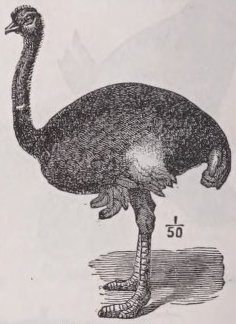
OSTRICH (Old English, Estridge∙, French, Autruche·, Spanish, Avestruz∙, Latin, Avis struthio). Among exotic birds there can be hardly one better known by report than the strange, majestic, and fleet-footed creature that “scorneth the horse and his rider,” or one that from the earliest times to the present has been oftener more or less fully described; and there must be few persons in any civilized country unacquainted with the appearance of this, the largest of living birds, whose size is not insignificant in comparison even with the mightiest of the plumed giants that of old existed upon the earth, since an adult male will stand nearly 8 feet in height, and weigh 300 B>....
As to the ways of the Ostrich in a state of nature, not much has been added of late years to the knowledge acquired and imparted by former travellers and naturalists, many of whom enjoyed opportunities that will never again occur of discovering its peculiarities, for even the most favourably-placed of their successors in recent years seem to content themselves with repeating the older observations, and to want either leisure or patience to make additions thereto, their personal acquaintance with the bird not amounting to more than such casual meetings with it as must inevitably fall to the lot of those who traverse its haunts. Thus there are still several dubious points in its natural history. On - the other hand we unquestionably know far more than our predecessors respecting its geographical distribution, which has been traced with great minuteness in the Vögel Ost-Afrikas of Drs Finsch and Hartlaub, who have therein given (pp. 597-607) the most comprehensive account of the bird that is to be found in the literature of ornithology. As with most birds, the Ostrich is disappearing before the persecution of man, and this fact it is which gives the advantage to older travellers, for there are many districts, some Qf wide extent, known to have been frequented by the Ostrich within the present century, especially towards the extremities of its African range— as on the borders of Egypt and the Cape Colony—in which it no longer occurs, while in Asia there is evidence, more or less trustworthy, of its former existence in most parts of the south-western desert-tracts, in few of which it is now to be found. Xenophon’s notice of its abundance in Assyria (Anabasis, i. 5) is well known. It is probable that it still lingers in the wastes of Kirwan in eastern Persia, whence examples may occasionally stray northward to those of Turkestan, even near the Lower Oxus; but the assertion, often repeated, as to its former occurrence in Baloochistan or Sindh, though not incredible, seems to rest on testimony as yet too slender for acceptance. Apparently the most northerly limit of the Ostrich’s ordinary range at the present day cannot be further than that portion of the Syrian Desert lying directly to the eastward of Damascus; and, within the limits of what may be. called Palestine, Canon Tristram (Fauna and Flora of Palestine, p. 139) regards it as but a straggler from central Arabia, though we have little information as to its appearance and distribution in that country. Africa, however, is still, as in ancient days, the continent in which the Ostrich most flourishes, and from the confines of Barbary to those of the European settlements in the south it appears to inhabit every waste sufficiently extensive to afford it the solitude it loves, and in many wide districts, where the influence of the markets of civilization is feebly felt, to be still almost as abundant as ever. Yet even there it has to contend with deadly foes in the many species of Carnivora which frequent the same tracts and prey upon its eggs and young—the latter especially; and Lichtenstein long ago remarked that if it were not for its numerous enemies “the multiplication of Ostriches would be quite unexampled.” The account given of the habits of the species by this naturalist, who had excellent opportunities of observing it during his three years’
travels in South Africa, is perhaps one of the best we have, and since his narrative has been neglected by most of its more recent historians we may do well by calling attention thereto. Though sometimes assembling in troops of from thirty to fifty, and then generally associating with zebras or with some of the larger antelopes, Ostriches commonly, and especially in the breeding season, live in companies of not more than four or five, one of which is a cock and the rest are hens. All the latter lay their eggs in one and the same nest, a shallow pit scraped out by their feet, with the earth heaped around to form a kind of wall against which the outermost circle of eggs rest. As soon as ten or a dozen eggs are laid, the cock begins to brood, always taking his place on them at nightfall surrounded by his wives, while by day they relieve one another, more it would seem to guard their common treasure from jackals and small beasts-of-prey than directly to forward the process of hatching, for that is often left wholly to the sun. Some thirty eggs are laid in the nest, and round it are scattered perhaps as many more. These last are said to be broken by the old birds to serve as nourishment for the newly-hatched chicks, whose stomachs cannot bear the hard food on which their parents thrive. The greatest care is taken by them not only to place the nest where it may not be discovered, but to avoid being seen when going to or from it, and their solicitude for their tender young is no less. Andersson in his Lake N , gami (pp. 253-269) has given a lively account of the pursuit by himself and Mr Francis Galton of a brood of Ostriches, in the course of which the father of the family flung himself on the ground and feigned being wounded to distract their attention from his offspring. Though the Ostrich ordinarily inhabits the most arid districts, it requires water to drink; more than that, it will frequently bathe, and sometimes even, according to Von Heuglin, in the sea.
The question whether to recognize more than one species of Ostrich, the Struthio camelus of Linnaeus, has been for some years agitated without leading to a satisfactory solution. It has long been known that, while eggs from North Africa present a perfectly smooth surface, those from South Africa are pitted (see Birds, vol. iii. p. 775, note 1). It has also been observed that northern birds have the skin of the parts not covered with feathers flesh-coloured, while this skin is bluish in southern birds, and hence the latter have been thought to need specific designation as S. australis. Still more recently examples from the Somali country have been described as forming a distinct species under the name of N. molybdophanes from the leaden colour of their naked parts.
The genus Struthio forms the type of one group of the Subclass Ratitae, which differs so widely from the rest, in points that have been concisely set forth by Prof. Huxley (Proc. Zool. Society, 1867, p. .419), as to justify us in regarding it as an Order, to which the name Struthiones may be applied (see Ornithology, p. 44); but that term, as well as Struthionidae, has been often used in a more general sense by systematists, even to signify the whole of the Ratitae, and hence for the present caution must be exercised as to whether certain fossil remains from the Sivalik formation, referred to “ Struthionidae," be regarded as true Ostriches or not. The most obvious distinctive character presented by the Ostrich is the presence of two toes only, the third and fourth, on each foot,—a character absolutely peculiar to the genus Struthio.
The great mercantile value of Ostrich-feathers, and the increasing difficulty, due to the causes already mentioned, of procuring them from wild birds, has led to the formation in the Cape Colony and elsewhere of numerous “Ostrich-farms,” on which these birds are kept in confinement, and at regular intervals of time deprived of their plumes. In favourable localities and with judicious management these establishments are understood to yield very considerable profit; while, as the ancient taste for wearing Ostrich-feathers shews no sign of falling off, but seems rather to be growing, it is probable that the practice will yet be largely extended.
Among the more important treatises on this bird may be mentioned :—E. D’Alton, Die Skelete der Straussartigen Vögel abgebildet und beschrieben, folio, Bonn, 1827; P. L. Sclater, “On the Struthious Birds living in the Zoological Society’s Menagerie,” Transactions, iv. p. 353, containing the finest representation (ph 67), by Air Wolf, ever published of the male Struthio camelus; Prof. Mivart, “On the Axial Skeleton of the Ostrich,” op. cit., viii. p. 385; Prof. Haughton, “On the Muscular Mechanism of the Leg of the Ostrich,” Ann. Nat. History, ser. 3, xv. pp. 262-272; and Prof. Macalister, “On the Anatomy of the Ostrich,” Proc. R. Irish Academy, ix. pp. 1-24.