
2. It is a dry scall even a leprosy on the head. Leviticus 13:30 .
Word of the Day: Catachrestical
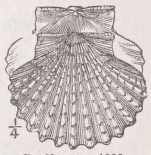
1. A shell fish, or rather a genus of shell fish, called pecten. The shell is bivalvular, the hinge toothless, having a small ovated hollow. The great scallop is rugged and imbricated with scales, grows to a large size, and in some countries is taken and barreled for market.
2. A recess or curving of the edge of any thing, like the segment of a circle; written also scallop
To mark or cut the edge or border of any thing into segments of circles.
1. Any one of numerous species of marine bivalve mollusks of the genus Pecten and allied genera of the family Pectinidae. The shell is usually radially ribbed, and the edge is therefore often undulated in a characteristic manner. The large adductor muscle of some the species is much used as food. One species (Vola Jacobaeus) occurs on the coast of Palestine, and its shell was formerly worn by pilgrims as a mark that they had been to the Holy Land. Called also fan shell. See Pecten, 2.
2. One of series of segments of circles joined at their extremities, forming a border like the edge or surface of a scallop shell.
3. One of the shells of a scallop; also, a dish resembling a scallop shell.
To mark or cut the edge or border of into segments of circles, like the edge or surface of a scallop shell. See Scallop, n., 2.
2. Having the edge or border cut or marked with segments of circles. See Scallop, n., 2.
One who fishes for scallops.
Fishing for scallops.
of Scallop
No thesaurus entries found for "scall".
King James Bible KJV Bible
Berean Standard Bible BSB Bible
9 KJV and 0 BSB verses contain “scall”
Then the priest shall see the plague: and, behold, if it be in sight deeper than the skin; and there be in it a yellow thin hair; then the priest shall pronounce him unclean: it is a dry scall, even a leprosy upon the head or beard.
the priest shall examine the infection, and if it appears to be deeper than the skin and the hair in it is yellow and thin, the priest must pronounce him unclean; it is a scaly outbreak, an infectious disease of the head or chin.
And if the priest look on the plague of the scall, and, behold, it be not in sight deeper than the skin, and that there is no black hair in it; then the priest shall shut up him that hath the plague of the scall seven days:
And in the seventh day the priest shall look on the plague: and, behold, if the scall spread not, and there be in it no yellow hair, and the scall be not in sight deeper than the skin;
And in the seventh day the priest shall look on the scall: and, behold, if the scall be not spread in the skin, nor be in sight deeper than the skin; then the priest shall pronounce him clean: and he shall wash his clothes, and be clean.
Then the priest shall look on him: and, behold, if the scall be spread in the skin, the priest shall not seek for yellow hair; he is unclean.
the priest is to examine him, and if the scaly outbreak has spread on the skin, the priest need not look for yellow hair; the person is unclean.
This is the law for all manner of plague of leprosy, and scall,
This is the law for any infectious skin disease, for a scaly outbreak,