
Series.
Word of the Day: Catachrestical
A large South American bird (Dicholophus, / Cariama cristata) related to the cranes. It is often domesticated. Called also cariama.
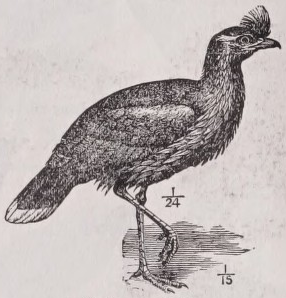
Seriema
Encyclopedia Britannica
SERIEMA, or Cariama, a South-American bird, sufficiently well described and figured in Marcgrave’s work (Hist. Per. Nat. Brasiliae, p. 203), posthumously published by De Laet in 1648, to be recognized by succeeding ornithologists, among whom Brisson in 1760 acknowledged it as forming a distinct genus Cariama, while Linnaeus regarded it as a second species of Palamedea (see Screamer, vol. xxi. p. 552), under the name of P. cristata, Englished by Latham in 1785 (Synopsis, v. p. 20) the “Crested Screamer,”—an appellation, as already observed, since transferred to a wholly different bird. Nothing more seems to have been known of it in Europe till 1803, when Azara published at Madrid his observations on the birds of Paraguay (Apuntamientos, No. 340), wherein he gave an account of it under the name of “Saria,” which it bore among the Guaranis,—that of “Cariama” being applied to it by the Portuguese settlers, and both expressive of its ordinary cry. It was not, however, until 1809 that this very remarkable form came to be autoptically described scientifically. This was done by the elder Geoffroy St Hilaire (Ann. du Muséum, xiii. pp. 362-370, pl. 26), who had seen a specimen in the Lisbon museum; and, though knowing it had already been received into scientific nomenclature, he called it anew Microdactylus marcgravii. In 1811 Illiger, without having seen an example, renamed the genus Dicholophus— a term which, as before stated (Ornithology, vol. xviii. p. 46, note 1), has since been frequently applied to it—placing it in the curious congeries of forms having little affinity which he called Alectorides. In the course of his travels in Brazil (1815-17), Prince Max of Wied met with this bird, and in 1823 there appeared from his pen (N. Act. Acad. L.-C. Nat. ...Curiosorum, xi. pt. 2, pp. 341-350, tab. xlv.) a very good contribution to its history, embellished by a faithful life-sized figure of its head. The same year Temminck figured it in the Planches Coloriées (No. 237). It is not easy to say when any example of the bird first came under the eyes of British ornithologists; but in the Zoological Proceedings for 1836 (pp. 29-32) Martin described the visceral and osteological anatomy of one which had been received alive the preceding year.
The Seriema, owing to its long legs and neck, stands some two feet or more in height, and in menageries bears itself with a stately deportment. Its bright red beak, the bare greenish blue skin surrounding its large yellow eyes, and the tufts of elongated feathers springing vertically from its lores, give it a pleasing and animated expression; but its plumage generally is of an inconspicuous ochreous grey above and dull white beneath,—the feathers of the upper parts, which on the neck and throat are long and loose, being barred by fine zigzag markings of dark brown, while those of the lower parts are more or less striped. The wing-quills are brownish black, banded with mottled white, and those of the tail, except the middle pair, which are wholly greyish brown, are banded with mottled white at the base and the tip, but dark brown for the rest of their length. The legs are red. The Seriema inhabits the campos or elevated open parts of Brazil, from the neighbourhood of Pernambuco to the Rio de la Plata, extending inland as far as Matto Grosso (long. 60°), and occurring also, though sparsely, in Paraguay. It lives in the high grass, running away in a stooping posture to avoid discovery on being approached, and taking flight only at the utmost need. Yet it builds its nest in thick bushes or trees at about a man’s height from the ground, therein laying two eggs, which Prof. Burmeister likens to those of the Land-Rail in colour. The young are hatched fully covered with grey down, relieved by brown, and remain for some time in the nest. The food of the adult is almost exclusively animal,—insects, especially large ants, snails, lizards, and snakes; but it also eats certain large red berries.
Until 1860 the Seriema was believed to be without any near relative in the living world of birds; but in the Zoological Proceedings for that year (pp. 334-336) Dr Hartlaub described an allied species discovered by Prof. Burmeister in the territory of the Argentine Republic. This bird, which has since been regarded as entitled to generic division under the name of Chunga burmeisteri (P.Z.S., 1870, p. 466, pl. xxxvi.), and seems to be known in its native country as the “Chunnia,” differs from the Seriema by frequenting forest or at least bushy districts. It is also darker in colour, has less of the frontal crest, shorter legs, a longer tail, and the markings beneath take the form of bars rather than stripes. In other respects the difference between the two birds seems to be immaterial.
There are few birds which have more exercised the taxonomer than this, and the reason seems to be plain. The Seriema must be regarded as the not greatly modified heir of some very old type, such as one may fairly imagine to have lived before many of the existing groups of birds had become differentiated. Looking at it in this light, we may be prepared to deal gently with the systematists who, having only the present before their eyes, have relegated it positively to this, that, or the other Order, Family, or other group of birds. There can be no doubt that some of its habits point to an alliance with the Bustard (vol. iv. p. 578) or perhaps certain Plovers (see Plover, vol. xix. p. 227), while its digestive organs are essentially, if not absolutely, those of the Heron (vol. xi. p. 760). Its general appearance recalls that of the Secretary-Bird (supra, p. 617); but this, it must be admitted, may be merely an analogy and may indicate no affinity whatever. On the one hand we have authorities, starting from bases so opposed as Prof. Parker (P.Z.S., 1863, p. 516) and Sundevall, placing it among the Accipitres, while on the other we have Nitzsch, Prof. Burmeister, Martin (ut supra), and Dr Gadow (Jourη. f. Ornithologie, 1876, pp. 445, 446) declaring in effect that this view of its affinities cannot be taken. Prof. Huxley has expressed himself more cautiously, and, while remarking (P.Z.S., 1867, p. 455) that in its skull “the internasal septum is ossified to a very slight extent, and the maxillo-palatine processes may meet in the middle line, in both of which respects it approaches the birds of prey,” adds that “the ossified part of the nasal septum does not unite below with the maxillo-palatines,” and that in this respect it is unlike the Accipitres; finally he declares (p. 457) that, as Otis connects the Geranornorplise with the Charadriomorphse, so Cariama connects the former with the Aetomorphse, “but it is a question whether these two genera may be better included in” the Geranomorphae, “or made types of separate groups.” (a. n.)
9th ed. Encyclopædia Britannica, vol. 21, p. 676
[1,184 words — estimated reading time: 7 minutes]
[1,184 words — estimated reading time: 7 minutes]
1. A continued succession in the things of the same order, and bearing the same relation to each other; as a series of kings; a series of successors.
2. Sequence; order; course; succession of things; as a series of calamitous events.
3. In natural history , an order or subdivision of some class of natural bodies.
4. In arithmetic and algebra , a number of terms in succession, increasing or diminishing in a certain ratio; as arithmetical series and geometrical series . [See Progression .]
1. A number of things or events standing or succeeding in order, and connected by a like relation; sequence; order; course; a succession of things; as, a continuous series of calamitous events.
2. Any comprehensive group of animals or plants including several subordinate related groups.
3. An indefinite number of terms succeeding one another, each of which is derived from one or more of the preceding by a fixed law, called the law of the series; as, an arithmetical series; a geometrical series.
Series
Encyclopedia Britannica
SERIES. A series is a set of terms considered as arranged in order. Usually the terms are or represent numerical magnitudes, and we are concerned with the sum of the series. The number of terms may be limited or without limit; and we have thus the two theories, finite series and infinite series. The notions of convergency and divergency present themselves only in the latter theory.
Finite Series.
1. Taking the terms to be numerical magnitudes, or say numbers, if there be a definite number of terms, then the sum of the series is nothing else than the number obtained by the addition of the terms; e.g., 4 + 9 + 10 = 23, 1 + 2 + 4 + 8 = 15. In the first example there is no apparent law for the successive terms; in the second example there is an apparent law. But it is important to notice that in neither case is there a determinate law: we can in an infinity of ways form series beginning with the apparently irregular succession of terms 4, 9, 10, or with the apparently regular succession of terms 1, 2, 4, 8. For instance, in the latter case we may have a series with the general term 2 n , when for n = 0,1, 2, 3, 4, 5 .. the series will be 1, 2, 4, 8, 16, 32, ..; or a series with the general term 1/6(n 3 + 5n + 6), where for the same values of n the series will be 1, 2, 4, 8, 15, 26, .. The series may contain negative terms, and in forming the sum each term is of course to be taken with the proper sign....
2. But we may have a given law, such as either of those just mentioned, and the question then arises, to find the sum of an indefinite number of terms, or say of n terms (n standing for any positive integer number at pleasure) of the series. The expression for the sum cannot in this case be obtained by actual addition; the formation by addition of the sum of two terms, of three terms, &c., will, it may be, suggest (but it cannot do more than suggest) the expression for the sum of n terms of the series. For instance, for the series of odd numbers l + 3 + 5 + 7 + ..., we have 1 = 1, 1 + 3 = 4, 1 + 3 + 5 = 9, etc. These results at once suggest the law, 1 + 3 + 5 ... + (2n - 1) = n 2 , which is in fact the true expression for the sum of n terms of the series; and this general expression, once obtained, can afterwards be verified.
3. We have here the theory of finite series: the general problem is, u n being a given function of the positive integer n, to determine as a function of n the sum u 0 + u 1 + u 2 ... + u n or in order to have n instead of n + 1 terms, say the sum u 0 + u 1 + u 2 . . + u n - 1 .
Simple cases are the three which follow.
(i.) The arithmetic series, a + (a + b) + (a + 2b).. + (a + n — 1) b ; writing here the terms in the reverse order, it at once appears that twice the sum is = 2a + n - 1 b taken n times: that is, the sum = na + ½(n - 1 ) b . In particular we have an expression for the sum of the natural numbers
1 + 2 + 3... + n = ½ n(n + 1), and an expression for the sum of the odd numbers 1 + 3 + 5 .. + (2 n -1) = n 2 .
(ii.) The geometric series, a + ar + ar 3 ... + ar n-1 ; here the difference between the sum and r times the sum is at once seen to be = a — ar n , and the sum is thus
1 - r n .
= Uj _ ~; in particular the sum of the series l+r + r 2 .. + r n-1 = ^-.
1 - r
(iii.) But the harmonic series,
111 1
— - “t“ ——— - I
a a + b α + 20'" α + (τι-l)0 ’
1,1.1 1 1 , . , or say ι÷2^b3∙ · ' + n ’ i * does not admit of summation; there is no algebraical function of n which is equal to the sum of the series.
4. If the general term be a given function u n , and we can find v n a function of n such that v,, +1 - v n = u n , then we have u 0 = v 1 - v 0 , u 1 = v 2 - v 1 , u 1 = v 3 ~v 9 ..u n = ‰ + ι - v n ; and hence τ∕ θ + u l + u 2 .. + u n = v n +ι - ⅛ 0 ,—an expression for the required sum. This is in fact an application of the Calculus of Finite Differences. In the notation of this calculus v n+l - v n is written ∆v n ; and the general inverse problem, or problem of integration, is from the equation of differences ∆v n = u n (where υ n is a given function of n) to find v n . The general solution contains an arbitrary constant, v n = V n + C ; but this disappears in the difference v n + 1 - v θ , As an example consider the series u o + u 1 ... + u n = 0 +1 + 3 .. + 1/2n(n +1); here, observing that n(n +1 )(τι + 2) - (n - 1 )n(n +1) = n(τι + l)(n+2 - ^∑T), = 3h(ti +1), we have v n +l = θn(7t +1 )(τt + 2); and hence 1+3 + 6. . + 1/2n(n + l)= 1/6n(n + l)(n + 2), as may be at once verified for any particular value of n.
Similarly, when the general term is a factorial of the order r, we have r+1 n(n + l).. (n + r-1) n(n + l).. (n + r)
+ ^^I 1.2^ 7. 1.2 .. (r + 1)
5. If the general term u n be any rational and integral function of n, we have
, ?i . ?i(?i —1) 0 nln- 1).. (?i-» + l) .p u n = «ο + j∆κ o + -1--J δ ⅛ 0 ... + 3 L e. where the series is continued only up to the term depending on p, the degree of the function u n , for all the subsequent terms vanish. The series is thus decomposed into a set of series which have each a factorial for the general term, and which can be summed by the last formula; thus we obtain
. ., (n + l)?i.
«0 + u 1 ... + u n = (?i +1 )u 0 + i-j—+- Δ1t 0 .. (n + l)>i(w-l). . (tt-j,+I )Λ
+ . 1 . 2. 3. . Qo+1) 0, which is a function of the degree p + 1.
Thus for the before-mentioned series l + 2 + 4 + 8+ .., if it be assumed that the general term u n is a cubic function of n, and writing down the given terms and forming the differences, 1, 2, 4, 8; 1, 2, 4; 1,2; 1, we have
M n = 1 + y + +*2 { = j(ra8 + 5n + 6 )> as above ); and the sum u 0 + u 1 . . + u n
(n + l> 1 (?! + l)?i(?i-l) 1 (n + l)n(n-l)(n-2)
— w +1 + j 2 + 123 " + ^ 1234 ’
= ?-(?i* + 2⅛ 3 +11?!® + 34?! + 24).
24
As particular cases we have expressions for the sums of the powers of the natural numbers—
l 2 + 2 2 ...+7i 2 = ^n(n+ l)(2τι + l)j l 3 + 2 3 .. + n 3 = |?i s (?t +1 ) 2 (observe that this = (1 + 2 ... + n ) 2 ); and so on.
6. We may, from the expression for the sum of the geometric series, obtain by differentiation other results:
i ι 1 —T^ ’ · thus 1+7- + ?· 3 . . .+7∙ n-1 = ς gives
1 -r
1 , n , o O , ∕ 1∖ 71-2 l-r n 1-7ir n-1 + (τt-l)r*
l+2r + 3∕". . + (τι-l)r =τ-; , = 7 z—⅛—' v z dr 1 -r (1 -r) 2 and we might in this way find the sum u 0 + n l r.. . + u tt r n , where u n is any rational and integral function of n.
7. The expression for the sum u 0 + u l . . . +«„ of an indefinite number of terms will in many cases lead to the sum of the infinite series u 0 + u- l .. .; but the theory of infinite series requires to be considered separately. Often in dealing apparently with an infinite series u 0 + u 1 + ... we consider rather an indefinite than an infinite series, and are not in any wise really concerned with the sum of the series or the question of its convergency: thus the equation
(1+w , + 5⅛Z‰ + . .)(1+ ^ + ⅛L<LV + ..) =i + < m+ .>+ ( -+")(∞÷"-υ j , + .. really means the series of identities (??i + 7t)= m + n
(?!! + 7l)(7Zl + 71 - 1 ) 77l(ni-l) ??! H 7l(>l-l)
Ï—2 1—2— + 1 Ï + ^^Ï— 2~’ &C '’ obtained by multiplying together the two series of the left-hand side. Again, in the method of generating functions we are concerned with an equation ψ(f) = √l θ + Λ 1 t... + A n t n + .., where the function φ(t) is used only to express the law of formation of the successive coefficients.
It is an obvious remark that, although according to the original definition of a series the terms are considered as arranged in a determinate order, yet in a finite series (whether the number of terms be definite or indefinite) the sum is independent of the order of arrangement.
Infinite series.
8. We consider an infinite series m 0 + u- i + u 2 + . . . of terms proceeding according to a given law, that is, the general term ‰ is given as a function of n. To fix the ideas the terms may be taken to be positive numerical magnitudes, or say numbers continually diminishing to zero; that is, u n >u n +ι, and u n is, moreover, such a function of n that by taking n sufficiently large u n can be made as small as we please.
Forming the successive sums >Sθ = u 0 , >S' 1 = ω θ + M 1 , *S' 2 = υ 0 + u l + u c ,, . . these sums λS , 0 , λS , 1 , *S ’ 2 .. . ’ will be a series of continually increasing terms, and if they increase up to a determinate finite limit *S' (that is, if there exists a determinate numerical magnitude $ such that by taking n sufficiently large we can make N - S n as small as we please) 0' is said to be the sum of the infinite series. To show that we can actually have an infinite series with a given sum *S ’, take m 0 any number less than >S ’, then *S' - w θ is positive, and taking u χ any numerical magnitude less than S - u 0 , then S -u 0 -u 1 is positive. And going on continually in this manner we obtain a series w θ + -w 1 + u 2 + . . . such that for any value of n however large >S' - «Q - ∙w 1 . . . — u n is positive; and if as n increases this difference diminishes to zero, we have m 0 + m 1 + -m 2 + . . . , —an infinite series having S for its sum. Thus, if s = 2, and we take u 0 <2, say u 0 = 1; u l <2 -1, say = -; u 2 <2
-1 -say ‰ = and so on, we have 1 +1 +1 + ... = 2; or, more generally, if r be any positive number less than
1, then 1 + r + r 2 + ... = that is, the infinite geometric series with the first term = 1, and with a ratio r<l, has the finite sum = . This in fact follows from
1 - r
1 — τ n the expression 1 + r + r 2 ... + r n ~ 1 = ∣—- for the sum of the finite series; taking r<l, then as n increases r n decreases to zero, and the sum becomes more and more neariy =
9. An infinite series of positive numbers can, it is clear, have a sum only if the terms continually diminish to zero; but it is not conversely true that, if this condition be satisfied, there will be a sum. For instance, in the case of the harmonic series 1 +~ + }, + .. . it can be shown that by taking a sufficient number of terms the sum of the finite series may be made as large as we please. F or, writing the series in the form 1 +’ + (i + i) + (j + 1 + 1 - + >) + . . , the number of terms in the brackets being doubled at each successive step, it is clear that the sum of the terms in any bracket is always > ∣; hence by sufficiently increasing the number of brackets the sum may be made as large as we please. In the foregoing series, by grouping the terms in a different manner 1 + (I + i) + Q + j + l + ∣) + .. j the sum of the terms in any bracket is always < 1; we thus arrive at the result that (n = 3 at least) the sum of 2 n terms of the series is > 1 + ~n and < n.
10. An infinite series may contain negative terms; suppose in the first instance that the terms are alternately positive and negative. Here the absolute magnitudes of the terms must decrease down to zero, but this is a suffi cient condition in order that the series may have a sum. The case in question is that of a series v 0 - v 1 -(- v 2 - . . , where v θ , v 1 , ι ’ 2 , . . are all positive and decrease down to zero. Here, forming the successive sums >S ’ θ = v θ , Λ' l = v 0 - ∙υ 1 , ∕S' 2 = v 0 - v 1 + v 2 , . . >S' θ , N 1 , S 2 , . . . are all positive, and we . have *S' 0 > <S' 1 , N 1 < S 2 , S 2 > *S' 3 , . . and N n+1 - sn tends continually to zero. Hence the sums *S r θ , *S' 1 , S 2 , . . tend continually to a positive limit S in such wise that >S' θ , >S 2 , *S 4 , . . . are each of them greater and N 1 , >S , 3 , S 5 , . . are each of them less than S ; and we thus have S as the sum 111
of the series. The series l-0 + sτ+ · · will serve as 2 o 4
an example. The case just considered includes the apparently more general one where the series consists of alternate groups of positive and negative terms respectively; the terms of the same group may be united into a single term ± v n , and the original series will have a sum only if the resulting series v 0 - v 1 + v 2 . . . has a sum, that is, if the positive partial sums v 0 , v 1 , v 2 ,. . decrease down to zero.
The terms at the beginning of a series may be irregular as regards their signs; but, when this is so, all the terms in question (assumed to be finite in number) may be united into a singL term, which is of course finite, and instead of the original series only the remaining terms of the series need be considered. Every infinite series whatever is thus substantially included under the two forms,—terms all positive and terms alternately positive and negative.
11. In brief, the sum (if any) of the infinite series ⅝ + w ι + ⅝+ · · is the finite limit, (if any) of the successive sums u 0 , Uq + u 1 , u 0 + u 1 + u 2 , . . .; if there is no such limit, then there is no sum. Observe that the assumed order u 0 , u 1 , u 2 . . . of the terms is part of and essential to the definition; the terms in any other order may have a different sum, or may have no sum. A series having a sum is said to be “convergent”; a series which has no sum is “divergent.”
If a series of positive terms be convergent, the terms cannot, it is clear, continually increase, nor can they tend to a fixed limit: the series 1 + 1 + 1 + . . is divergent. For the convergency of the series it is necessary (but, as has been shown, not sufficient) that the terms shall decrease to zero. So, if a series with alternately positive and negative terms be convergent, the absolute magnitudes cannot, it is clear, continually increase. In reference to such a series Abel remarks, “Peut-on imaginer rien de plus horrible que de débiter 0 = l m - 2 n +3 w - 4 w +, &c., où n est un nombre entier positif?” Neither is it allowable that the absolute magnitudes shall tend to a fixed limit. The so-called “neutral” series 1-1 + 1-1.. is divergent: the successive sums do not tend to a determinate limit, but are alternately + 1 and 0; it is necessary (and also sufficient) that the absolute magnitudes shall decrease to zero.
In the so-called semi-convergent series we have an equation of the form s — U o - U 1 + U 2 -.. ., where the positive values U o , U 1 , U 2 , . . . decrease to a minimum value, suppose U p , and afterwards increase; the series is divergent and has no sum, and thus S is not the sum of the series. N is only a number or function calculable approximately by means of the series regarded as a finite series terminating with the term ± U p . The successive sums U o , U o — U l , U o - U 1 + U 2 , . . up to that containing ± U p , give alternately superior and inferior limits of the number or function N.
12. The condition of convergency may be presented under a different form: let the series u 0 + u 1 + u 2 + . . be convergent, then, taking m sufficiently large, the sum is the limit not only of u 0 + u 1 +. . + u m but also of u 0 + 1ι l ... + u m+r , where r is any number as large as we please. The difference of these two expressions must therefore be in- definitely small; by taking m sufficiently large the sum ‰+ι + ‰+ 2 . . . . + tt nι +r (where r is any number however large) can be made as small as we please; or, as this may also be stated, the sum of the infinite series ‰+ι + m ot +2 ÷...
9th ed. Encyclopædia Britannica, vol. 21, p. 677 — signed A. C.
[6,058 words — estimated reading time: 35 minutes]
[6,058 words — estimated reading time: 35 minutes]
No thesaurus entries found for "serie".
No Bible verses found for "serie".