
Word of the Day: Catachrestical
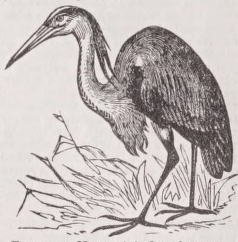
Any wading bird of the genus Ardea and allied genera, of the family Ardeidae. The herons have a long, sharp bill, and long legs and toes, with the claw of the middle toe toothed. The common European heron (Ardea cinerea) is remarkable for its directly ascending flight, and was formerly hunted with the larger falcons.
Heron
Encyclopedia Britannica
HERON, or Hero, a mathematician and natural philosopher of Alexandria, was the pupil of Ctesibius, and flourished probably about a century or a century and a half before Christ. His name has been preserved in the well-known experiment of Hero’s fountain, in which, by means of condensed air, water is made to spring from a jet in a continuous stream. Several of Heron’s writings are entirely lost, and of those that remain some have never been printed. His most valuable work is that on Pneumatics, in which are given his experiments on the elasticity of the air and of steam. His Mechanics and Barulcus treat of the subjects which would now be comprised in an elementary book on dynamics. At the end of his Cata-ρeltica or Belopoietica, which are probably the same, occurs Heron’s solution of the ancient and much discussed problem to find two mean proportionals between two given straight lines. Cheirobalistra, Cambestria, C amarica, Automata, are the titles of some of his other physical works. His mathematical works (see Hultsch’s Heroηis Alexandrini Geometricorum et Stereometricorum Reliquioe, Berlin, 1864) are very fragmentary, and it is difficult to determine whether several of them are not to be attributed to later and anonymous writers. Heron seems to have been the first to show how the area of a triangle maybe found from its three sides. See two papers by Vincent and Boncompagni in Bullettiηo di bibliogr. e di storia delle scienze matem. e fisiche, iv....
HERON, called the younger, to distinguish him from his namesake of Alexandria, was, like him, a mathematician and natural philosopher. By some he is supposed to have flourished in the first half of the 7th century a.d. ; by others, with more probability, to have lived at Constantinople in the 10th century. He wrote a treatise on Besieging Engines which still exists, and another on the Construction of Sun-dials, which is now lost. Some mathematical writings assigned to him should perhaps be referred to Heron the elder (see Mémoires Présentés à V Académie des Inscriptions, l ère série, tome iv., Paris, 1854).
9th ed. Encyclopædia Britannica, vol. 11, p. 760
[252 words — estimated reading time: 2 minutes]
[252 words — estimated reading time: 2 minutes]
Heron
Watson's Biblical & Theological Dictionary
אנפה, Lev. xi, 19; Deut. xiv, 18. This word has been variously understood. Some have rendered it the kite, others the woodcock, others the curlieu, some the peacock, others the parrot, and others the crane. The root, אנפ, signifies _to breathe short_ through the nostrils, _to snuff_, as in anger; hence to be angry; and it is supposed that the word is sufficiently descriptive of the heron, from its very irritable disposition. Bochart, however, thinks it the mountain falcon; the same that the Greeks call ἀνόπαια, mentioned by Homer; and this bears a strong resemblance to the Hebrew name.
Watson's Biblical & Theological Dictionary
[99 words — estimated reading time: 1 minute]
[99 words — estimated reading time: 1 minute]
A place where herons breed.
No thesaurus entries found for "Heron".
King James Bible KJV Bible
Berean Standard Bible BSB Bible
2 KJV and 2 BSB verses contain “Heron”