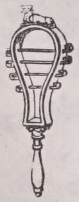
An instrument consisting of a thin metal frame, through which passed a number of metal rods, and furnished with a handle by which it was shaken and made to rattle. It was peculiarly Egyptian, and used especially in the worship of Isis. It is still used in Nubia.
SISTRUM, a kind of rattle used by the ancient Egyptians in religious ceremonies, especially in the worship of Isis. It consisted of a frame through which passed four rods; attached to the frame was a handle. When shaken the rods rattled and produced the sound. After the introduction of Egyptian worships into Italy the Romans became familiar with the sistrum. It is described by Apuleius (Metam., xi. 4). An ancient sistrum formerly existed in the library of Ste Geneviève at Paris. In paintings found at Portici a priest of Isis and a woman are represented rattling the sistrum. The instrument is said to be still in use in Nubia and Abyssinia.
9th ed. Encyclopædia Britannica, vol. 22, p. 102 [112 words — estimated reading time: 1 minute]
And David and all the house of Israel played before the LORD on all manner of instruments made of fir wood, even on harps, and on psalteries, and on timbrels, and on cornets, and on cymbals.
David and all the house of Israel were celebrating before the LORD with all kinds of wood instruments, harps, stringed instruments, tambourines, sistrums, and cymbals.
This site uses cookies to remember your display preferences (search sources and editions, Bible version, auto-link, images, light/dark theme). No personal data whatsoever is collected. Privacy Policy