
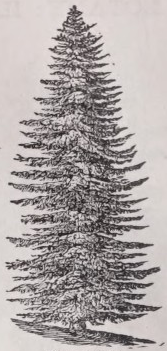
FIR, the name originally given by our Scandinavian forefathers to the Scotch piue (Pinus sylvestris), is at present not unfrequently employed as a general term for the whole of the true Conifers (Abietinae)·, but, in a more exact sense, it has been transferred to the “spruce” and “silver firs,” the genera Abies and Picea of most modern botanists.
The firs are distinguished from the pines and larches by having their needle-like leaves placed singly on the shoots, instead of growing in clusters from a sheath or abortive branch. Their cones are composed of thin, rounded, closely-imbricated scales, furnished in some species with bracts springing from the base. The trees have usually a straight trunk, and a tendency to a conical or pyramidal growth,—throwing out each year a more or less regular whorl of branches from the foot of the leading shoot, while the buds of the lateral boughs extend horizontally.
In the Spruce Firs (Abies), the cones are pendent when mature and their scales persistent; the leaves are arranged all round the shoots, though the lower ones are sometimes directed laterally. In the sub-genus Picea, the Silver Firs, the cones are erect, and their scales drop off when the seed ripens; the leaves are placed in distinct rows on each side of the shoot....
The most important of the firs, in an economic sense, is the Norway Spruce (Abies excelsa), so well known in British plantations, though rarely attaining there the gigantic height and grandeur of form it often displays in its native woods. Under favourable circumstances of growth it is a lofty tree, with a nearly straight, tapering trunk, throwing out in somewhat irregular whorls its wide-spreading branches, densely clothed with dark, clear green foliage. The boughs and their side-branches, as they increase in length, have a tendency to droop, the lower tier, even in large trees, often sweeping the ground,—a habit that, with the jagged sprays, and broad, shadowy, wave-like foliagemasses, gives a peculiarly graceful and picturesque aspect to the Norway spruce. The slender, sharp, slightly curved leaves are scattered thickly around the shoots; the upper ones pressed towards the stem, and the lower directed sideways, so as to give a somewhat flattened appearance to the individual sprays. The elongated, cylindrical cones grow chiefly at the ends of the upper branches; they are purplish at first, but become afterwards green, and eventually light brown; their scales are slightly toothed at the extremity; they ripen in the autumn, but seldom discharge their seeds until the following spring.
The tree is very widely distributed, growing abundantly on most of the mountain ranges of northern and central Europe; while in Asia it occurs at least as far east as the Lena, and in latitude extends from the Altaic ranges to beyond the Arctic circle. On the Swiss Alps it is one of the most prevalent and striking of the forest trees, its dark evergreen foliage often standing out in strong contrast to the snowy ridges and glaciers beyond. In the lower districts of Sweden it is the predominant tree in most of the great forests that spread over so large a portion of that country. In Norway it constitutes a considerable part of the dense woods of the southern dales, flourishing, according to Schübeler, on the mountain slopes up to an altitude of from 2800 to 3100 feet, and clothing the shores of some of the fjords to the water’s edge; in the higher regions it is generally mingled with the pine. Less abundant on the western side of the fjelds, it again forms woods in Nordland, extending in the neighbourhood of the coast nearly to the 67th parallel; but it is, in that arctic climate, rarely met with at a greater elevation than 800 feet above the sea, though in Swedish Lapland it is found on the slope of the ,Sulitelma as high as 1200 feet, its upper limit being everywhere lower than that of the pine. In all the Scandinavian countries it is known as the Gran or Grann. Great tracts of low country along the southern shores of the Baltic and in northern Russia are covered with forests of spruce. It everywhere shows a preference for a moist but well-drained soil, and never attains its full stature or luxuriance of growth upon arid ground, whether on plain or mountain—a peculiarity that should be remembered by the planter. In a favourable soil and open situation it becomes the tallest and one of the stateliest of European trees, rising sometimes to a height of from 150 to 170 feet, the trunk attaining a diameter of from 5 to 6 feet at the base. But when it grows in dense woods, where the lower branches decay and drop off early, only a small head of foliage remaining at the tapering summit, its stem, though frequently of great height, is rarely more than IJ or 2 feet in thickness. Its growth is rapid, the straight leading shoot, in the vigorous period of the tree, often extending 2£ or even 3 feet in a single season. In its native habitats it is said to endure for several centuries; but in those countries from which the commercial supply of its timber is chiefly drawn, it attains perfection in from 70 to 90 years, according to soil and situation.
In the most prevalent variety of the Norway spruce the wood is white, apt to be very knotty when the tree has grown in an open place, but, as produced in the close northern forests, often of fine and even grain. Immense quantités are imported into Britain from Norway, Sweden, and Prussia, under the names of “white Norway,” “Christiania,” and “Danzig deal.” The larger trees are sawn up into planks and battens, much used for the purposes of the builder, especially fcr flooring, joists, and rafters. Where not exposed to the weather, the wood is probably as lasting as that of the pine, but, not being so resinous, appears less adapted for out-door uses. Of late years great quantities have been sent from Sweden in a manufactured state, in the form of door and window-frames and ready-prepared flooring, and much of the cheap “white deal” furniture is made of this wood. The younger and smaller trees are remarkably durable, especially when the bark is allowed to remain on them; and most of the poles imported into Britain for scaffolding, ladders, miningtimber, and similar uses are furnished by this fir. Small masts and spars are often made of it, and are said to be lighter than those of pine. The best poles, according to Monteath, are obtained in Norway from small, slender, drawn-up trees, growing under the shade of the larger ones in the thick woods, these being freer from knots, and tougher from their slower growth. A variety of the spruce, abounding in some parts of Norway, produces a red heartwood, not easy to distinguish from that of the Norway pine (Scotch fir), and imported with it into England as “red deal” or “pine.” This kind is sometimes seen in plantations, where it may be recognized by its shorter, darker leaves, and longer cones. The smaller branches and the waste portion of the trunks, left in cutting up the timber, are exported as fire-wood, or used for splitting into matches, an industry that has lately sprung up in Sweden. Recently, the wood of the spruce has been employed in the manufacture of paper-stuff, being first reduced to a state of fine division, and then deprived of its resin by long boiling in alkaline solutions,—an application that will probably be considerably extended with the wider employment of paperpulp in the useful arts.
The resinous products of the Norway spruce, though yielded by the tree in less abundance than those furnished by the pine, are of considerable economic value. In Scandinavia a thick turpentine oozes from cracks or fissures in the bark, forming by its congelation a fine yellow resin, known commercially as “spruce rosin,” or “frankincense”; it is also procured artificially by cutting off the ends of the lower branches, when it slowly exudes from the extremities. In Switzerland and parts of Germany, where it is collected in some quantity for commerce, a long strip of bark is cut out of the tree near the root; the resin, that slowly accumulates during the summer, is scraped out in the latter part of the season, and the slit enlarged slightly the following spring to ensure a continuance of the supply. The process is repeated every alternate year, until the tree no longer yields the resin in abundance, which under favourable circumstances it will do for twenty years or more. The quantity obtained from each fir is very variable, depending on the vigour of the tree, and greatly lessens after it has been subjected to the operation for some years. Eventually the tree is destroyed, and the wood rendered worthless for timber, and of little value even for fuel. From the product so obtained most of the better sort of “Burgundy pitch” of the druggists is prepared. The resin collected from the fir is melted and boiled in water, then filtered through a sackcloth bag, and left to congeal in a cask beneath; nearly half the original amount of resin is obtained in this purified condition. Its chief employment is for plasters, much used in disorders of the chest and other complaints in which a mild stimulant to the skin is required. It is often applied in conjunction with the spruce-rosin itself and other ingredients. Much of the so-called Burgundy pitch of the shops is, according to Pereira, a compound of common rosin, palm oil, and water. By distillation with water the resin of the spruce yields oil of turpentine; but only a comparatively small quantity of that of commerce is obtained from this source, and it is considered inferior to that yielded by the pine and larch. By the peasantry of its native countries the Norway spruce is applied to innumerable purposes of daily life. The bark and young cones afford a tanning material, inferior indeed to oak-bark, and hardly equal to that of the larch, but of value in countries where substances more rich iu tannin are not abundant. In Norway the sprays, like those of the juniper, are scattered over the floors of churches and the sitting-rooms of dwelling-houses, as a fragrant and healthful substitute for carpet or matting. The young shoots are also given to oxen in the long winters of those northern latitudes, when other green fodder is hard to obtain. In times of scarcity the Norse peasant-farmer uses the sweetish inner bark, beaten in a mortar and ground in his primitive mill with oats or barley, to eke out a scanty supply of meal, the mixture yielding a tolerably palatable though somewhat resinous substitute for his ordinary flad∙brod. A decoction of the buds in milk or whey is a common household remedy for scurvy; and the young shoots or green cones form an essential ingredient in the spruce-beer drank with a similar object, or as an occasional beverage. The well-known “Danzig-spruce” is prepared by adding a decoction of the buds or cones to the wort or saccharine liquor before fermentation. Similar preparations are in use wherever the spruce fir abounds. The wood is burned for fuel, its heat-giving power being reckoned in Germany about onefourth less than that of beech. From the wide-spreading roots string and ropes are manufactured in Lapland and Bothnia: the longer ones which run near the surface are selected, split through, and then boiled for some hours in a ley of "wood-ashes and salt, which, dissolving out the resin, loosens the fibres and renders them easily separable, and ready for twisting into cordage. Light portable boats are sometimes made of very thin boards of fir, sewn together with cord thus manufactured from the roots of the tree.
The Norway spruce seems to have been the “Picea” of Pliny, but is evidently often confused by the Latin writers with their “Abies,” the Picea pectinata of modern botanists. From an equally loose application of the word “fir” by our older herbalists, it is difficult to decide upon the date of introduction of this tree into Britain; but it was commonly planted for ornamental purposes in the beginning of the 17th century. In places suited to its growth it seems to flourish nearly as well as in the woods of Norway or Switzerland; but as it needs for its successful cultivation as a timber tree soils that might be turned to agricultural account, it is not so well adapted for economic planting in Britain as the Scotch fir or larch, which come to perfection in more bleak and elevated regions, and on comparatively barren ground, though it may perhaps be grown to advantage on some moist hill-sides and mountain hollows. Its great value to the English forester is as a “nurse” for other trees, for which its dense leafage and tapering form render it admirably fitted, as it protects, without overshading, the young saplings, and yields saleable stakes and small poles when cut out. For hop-poles it is not so well adapted as the larch. As a picturesque tree, for park and ornamental plantation, it is among the best of the conifers, its colour and form contrasting yet harmonizing with the olive green and rounded outline of oaks and beeches, or with the red trunk and glaucous foliage of the pine. When young its spreading boughs form good cover for game. The fresh branches, with their thick mat of foliage, are useful to the gardener for sheltering wallfruit in the spring. In a good soil and position the tree sometimes attains an enormous size: one in Studley Park, Yorkshire, was, a few years back, nearly 140 feet in height, and the trunk more than 6 feet in thickness near the ground. The spruce bears the smoke of great cities better than most of the Abietinae; but in suburban localities after a certain age it soon loses its healthy aspect, and is apt to be affected with blight fEriosomà), though not so much as the Scotch fir and most of the pines.
The Black Spruce (.-16⅛s nigra) is a tree of more formal growth than the preceding. The branches grow at a more acute angle and in more regular whorls than those of the fir of Norway; and, though the lower ones become bent to a horizontal position, they do not droop, so that the tree has a much less elegant appearance. The leaves, which grow very thickly all round the stem, are short, nearly quadrangular, and of a dark greyish green. The cones, produced in great abundance, are short and oval in shape, the scales with rugged indented edges; they are deep purple when young, but become brown as they ripen. The tree abounds throughout New England, Nova Scotia, and all the countries around the St Lawrence, in Canada growing up to 65°,—in all these regions often forming a large part of the dense forests. A variety with lighter foliage and reddish bark is common in Newfoundland and some districts on the mainland adjacent. The trees usually grow very close together, the slender trunks rising to a great height bare of branches; but they do not attain the size of the Norway spruce, being seldom taller than 60 or 70 feet, with a diameter of 1⅜ or 2 feet at the base. This species prefers a peaty soil, and often grows luxuriantly in very moist situations. The wood is strong, light, and very elastic, forming an excellent material for small masts and spars, for which purpose the trunks are used in America, and exported largely to England. The sawn timber is inferior to that of A. excelsa, besides being of a smaller size. In the countries in. which it abounds, the log-houses of the settlers are often built of the long straight trunks. The spruce-beer of America is generally made from the young shoots of this tree. The small twigs, tied in bundles, are boiled for some time in water with broken biscuit or roasted grain; the resulting decoction is then poured into a cask with molasses, or maple sugar, and a little yeast, and left to ferment. It is often made by the settlers and fishermen of the St Lawrence countries, being esteemed as a preventive of scurvy. The American “essence of spruce,” occasionally used in England for making spruce-beer, is obtained by boiling the shoots and buds and concentrating the decoction. The resinous products of the tree are of no great value.
The White Spruce (Abies alba), sometimes met with in English plantations, is a tree of lighter growth than the black spruce, the branches bcihg more widely apart; the foliage is of α light glaucous green; the small light-brown cones are more slender and tapering than in A. nigra, and the scales have even edges. It is of comparatively small size, but is of some importance in the wilds of the Canadian dominion, where it is found further north than any other tree, growing up to at least 69°; the slender trunks yield the only useful timber of some of the more desolate northern regions. In the woods of Canada it occurs frequently, mingled with the black spruce and other trees. The fibrous tough roots, softened by soaking in water, and split, are used by the Indians and voyageurs to sew together the birch-bark covering of their canoes; and a resin that exudes from the bark is employed to varnish over the seams.
The Hemlock Spruce (A. canadensis) is a large tree, abounding in most of the north-eastern parts of America up to Labrador; in Lower Canada, New Brunswick, and Nova Scotia it is often the prevailing tree. The short leaves are flat, those above pressed close to the stem, and the others forming two rows; they are of a rather light green tint above, whitish beneath. The cones are very small, ovate, and pointed. The large branches droop, like those of the Norway spruce, but the sprays are much lighter and more slender, rendering the tree one of the most elegant of the conifers, especially when young. When old, the branches, broken and bent down by the winter snows, give it a ragged but very picturesque aspect. The trunk is frequently three feet thick near the base. The hemlock prefers rather dry and elevated situations, often forming woods on the declivities of mountains. The timber is very much twisted in grain, and liable to warp and split, but is used for making plasterers’ laths and for fencing; “shingles” for roofing are sometimes made of it. The bark, split off in May or June, forms one of the most valuable tanning substances in Canada. The sprays are sometimes used for making spruce-beer and essence of spruce.
The Douglas Spruce (A. Douglasü) is one of the finest trees of the genus, often rising to a height of 200 feet and sometimes considerably more, while the gigantic trunk frequently measures 8 or 10 feet across. The yew-like leaves spread laterally, and are of a deep green tint; the cones are furnished with tridentate bracts that project far beyond the scales. It forms extensive forests in Vancouver’s Island, British Columbia, and Oregon, whence the timber is exported, being highly prized for its strength, durability, and even grain, though very heavy; it is of a deep yellow colour, abounding in resin, which oozes from the thick bark. It was introduced into Britain soon after its discovery by Douglas, and has been planted in some parts of the kingdom experimentally, but does not appear to flourish well in the climate of England generally, though individual plants may be occasionally seen in good condition in ornamental shrubberies.
Of the Picea group, the Silver Fir (P. pectinata) may be taken as the type,—a lofty tree, rivalling the Norway spruce in size, with large spreading horizontal boughs curving upward towards the extremities. The flat leaves are arranged in two regular, distinct rows; they are deep green above, but beneath have two broad white lines, which, as the foliage in large trees has a tendency to curl upwards, give it a silvery appearance from below. The large cones stand erect on the branches, are cylindrical in shape, and have long bracts, the curved points of which project beyond the scales. When the tree is young the bark is of a silvery grey, but gets rough with age. This tree appears to have been the true “Abies” of the Latin writers—the “pulcherrima abies” of Virgil. From early historic times it has been held in high estimation in the south of Europe, being used by the Romans for masts and all purposes for which timber of great length was required. It is at present abundant in most of the mountain ranges of southern and central Europe, but is not found in the northern parts of that continent. In Asia it occurs on the Caucasus and Ural, and in some parts...
[4,085 words — estimated reading time: 25 minutes]
TREE, ברוש, occurs 2 Sam. vi, 5; 1 Kings v, 8, 10; vi, 15, 34; ix, 11; 2 Kings xix, 23; 2 Chron. ii, 8; iii, 5; Psalm civ, 17; Isaiah xiv, 8; xxxvii, 24; xli, 19; lv, 13; lx, 13; Ezek. xxvii, 5; xxxi, 8; Hosea xiv, 8; Nahum ii, 3; Zech. xi, 2. The LXX render it so variously as to show that they knew not what particular tree is meant; the Vulgate, generally by _abietes_, the “fir tree.” Celsius asserts that it is the cedar; but Millar maintains that it is the fir. The fir tree is an evergreen, of beautiful appearance, whose lofty height, and dense foliage, afford a spacious shelter and shade. The trunk of the tree is very straight. The wood was anciently used for spears, musical instruments, furniture for houses, rafters in building, and for ships. In 2 Sam. vi, 5, it is mentioned that David played on instruments of fir wood; and Dr. Burney, in his “History of Music,” observes, “This species of wood, so soft in its nature, and sonorous in its effects, seems to have been preferred by the ancients, as well as moderns, to every other kind for the construction of musical instruments, particularly the bellies of them, on which the tone of them chiefly depends. Those of the harp, lute, guitar, harpsichord, and violin, in present use, are always made of this wood.”
[235 words — estimated reading time: 2 minutes]
FIRDOUSÍ. Abu’ICásim Mansúr, who took the nom de 2slume of Firdousí, was a Persian poet of great eminence, and is chiefly known to European readers by his magnificent epic poem the Shahnamah, or “Book of Kings,” a complete history of Persia in nearly 60,000 verses. He was born at Shadab, a suburb of Tús, about the year 329 of the Hegira (941 a.d.). His father, Maulana Ahmed, son of Maulana Fakhr-ed-dín el Firdousí, belonged to the class of Dihkans (the old native country families and landed proprietors of Persia, who had preserved their influence and status under the Arab rule), and possessed an estate iu the neighbourhood of Tús. Firdousí’s own education eminently qualified him for the gigantic task which he subsequently undertook, for he was profoundly versed in the Arabic language and literature, and had also studied deeply the Pehlavi or Old Persian, and was conversant with the ancient historical records which existed in that tongue. As his history is intimately connected with that of the grand epic which he composed, it will be necessary to say a few words concerning the origin of the latter and the nature of the authorities from which it was compiled....
An epic poem, properly so called, is a collection of the ballads and songs, in which the memory of heroic deeds is always preserved in the earlier periods of a people’s history, thrown by the rhapsodists into a connected aud consecutive form. To become national and to take hold on the people’s hearts it must contain nothing but the genuine national legends and traditions, and must have grown spontaneously. Many attempts have been made by poets of different nations to create a national epic, but they have always failed for the lack of the elements above referred to. Homer’s Iliad and Virgil’s Aeneid are typical specimens of the real and spurious epic,—the former breathing in every line the true spirit of the Hellenic nation, and always rousing the national enthusiasm and appealing to the national feeling; the latter never having been regarded by the Latin race with any deeper feeling than that of admiration for its literary merits. The Shahnamah of Firdousí is perhaps the only exception of a poem produced by a single author, and at once taking its place as the national epic of the people. The nature of the work, the materials from which it was composed, and the circumstances under which it was written are, however, in themselves exceptional, and necessarily tended to this result. The grandeur and antiquity of the empire and the vicissitudes through which it passed, their long series of wars and the magnificent monuments erected by their ancient sovereigns, could not fail to leave numerous traces in the memory of so imaginative a people as the Persians.
As early as the 5th century of the Christian era we find mention made of these historical traditions in the work of an Armenian author, Moses of Khorene. During the reign of Naushirwan, the contemporary of Mahomet, and by order of that monarch, an attempt had been made to collect, from various parts of the kingdom, all the popular tales and legends relating to the ancient kings, and the results were deposited in the royal library. Under the last sovereign of the Sassanian dynasty, Yezdegird, the work was resumed, the former collection being revised and greatly added to by the Dihkan Danishwer, assisted by several learned mobeds. His work was entitled the Khodai-naméh, which in the old dialect also meant the “Book of Kings.” On the Arab invasion this work was in great danger of perishing at the hands of the iconoclastic caliph Omar and his generals, but it w as fortunately preserved; and we find it in the 2d century of the Hegira being paraphrased in Arabic by Abdallah ibn el Mokaffa, a learned Persian who had embraced Islam. Other Guebres occupied themselves privately with the collection of these traditions; and, when a prince of Persian origin, Yakúb ibn Leith, founder of the Soffaride dynasty, succeeded in throwing off his allegiance to the caliphate, he at once set about continuing the work of his illustrious predecessors. His “Book of Kings” was completed in the year 260 of the Hegira, and was freely circulated in Khorassan and Irak. Yakúb’s family did not continue long in power; but the Samanian princes, descendants of the Sassanians, who succeeded them, applied themselves zealously to the same work, and entrusted it to the poet Dakiki himself, a Guebre by religion. Dakiki’s labours were brought to a sudden stop by his own assassination, and the fall of the Samanian house happened not long after, and their kingdom passed into the hands of the Ghaznavides. Mahmúd ibn Sebuk-tagin, the second of the dynasty (667-1030 a.d.), continued to make himself still more independent of the caliphate than his predecessors, and, though a warrior and a fanatical Moslem, extended a generous patronage to Persian literature and learning, and even developed it at the expense of the Arabic institutions. The task of continuing and com pleting the collection of the ancient historical traditions of the empire especially attracted him. With the assistance of neighbouring princes and of many of the influential Dihkans, Mahmud collected a vast amount of materials for the work, and after having searched in vain for a man of sufficient learning and ability to edit them faithfully, and having entrusted various episodes for versification to the numerous poets whom he had gathered round him, he at length made choice of Firdousí. Firdousí had been always strongly attracted by the ancient Pehlavi records, and had begun at an early age to turn them into Persian epic verse. On hearing of the death of the poet Dakiki, he conceived the ambitious design of himself carrying out the work which the latter had only just commenced; and, although he had not then any introduction to the court, he contrived, thanks to one of his friends, Mohammed Lashkari, to procure a copy of the Dihkan Danishwer’s collection, and at the age of thirty-six commenced his great undertaking. Abu Mansour, the governor of Tús, patronized him and encouraged him by substantial pecuniary support. when Mahmud succeeded to the throne, and evinced such active interest in the work, Firdousí was naturally attracted to the court of Ghaznin. At first court jealousies and intrigues prevented Firdousí from being noticed by the sultan; but at length one of his friends, Mahek, undertook to present to Mahmud his poetic version of one of the well-known episodes of the legendary history. Hearing that the poet was born at Tús, the sultan made him explain the origin of his native town, and was much struck with the intimate knowledge of ancient history which he displayed. Being presented to the seven poets who were then engaged on the projected epic, Abu ’1 Cásim was admitted to their meetings, and on one occasion improvised a verse, at Mahmud’s request, in praise of his favourite Ayáz, with such success that the sultan bestowed upon him the name of Firdousí, saying that he had converted his assemblies into paradise (shirdoκs). During the early days of his sojourn at court, an incident happened which contributed in no small measure to the realization of his ambition. Three of the seven poets were drinking in a garden when Firdousí approached, and wishing to get rid of him without rudeness, they informed him who they were, and told him that it was their custom to admit none to their society but such us could give proof of poetical talent. To test his acquirements they proposed that each should furnish an extemporary line of verse, his own to be the last, and all three ending in the same rhyme. Firdousí accepted the challenge, and the three poets having previously agreed upon three rhyming words to which a fourth could not be found in the Persian language, ’Ansari began—
Thy beauty eclipses the light of the sun;
Farrakhi added—
The rose with thy oheek would comparison shun;
’Asjadi continued—
Thy glances pierce through the mailed warrior’s johsun; and Firdousí, without a moment’s hesitation, completed the quatrain—
Like the lance of fierce Giv in his fight with Poshun.
The poets asked for an explanation of this allusion, and Firdousí recited to them the battle as described in the Shah- nama l h, and delighted and astonished them with his learning and eloquence.
Mahmud now definitely selected him for the work of compiling and versifying the ancient legends, and bestowed upon him such marks of his favour and munificence as to elicit from the poet an enthusiastic panegyric, which is in serted in the preface of the Shahnam,ah, and forms a curious contrast to the bitter satire which he subsequently prefixed to the book. The sultan ordered his treasurer, Khojah Hasan Meimendi, to pay to Firdousí a thousand gold pieces for every thousand verses; but the poet preferred allowing the sum to accumulate till the whole was finished, with the object of amassing sufficient capital to construct a dike for his native town of Tús, which suffered greatly from defective irrigation, a project which had been the chief dream of his childhood. Owing to this resolution, and to the jealousy of Hasan Meimendi, who often refused to advance him sufficient for the necessaries of life, Firdousí passed the later portion of his life in great privation, though enjoying the royal favour and widely extended fame. Amongst other princes whose liberal presents enabled him to combat his pecuniary difficulties, was one Rustem, son of Fakhr ed dauleh, the Deilamite, who sent him a thousand gold pieces in acknowledgment of a copy of the episode of Rustem and Isfendiar which Firdousí had sent him, and promised him a gracious reception if he should ever come to his court. As this prince belonged, like Firdousí, to the Shiah sect, while Mahmud and Meimendi were Sunnites, and as he was also politically opposed to the sultan, Hasan Meimendi did not fail to make the most of this incident, and accused the poet of disloyalty to his sovereign and patron, as well as of heresy. Other enemies and rivals also joined in the attack, and for some time Firdousí’s position was very precarious, though his pre-eminent talents and obvious fitness for the work prevented him from losing his post. To add to his troubles he had the misfortune to lose his only son at the age of 37.
At length the book was completed, and Firdousí entrusted it to Ayáz, the sultan’s favourite, for presentation to him. Mahmud ordered Hasan Meimendi to take the poet as much gold as an elephant could carry, but the jealous treasurer persuaded the monarch that it was too generous a reward, and that an elephant’s load of silver would be sufficient. 60,000 silver dirhems were accordingly placed in sacks, and taken to Firdousí by Ayáz at the sultan’s command, instead of the 60,000 gold pieces, one for each verse, which had been promised. The poet was at that moment in the bath, and seeing the sacks, and believing that they contained the expected gold, received them with great satisfaction, but finding only silver he complained to Ayáz that he had not executed the sultan’s order. Ayáz related what had taken place between Mahmud and Hasan Meimendi, and Firdousí in a rage gave 20 thousand pieces to Ayáz himself, the same amount to the bath-keeper, and paid the rest to a beer seller for a glass of beer (fotιka), sending word back to the sultan that it was not to gain money that he had taken so much trouble. On hearing this message, Mahmud at first reproached Hasan with having caused him to break his word, but the wily treasurer succeeded in turning his master’s anger upon Firdousí to such an extent that he threatened that on the morrow he would “cast that Carmathian (heretic) under the feet of his elephants.” Being apprised by one of the nobles of the court of what had taken place, Firdousí passed the night in great anxiety; but passing in the morning by the gate that led from his own apartments into the palace, he met the sultan in his private garden, and succeeded by humble apologies in appeasing his wrath. He was, however, far from being appeased himself, and determined at once upon quitting Ghaznin. Returning home he tore up the draughts of some thousands of verses which he had composed and threw them in the fire, and repairing to the grand mosque of Ghaznin he wrote upon the walls, at the place where the sultan was in the habit of praying, the following lines :—
“The auspicious court of Mahmud, king of Zabulistαn, is like a sea. What a sea! One cannot see its shore. If I have dived therein without finding any pearls it is the fault of my star and not of the sea.”
He then gave a sealed paper to Ayáz, begging him to hand it to the sultan in a leisure moment after 20 days had elapsed, and set off on his travels with no better equipment than his staff and a dervish’s cloak. At the expiration of the 20 days Ayáz gave the paper to the sultan, who on opening it found the celebrated satire which is now always prefixed to copies of the Shahnamah, and which is perhaps one of the bitterest and severest pieces of reproach ever penned. Mahmud, in a violent rage, sent after the poet, and promised a large reward for his capture, but he was already in comparative safety. Firdousí directed his steps to Mazenderan, and took refuge with Kabous, prince of Jorján, who at first received him with great favour, and promised him his continued protection and patronage; leaning, however, the circumstances under which he had left Ghaznin, he feared the resentment of so powerful a sovereign as Mahmud, who he knew already coveted his kingdom, and dismissed the poet with a magnificent present. Firdousí next repaired to Baghdad, where he made the acquaintance of a merchant, who introduced him to the vizier of the caliph, El Cadet Billah, by presenting an Arabic poem which the poet had composed in his honour, The vizier gave Firdousí an apartment near himself, and related to the caliph the manner in which he had been treated at Ghaznin. The caliph summoned him into his presence, and was so much pleased with a poem of a thousand couplets, which Firdousí composed in his honour, that he at once received him into favour. The fact of his having devoted his life and talents to chronicling the renown of fire-worshipping Persians was, however, somewhat of a crime in the orthodox caliph’s eyes; in order, therefore, to recover his prestige, Firdousí composed another poem, of 9000 couplets, on the theme borrowed from the Koran of the loves of Joseph and Potiphar’s wife— Yúsuf and Zuleikha. This poem, though rare and little known, is still in existence—the Royal Asiatic Society possessing a copy. But Mahmud had by this time heard of his asylum at the court of the caliph, and wrote a letter menacing his liege lord, and demanding the surrender of the poet. Firdousí, to avoid further troubles, departed for Ahwaz, a province of the Persian Irak, and dedicated his Yúsuf and Zτdeikha to the governor of that district. Thence he went to Kυhistan, where the governor, Nasir Lek, was his intimate and devoted friend, and received him with great ceremony upon the frontier. Firdousí confided to him that he contemplated writing a bitter exposition of his shameful treatment at the hands of the sultan of Ghaznin; but Nasir Lek, who was a personal friend of the latter, dissuaded him from his purpose, but himself wrote and remonstrated with Mahmud. Nasir Lek’s message and the urgent representations of Firdousí’s friends had the desired effect; and Mahmud not only expressed his intention of offering full reparation to the poet, but put his enemy Meimendi to death. The change, however, came too late; lirdousí, now a broken and decrepit old man, had in the meanwhile returned to Tús, and, while wandering through the streets of his native town, heard a child lisping a verse from his own satire, in which he taunts Mahmud with his slavish birth :—
“Had. Mahmud’s father been what he is now A crown of gold had decked this aged brow; Had Mahmud’s mother been of gentle blood, In heaps of silver knee-deep had I stood.”
He was so affected by this proof of universal sympathy with his misfortunes that he went home, fell sick, and died. He was buried in a garden, but About Casim Gourgani, chief sheikh of Tús, refused to read the usual prayers over his tomb, alleging that he was an infidel, and had devoted his life to the glorification of fire-worshippers and misbelievers. The next night, however, having dreamt that he beheld Firdousí in paradise dressed in the sacred colour, green, and wearing an emerald crown, he reconsidered his determination; and the poet was henceforth held to be perfectly orthodox. He died in the year 411 of the Hegira (1020 A.D.),aged about eighty, eleven years after the completion of his great work. Mahmud had in the meanwhile despatched the promised hundred thousand pieces of gold to Firdousí, with a robe of honour and ample apologies for the past. But as the camels bearing the treasure reached one of the gates of the city, Firdousí’s funeral was leaving it by another. His daughter, to whom they brought the sultan’s present, refused to receive it; but, his aged sister remembering his anxiety for the construction of the stone embankment for the river of Tús, this work was completed in honour of the poet’s memory, and a large caravanserai built with the surplus.
The Shahnamah is based, as we have seen, upon the ancient legends current among the populace of Persia, and collected by the Dihkans, a class of men who had the greatest facilities for this purpose. There is every reason to believe that Firdousí adhered faithfully to these records of antiquity, and that the poem is a perfect storehouse of the genuine traditions of the country. Among much that is marvellous or incongruous, therefore, we may fairly look for the records of real events; and there is no doubt that, studied by the light of modern criticism, the volume will prove of great service and interest to future historians and ethnologists.
The entire poem has been published with a French translation in a magnificent folio edition, at the expense of the French Government, by the late learned and indefatigable Jules de Mold. The size and number of the volumes, however, and their great expense, make them difficult of access, while the original Persian, though easily procurable, is of course a sealed book to the majority of European readers. To supply this defect, Madame de Mohl has published in a cheap and convenient form the French translation, with her illustrious husband’s critical notes and introduction, This will henceforth be the standard work on the subject, containing as it does a résumé of everything that has ever been written on the Shahnamah, or which can elucidate its contents. It is published at the “Imprimerie Nationale,” Paris, under the title of Le Livre des Rois, par Λbou ’ l Kasim Firdousí, traduit et commenté par Jules Mohl, Membre de l ’ Institut, Professeur au College de France; publié par Mme. Mohl, Paris, 1876-7. (e. h. P.)
[3,326 words — estimated reading time: 20 minutes]
FIRE. So general is the knowledge of fire and its uses that it is a question whether we have any authentic instance on record of a tribe altogether ignorant of them. A few notices indeed are to be found in the voluminous literature of travel which would decide the question in the affirmative; but when they are carefully investigated, their evidence is found to be far from conclusive. The missionary Krapf was told by a slave of a tribe in the southern part of Shoa who lived like monkeys in the bamboo jungles, and were totally ignorant of fire; but no better authority has been found for the statement, and the story, which seems to be current in Eastern Africa, may be nothing else than the propagation of fables about the Pygmies whom the ancients located around the sources of the Nile. Commodore Wilkes, commander of the United States exploring expedition, says that in Fakaafo or Bowditch Island “there was no sign of places for cooking nor any appearance of fire,” and that the natives felt evident alarm at the sparks produced by flint and steel and the smoke emitted by those with cigars in their mouths. The presence of the word aft, fire, in the Fakaafo vocabulary supplied by Hales the ethnographer of the expedition, though it might perhaps be explained as equivalent only to solar light and heat, undoubtedly invalidates the commodore’s supposition; and the Rev. George Turner, in an account of a missionary voyage in 1859, not only repeats the word assi in his list for Fakaafo, but relates the native legend about the origin of fire, and describes some peculiar customs connected with its use. Alvaro de Saavedra, an old Spanish traveller, informs us that the inhabitants of Los Jardines, an island of the Pacific, showed great fear when they saw fire,—which they did not ...know before. But that island has not been identified with certainty by modern explorers. It belongs, perhaps, to the Ladrones or Marianas Archipelago, where fire was unknown, says Padre Gobien, “till Magellan, wroth at the pilferings of the inhabitants, burnt one of their villages. When they saw their wooden huts ablaze, their first thought was that fire was a beast which eats up wood. Some of them having approached the fire too near were burnt, and the others kept aloof, fearing to be torn or poisoned by the powerful breath of that terrible animal.” To this Freycinet objects that these Ladrone islanders made pottery before the arrival of Europeans, that they had words expressing the ideas of flame, fire, oven, coals, roasting, and cooking. Let us add that in their country numerous graves and ruins have been found, which seem to be remnants of a former culture. Thus the question remains in uncertainty: though there is nothing impossible in the supposition of the existence of a fireless tribe, it cannot be said that such a tribe has been discovered.
It is useless to inquire in what way man first discovered that fire was subject to his control, and could even be called into being by appropriate means. With the natural phenomenon and its various aspects he must soon have become familiar. The volcano lit up the darkness of night and sent its ashes or its lava down into the plains; the lightning or the meteor struck the tree, and the forest was ablaze; or some less obvious cause produced some less extensive ignition. For a time it is possible that the grand manifestations of nature aroused no feelings save awe and terror; but man is quite as much endowed with curiosity as with reverence or caution, and familiarity must ere long have bred confidence if not contempt. It is by no means necessary to suppose that the practical discovery of fire was made only at one given spot and in one given way; it is much more probable indeed that different tribes and races obtained the knowledge in a variety of ways. We still find in different parts of the world the natives taking advantage of hot springs, naphtha or petroleum wells, and accessible craters. In the island of Tanna, for instance, there is a mountain to the west of Port Resolution which abounds in evidence of its volcanic character—in fissures, steam-jets, hot-springs, &c. The inhabitants, says the Rev. George Turner, have not the slightest apprehension of danger; their settlements are arranged so that their murum or public square occupies one of the “hot places of the mountain; and there they lounge and enjoy the subterranean heat. Some of the springs reach the boiling point. Every day women may be seen cooking vegetables in artificial pits which form a series of never failing boiling pots. In some places the men or boys have only to stand on the rocks, spear their fish, and pitch them behind into the hot springs.” Similar accounts are given of the Maories in New Zealand, and the Negritos in the New Hebrides.
It has been asserted of many tribes that they would be unable to rekindle their fires if they were all allowed to die out. Travellers in Australia and Tasmania depict the typical native woman bearing always about with her a burning brand, which it is one of her principal duties to protect and foster; and it has been supposed that it was only ignorance which imposed on her the endless task. This, however i is not so certain; for Mr Miklucho Maclav remarks of the Papuans, whom he has closely studied, that though they know how to produce fire, they prefer to carry it about. It was one of the distinguishing marks of the Samoan noble that his fire was never permitted to go out; and his attendants had a special name from their business of watching it while he slept. In Corea the preservation of the ancestral fire is still regarded as of the first importance for the happiness of a family, and the same belief has had a very extensive sway in other parts of the world.
The methods employed for producing fire vary considerably in detail, but are for the most part merely modified applications of concussion or friction. Sir John Lubbock has remarked that the working up of stone into implements must have been followed sooner or later by the discovery of fire; for in the process of chipping sparks were elicited, and in the process of polishing heat was generated. The first or concussion method is still familiar in the flint and steel, which has hardly passed out of use even in the most civilized countries. Its modifications are comparatively few and unimportant. The Alaskans and Aleutians take two pieces of quartz, rub them well with native sulphur, strike them together till the sulphur catches fire, and then transfer the flame to a heap of dry grass over which a fevz feathers have been scattered. Instead of two pieces of quartz the Eskimos use a piece of quartz and a piece of iron pyrites. Mr Frederick Boyle saw fire produced by striking broken china violently against a bamboo, and Bastian observed the same process in Burmah, and Wallace in Ternate. In Cochin China two pieces of bamboo are considered sufficient, the silicious character of the outside layer rendering it as good as native flint The friction methods are more various. One of the simplest is what Mr Tylor calls the stick and groove—“a blunt pointed stick being run along a groove of its own making in a piece of wood lying on the ground.” Much, of course, depends on the quality of the woods and the expertness of the manipulator. In Tahiti Mr Darwin saw a native produce fire in a few seconds, but only succeeded himself after much labour. The same device was employed in New Zealand, the Sandwich islands, Tonga, Samoa, and the Radack. ' islands. Instead of rubbing the movable stick backwards and forwards other tribes make it rotate rapidly in a round hole in the stationary piece of wood—thus making what Mr Tylor has happily designated a fire-drill. This device has been observed in Australia, Kamchatka, Sumatra, and the Carolines, among the Veddahs of Ceylon, throughout a great part of Southern Africa, among the Eskimo and Indian tribes of North America, in the West Indies, in Central America, and as far south as the Straits of Magellan. It was also employed by the ancient Mexicans, and Mr Tylor gives a quaint picture of the operation from a Mexican MS.,—aman half kneeling on the ground is causing the stick to rotate between the palms of his hands. This simple method of rotation seems to be very generally in use; but various devices have been resorted to for the purpose of diminishing the labour and hastening the result. The Gaucho of the Pampas takes “an elastic stick about 18 inches long, presses one end to his breast and the other in a hole in a piece of wood, and then rapidly turns the curved part like a carpenter’s centre-bit” In other cases the rotation is effected by means of a cord or thong wound round the drill and pulled alternately by this end and that. In order to steady the drill the Eskimo and others put the upper end in a socket of ivory or bone which they hold firmly in their mouth. A further advance was made by some of the North American Indians, who appear to have applied the principle of the bow-drill; and the still more ingenious pump-drill was used by the Iroquois Indians. For full descriptions of these instruments and a rich variety of details connected with fire-making we must refer the reader to Mr Tylor’s valuable chapter in his Rc∙ searches. These methods of producing fire are but rarely used in Europe, and only in connexion with superstitious observances. We read in Wuttke that some time ago the authorities of a Mecklenburg village ordered a “wild fire " to be lit against a murrain amongst the cattle. For two hours the men strove vainly to obtain a spark, but the fault was not to be ascribed to the quality of the wood, or to the dampness of the atmosphere, but to the stubbornness of an old lady, who, objecting to the superstition, would not put out her night lamp; such a fire, to be efficient, must burn alone. At last the strong-minded female was compelled to give in; fire was obtained,—but of bad quality, for it did not stop the murrain.
It has long been known that the rays of the sun might be concentrated by a lens or concave mirror. Aristophanes mentions the burning-lens in The Clouds, and the story of Archimedes using a mirror to fire the ships at Syracuse is familiar to every schoolboy. If Garcilasso de la Vega can be trusted as an authority, the Virgins of the Sun in Peru kindled the sacred fire with a concave cup set in a great bracelet. In China the burning-glass is in common use.
To the inquiry how mankind became possessed of fire, the cosmogonies, those records of pristine speculative thought, do not give any reply which would not be found in the relations of travellers and historians.
They say in the Tonga Islands that the god of the earthquakes is likewise the god of fire. At Mangala it is told that the great Maui went down to hell, where he surprised the secret of making fire by rubbing two pieces of wood together. The Maoris tell the tale differently. Maui had the fire given to him by his old blind grandmother, Mahuika, who drew it from the nails of her hands. Wishing to have a stronger one, he pretended that it had gone out, and so he obtained fire from her great toe. It was so fierce that every thing melted before the glow; even Maui and the grandmother herself were already burning when a deluge, sent from heaven, saved the hero and the perishing world; but before the waters extinguished all the blaze, Mahuika shut a few sparks into some trees, and thence men draw it now. The Maories have also the legend that thunder is the noise of Tawhaki’s footsteps, and that lightnings flash from his armpits. At Western Point, Victoria, the Australians say the good old man Pundyil opened the door of the sun, whose light poured then on earth, and that Karakorok, the good man’s good daughter, seeing the earth to be full of serpents, went everywhere destroying serpents; but before she had killed them all, her staff snapped in two, and while it broke, a flame burst out of it. Here the serpent-killer is a fire-bringer. In the Persian Shahnainah also fire was discovered by a dragon-fighter. Hushenk, the powerful hero, hurled at the monster a prodigous stone, which, evaded by the snake, stfuck a rock and was splintered by it. ‘ ‘ Light shone from the dark pebble, the heart of the rock flashed out in glory, and fire was seen for the first time in the world.” The snake escaped, but the mystery of fire had been revealed.
North American legends narrate how the great buffalo, careering through the plains, makes sparks flit in the night, and sets the prairie ablaze by his hoofs hitting the rocks. We meet the same idea in the Hindu mythology, which conceives thunder to have been, among many other things, the clatter of the solar horses on the Akmon or hard pavement of the sky. The Dakotas claim that their ancestor obtained fire from the sparks which a friendly panther struck with its claws, as it scampered upon a stony hill.
Tohil, who gave the Quiches fire by shaking his sandals, was, like the Mexican Quetzelcoatl, represented by a flint stone. Gua-mansuri, the father of the Peruvians, produced the thunder and the lightning by hurling stones with his sling. The thunderbolts are his children. Kudai, the great god of the Altaian Tartars, disclosed “the secret of the stone’s edge and the iron’s hardness.” The Slavonian god of thunder was depicted with a silex in his hand, or even protruding from his head. The Lapp Tiennes struck with his hammer upon his own head; the Scandinavian Thor held a mallet in one hand, a flint in the other. Taranis, the Gaul, had upon his head a huge mace sun ’ ounded by six little ones. Finnish poems describe how “fire, the child of the sun, came down from heaven, where it was rocked in a tub of yellow copper, in a large pail of gold.” Ukko, the Esthonian god, sends forth lightnings, as he strikes his stone with his steel. According to the Kalewala, the same mighty Ukko struck his sword against his nail, and from the nail issued the “fiery babe.” He gave it to the Wind’s daughter to rock it, but the unwary maiden let it fall in the sea, where it was swallowed by the great pike, and fire would have been lost for ever, if the child of the sun had not come to the rescue. He dragged the great pike from the water, drew out his entrails, and found there the heavenly spark still alive. Hephaestus also, the Greek fire god, fell from heaven into the sea of Lemnos. Prometheus brought to earth the torch he had lighted at the sun’s chariot.
Human culture may be said to have begun with fire, of which the uses increased in the same ratio as culture itself. To save the labour expended on the initial process of procuring light, or on carrying it about constantly, primitive men hit on the expedient of a fire which should burn night and day in a public building. The Egyptians had one in every temple, the Greeks, Latins, and Persians in all towns and villages. The Natchez, the Mexicans, the Mayas, the Peruvians, had their “national fires” burning upon large pyramids. Of these fires the “eternal lamps” in the synagogues, in the Byzantine and Catholic churches, may be a survival. The “Regia,” Rome’s sacred centre, supposed to be the abode of Vesta, stood close to a fountain; it was convenient to draw from the same spot the two great requisites, fire and water. All civil and political interests grouped themselves around the Prytaneion which was at once a temple, a tribunal, a town-hall, and a gossiping resort; all public business and most private affairs were transacted by the light and in the warmth of the common fire. No wonder that its flagstones should become sacred. Primitive communities consider as holy everything that ensures their existence and promotes their welfare, material things such as fire and water not less than others. Thus the Prytaneion grew into a religious institution. And if we hear a little more of fire worship than of water worship, it is because fire, being on the whole more difficult to obtain, was esteemed more precious.
We have curious and concordant testimonies that the principal functions of the state itself grew out of the care which was bestowed on the tribal fire. The men who attended it in Hellas were called the Prytanes. They had to eat together, and it would have been considered as a bad omen if they had neglected that duty. They were fed at the public expense; and well they might be, for having been, probably, general cooks at the outset, they became, when the city was established, Archontes or magistrates, and even Basileis, or a combination of the captain, the priest, and the king. Thus the first guardians of the tribal fire were the earliest public servants, who by degrees appropriated all important offices, as the state itself developed into a vast aggregation of interests. And when Augustus usurped the Roman empire, he assumed all the powers which a pristine board of flamens, or of Prytanes, may have possessed. He made himself Pontifex Maximus, and assumed the charge of the public fire; and on transporting it to his own palace, he had to convert it into public property. The Hellenic nations, as well as the Aztecs, received ambassadors in their temples of fire, where, as at the national hearth, they feasted the foreign guests. The Prytaneion and the state were convertible terms. If by chance the fire in the Roman temple of Vesta was extinguished, all tribunals, all authority, all public or private business, had to stop immediately. The connexion between heaven and earth had been broken, and it had to be restored in some way or other,—either by Jove sending down divine lightning on his altars, or by the priests making a new fire by the old sacred method of rubbing two pieces of wood together, or by catching the rays of the sun in a concave mirror. No Greek or Roman army crossed the frontier without carrying an altar where the fire taken from the Prytaneion burned night and day. When the Greeks sent out colonies the emigrants took with them living coals from the altar of Hestia, and had in their new country a fire lit as a representative of that burning in the mother country. Not before the three curiae united their fires into one could Rome become powerful; and Athens became a shining light to the world only, we are told, when the twelve tribes of Attica, led by Theseus, brought each its brand to the altar of Athene Polias. All Greece confederated, making Delphi its central hearth; and the islands congregated around Delos, whence the new fire was fetched every year.
According to a not impossible theory, all architecture, public and private, sacred and profane, began with the erection of sacred sheds to protect the sacred fire, which abodes men dared to inhabit only after a length of time. For it must be borne in mind that fire was looked upon as a divinity. We are expressly told that Vesta had no image or statue even in her own temple, the Vestal fire being considered as the very goddess herself. The husbandmen who ate their repast before the hearth believed, as Ovid relates, that they sat in the presence of the gods themselves. The hearth fire was kept holy, its flame was to remain bright and pure. The minute and irksome prescriptions of the Zend-Avesta carried this feeling to the extreme: it was and it is still a widely spread belief that nothing unclean is to be thrown in the fire, that no indecent actions are to be committed before it. To spit in one’s fire would be now considered in many places, in Albania, for example, as an unpardonable offence. The Galtchas of Ferghana, according to Μ. de Ujfalvy, are so reverential that they would not blow out a light lest they should render the flame impure with their breath; and a similar peculiarity was observed by Wood in Badakshan and by Khanikoff among the Tadjiks of Bokhara.
In the course of time, the same reasons which made the tribe provide itself with a permanent...
[6,657 words — estimated reading time: 40 minutes]
God hath often appeared in fire, and encompassed with fire, as when he showed himself in the burning bush; and descended on Mount Sinai, in the midst of flames, thunderings, and lightning, Exodus iii, 2; xix, 18. Hence fire is a symbol of the Deity: “The Lord thy God is a consuming fire,” Deut. iv, 24. The Holy Ghost is compared to fire: “He shall baptize you with the Holy Ghost and with fire,” Matt. iii, 11. To verify this prediction, he sent the Holy Ghost, which descended upon his disciples, in the form of tongues, or like flames of fire, Acts ii, 3. It is the work of the Holy Spirit to enlighten, purify, and sanctify the soul; and to inflame it with love to God, and zeal for his glory. Fire from heaven fell frequently on the victims sacrificed to the Lord, as a mark of his presence and approbation. It is thought, that God in this manner expressed his acceptance of Abel’s sacrifices, Gen. iv, 4. When the Lord made a covenant with Abraham, a fire like that of a furnace passed through the divided pieces of the sacrifices, and consumed them, Gen. xv, 17. Fire fell upon the sacrifices which Moses offered at the dedication of the tabernacle, Lev. ix, 24; and upon those of Manoah, Samson’s father, Judges xiii, 19, 20; upon Solomon’s, at the dedication of the temple, 2 Chron. vii, 1; and on Elijah’s, at Mount Carmel, 1 Kings xviii, 38. The fire which came down from heaven, first upon the altar in the tabernacle, and afterward descended anew upon the altar in the temple of Solomon, at its consecration, was there constantly fed and maintained by the priests, day and night, in the same manner as it had been in the tabernacle. The Jews have a tradition, that Jeremiah, foreseeing the destruction of the temple, took this fire and hid it in a pit; but that at the ...rebuilding of the temple, being brought again from thence, it revived upon the altar. But this is a fiction: and the generality of them allow, that, at the destruction of the temple, it was extinguished: and in the time of the second temple, nothing was made use of for all their burnt offerings but common fire only. The ancient Chaldeans adored the fire, as well as the old Persians, and some other people of the east. The torments of hell are described by fire, both in the Old and New Testament. Our Saviour makes use of this similitude, to represent the punishment of the damned, Mark ix, 44. He likewise speaks frequently of the eternal fire prepared for the devil, his angels, and reprobates, Matt. xxv, 41. The sting and remorse of conscience is the worm that will never die; and the wrath of God upon their souls and bodies, the fire that shall never go out. There are writers who maintain, that by the worm is to be understood a living and sensible, not an allegorical and figurative, worm; and by fire, a real elementary and material fire. Among the abettors of this opinion are Austin, Cyprian, Chrysostom, Jerom, &c. The word of God is compared to fire: “Is not my word like a fire?” Jer. xxiii, 20. It is full of life and efficacy; like a fire it warms, melts, and heats; and is powerful to consume the dross, and burn up the chaff and stubble. Fire is likewise taken for persecution, dissension, and division: “I am come to send fire on earth,” Luke xii, 49; as if it was said, upon my coming and publishing the Gospel, there will follow, through the devil’s malice and corruption of men, much persecution to the professors thereof, and manifold divisions in the world, whereby men will be tried, whether they will be faithful or not.
[641 words — estimated reading time: 4 minutes]
FIRE-CLAY, FIRE-BRICKS. Fire-clays may be defined as native combinations of hydrated silicates of alumina, mechanically associated with silica and alumina in various states of subdivision, and sufficiently free from silicates of the alkalies and from iron and lime to resist vitrification at high temperatures; the absence of the vitrifiable element is, however, merely a question of degree, as no native clays are wholly free from iron, the alkalies, lime, and the other alkaline earths.
Fire-clay may be looked upon as a special term for the grey clays of the Coal-Measures, interstratified with, and generally in close proximity to, the seams of coal, in beds varying from a few inches to many yards in thickness. They are locally known as “clunches” and “underclays,” and are supposed to represent the soil that produced the vegetation from which the coal was formed.
The association of coal with the fire-clays of the carboniferous formation has localized the manufacture of firebricks, and by far the larger proportion are produced in the Coal-Measure districts, especially at Stourbridge, celebrated for producing a highly refractory brick, Broseley, Benthall, Madeley and Coalbrookdale in the Shropshire coal-field, and in the Midland, Yorkshire, North and South Wales, Durham, and the Scotch coal-fields; but in later years the area of fire-brick manufacture has much widened. There has been an extensive production since about 1850 from the Eocene clays in the neighbourhood of Poole and Wareham in Dorsetshire; and a more limited supply from the Miocene between Bovey Tracey and Newton Abbot in Devonshire....
Still more recently Cornwall has become the seat of the manufacture, where, as at Calstock, Tregoning Hill near Breage, St Ednor near St Columb, and Lee Moor, fire-bricks of fine quality are made from china-clay refuse and disintegrated granite. Mr Argall of the Tregoning Hill Company states that the locality was one of the first seats of china-clay mining between the years 1730 and 1750, and that in 1862 the present company commenced to make fire-bricks and tiles from the refuse of the clays, taking about two-thirds of silica and one-third of mica, which are mixed together in a pug mill, moulded and burnt in round ovens holding about 16,000 bricks, and that a very superior fire-brick is made from clay direct from the “stopes,” containing [table]
which are employed by founders, smelters, gas companies, &c. The price paid at the works is from 50s. to 55s. per 1000. The source of the materials is decomposed granite, of which Tregoning Hill consists.
The Hingston Down fire-clay deposit, near Calstock, supplying the Calstock fire-brick works, the Phaenix works, and the Tamar works in the same neighbourhood, consists of a range of decomposed granite with an average width of three-quarters of a mile, running east and west for 3 or 4 miles, extending to an ascertained depth of from 300 to 400 feet, and intersected by mineral lodes. The Calstock Fire-Brick Company (limited), superintended by Mr C. B. Evate, commenced operations in the year 1870, and manufactured from the decomposed granite fire-bricks of a highly refractory character, which are delivered free on board at the port of Calstock at from 50s. to 60s. a thousand, weighing about 3¾ tons. Another source of firebrick material, scarcely yet developed, is the pockets or depressions occurring in the mountain limestone of North Wales, Derbyshire, and Ireland, containing white refractory clays and sands, the insoluble remnants from the local dissolution of the limestone, intermixed with the debris of the overlying millstone grit. These clays and sands when evenly mingled are sufficiently adhesive to k be moulded, and their small contractility and highly refractory character render them pre-eminently suitable for fire-brick manufacture. Fire-brick works have already been established on the estate of Captain Cooke of Colomendy Hall, near Mold, and the refractory clays and sands are largely employed for lining furnaces, 3000 tons having been sold for this purpose alone in the year 1877.
The fire-clays of the Coal-Measures vary as regards their refractory character, not only in the different coal-fields, but the individual strata in close alternation often present sudden variations, refractory beds being interstratified with useless strata largely charged with disseminated carbonate of iron. The grey colour of the Coal-Measure clays is partially due to the presence of this mineral, which, whether disseminated through the mass or otherwise occurring in excess as concretionary nodules, is prejudicial to the clays as a material for fire-bricks. Carbonaceous matter is also present in variable proportions, colouring the clay from a slaty-black to a pale grey, but as this is eliminated in the earlier stages of the burning of the bricks, its presence in no way influences their refractory character.
The relative proportion of silica and alumina which some manufacturers have laid undue stress upon as indicating heat-resisting quality is of little moment, as both these constituents, whether occurring in combination as silicates of alumina, or as free alumina and silica, are essentially the refractory elements of all good fire-bricks, being unvitrifiable per se, excepting when associated with the alkalies, lime, or oxides of iron. The plastic character of refractory clays is also of limited influence on their suitability for fire-brick manufacture; extreme plasticity, which is generally accompanied by excessive contractility and vitrifiability, is prejudicial. As a rule few clays or materials used in the manufacture of fire-bricks are insufficiently plastic to prevent their being easily moulded, and in the manufacture by the dry process, or the compression of the brick out of nearly dry pulverized clay, plasticity is not so essential a quality. As regards chemical composition the following analyses indicate its general character, and the variability of the proportion of the constituents of some of the more important fire-clays :— [table]
The above analyses indicate a preponderance of silica in the Coal-Measure fire-clays compared with the Tertiary clays of Devon and Dorset, in which a larger proportion of alumina occurs. The latter character is accompanied by tenacity and plasticity, and greater contraction in drying and burning, which, when excessive, is counteracted by mingling with the clay sand and ground burnt clay or sherds.
Contractility.— The contraction in burning (excluding the contraction in drying) of several Coal-Measure fire-clays pressed out of nearly dry pulverized clay was ascertained by the writer to be as follows:— [table]
The average contraction of the Coal-Measure fire-clays is thus little over two per cent. A brick manufactured from the best Stourbridge clay without admixture of burnt material contracted seven-eighths of an inch in nine inches, but this would probably represent the contraction both in drying and burning. The contraction in burning of the Tertiary fire-clays used for the manufacture of fire-bricks in Devon and Dorset is much more than that of the Coal Measure clays [table]
The clays above enumerated are not exclusively used for fire-brick manufacture, but fairly indicate the general character of the Tertiary fire-brick clays, which, compared with the Coal-Measure fire-clays, are characterized by a preponderance of alumina, tenacity of texture, contractility in the kiln, and an absence of iron and the alkalies, <fcc., which tend to vitrification. Tenacity of texture in a fire-brick material is, however, a mechanical condition, which, caeteris paribus, assists vitrification, a coarse open body being more refractory than a close homogeneous brick of similar chemical composition. A well manufactured brick should be of a pale cream or clear buff colour, uniform throughout its mass, and burnt to the full extent of its contractility.
The chemical changes which take place in the burning consist, first, of the destruction of the disseminated carbonaceous matter, the dehydration of the silicates of alumina, destroying their plastic character, and the decomposition of the disseminated carbonate of protoxide of iron, converting it into anhydrous sesquioxide, to which the yellow colour of the burnt brick is due; if the burning is carried to a high state of vitrification the yellow tint is replaced by a dull grey, due to the partial reduction of the sesquioxide of iron and its conversion into silicate of protoxide or minutely disseminated particles of metallic iron; any alkalies present also form vitreous combinations with the silica during the latter stages of the burning. The paleness of colour of a fire-brick is not always a safe indication of the absence of iron, as the presence of a large proportion of carbonaceous matter in the clay tends to bleaching by the reduction of the colouring sesquioxidc to a lower oxide preserved as a silicate in a comparatively colourless condition. Again, the presence of lime and the other alkaline earths, which are disadvantageous fluxing elements, will cloak the colouring power of a large pér-centage of oxide of iron by the formation of a pale double silicate of lime and iron. This is taken advantage of in the manufacture of buff building bricks by mixing ground chalk with ferruginous clays which would otherwise burn dark red.
A properly burnt brick, uniform in colour throughout its mass, can only be obtained by slow progressive firing; a broken brick that has been too quickly burnt, though pale on the surface, presents a darker central patch and concentric rings of various shades of colour, due mainly to the different states of oxidation of the iron, and partly to the presence of unconsumed carbonaceous matter; but the chemistry of this colour-variegation is not clearly understood.
Durability of Fire-Bricks.— The destruction and wearing out of a fire-brick in its ordinary uses takes place in different ways. First, it may waste by crumbling and shattering; this occurs only when the brick is unnecessarily porous in texture, or from the presence of extraneous lumps of foreign materials, such as small pebbles and fragments of lime and iron-stone, which the manufacturer endeavours to get rid of by sifting or crushing before the clay is moulded. Secondly, the gradual vitrification of the brick under the pressure of the superimposed structure distorts its form, and the semiplastic red-hot or white-hot mass is gradually squeezed out of shape, and has to be periodically replaced in the hotter parts of the furnaces and kilns. However completely a brick has been burnt, bringing its dimensions almost to the limit of contractility, constant exposure to long-continued heat still further reduces its bulk, causing the displacement of the mass of which it forms a part, aud necessitating replacement and repairs. Thirdly, there is the gradual fretting away of the exposed brick surface by vitrification, however refractory a brick may be; when it lines flues and furnaces, the fumes and ashes incessantly carried into contact with it bring foreign accessions, which vitrify the exposed portions and form a coating of viscid slag, which eats into the brick surface, creeping down and clogging the flues and fire-holes with a vitreous mass. In the case of blast-furnaces the fretting away of the surface of the fire-brick linings gradually enlarges their capacity, the surface destruction decreasing from the tweers upwards, the faces opposite the impact of the blast being distinctly excavated beyond the outline of the enlarged circumference. In one of the furnaces of the Madeley Wood Company, Madeley, Shropshire, “blown in” in 1867 and “blown out” in 1874, the diameter at the base, originally 3 feet, had been enlarged to about 7 feet 6 inches, and at the widest part, a little below the middle, from 12 feet, its original diameter, to 13 feet. In another furnace, after ten years’ blast, the original diameter of 4 feet 5 inches at the base had been enlarged to 9 feet 6 inches; at a third of its height from 9 feet 11 inches to 12 feet; and half way up, from 11 feet 9 inches to 12 feet 10 inches, the destruction of bnck-surface gradually decreasing towards the top, where the increase of size was but trifling. This would represent a consumption of brick-surface of from 3 to 4 inches a year at the tweers, and about three-quarters of an inch a year towards the middle of the furnace.
It is beyond the scope of this article to enter into the details of fire-brick manufacture, which in its main features resemble the manufacture of building bricks, except that fire-bricks are rarely if ever burnt in clamps.
Properly constructed ovens on the “down draft” principle, with the outlet from the bottom into a tall chimney, are now almost universally employed, as they ensure greater regularity in the burning than in the old form of kiln, with a direct escape from the top, as well as economy in fuel. The consumption of coal varies from 9 to 15 cwt. per 1000 bricks, exclusive of the coal used in the drying stoves.
Coal-Measure fire-clays are often mined in an almost rocky condition, requiring long exposure to the weather to effect their disintegration. The softer clunches or clays are sometimes prepared for the moulder by “weathering,” but the more common practice is to grind the fire-clay just as it comes from the pit under heavy “runners” or rollers, effecting a granular texture which is a desirable quality in a refractory brick. It is now becoming a common practice to grind up with the raw clay from onefourth to one-third of its weight of broken burnt sherds or fire-bricks. All waste materials are thus utilized, and the excessively contractile character of highly plastic clays such as those of Dorsetshire is counteracted. Silicious sand is also sometimes mixed with the more plastic clays to reduce their contractility.
The ground clay is either brought into a plastic state with water in a pug-mill and moulded by hand, or by brickmoulding machinery generally connected with the pug-mill outlet; or the partially moist ground-clay dust is compressed into bricks in iron moulds by steam power, a modification of Prosser’s well-known process. More shapely bricks are thus produced than by plastic moulding, and their perfectly true flat sides enable a minimum of jointing materials to be employed—a circumstance of importance in the stability of fire-brick masonry, as thick fireclay jointing contracts in the firing, tending to shatter tho structure.
In addition to the use of fire-clay for the bedding of all fire-brick structures, it forms the materials of gas retorts, crucibles, and every kind of potter’s kiln furniture, such as saggars, cranks, slip kiln bottoms, enamel kiln linings, &c. These have been up to within the last year or two moulded out of plastic clay, but by processes and machinery recently patented by Mr A. Maw, saggars, cranks, and every kind of kiln furniture can be moulded out of nearly dry pulverized clay, at a great reduction in cost below that of the plastic process, and the exact regularity of form attained effects a large saving of space in the ovens and kilns. Moreover, the even bearing on each other of the regularly-shaped saggars when piled up in the oven, reduces the “wear and tear” and breakage to a minimum. Fire-bricks vary much in price in the different producing districts,— about 40s. per 1000 may now be looked upon as a minimum, ranging up to 70s. and 80s., further augmented by the cost of carriage to other districts. A thousand fire-bricks weigh from 3¾ to 4 tons. (g. μ.)
[2,594 words — estimated reading time: 15 minutes]