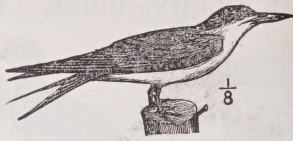
1. A common name of certain aquatic fowls of the genus Sterna; as the great tern or sea swallow, (S. hirundo, )
2. the black tern the lesser tern or hooded tern and the foolish tern or noddy, (S. stolida.) The brown tern or brown gull, (S. obscura, ) is considered as the young of the pewitgull or sea-crow, before molting.
2. That which consists of, or pertains to, three things or numbers together; especially, a prize in a lottery resulting from the favorable combination of three numbers in the drawing; also, the three numbers themselves.
TERN (Norsk Taerne, Tenne, or Tende ; Swedish Tαrηa∙, Dutch Stern v ), the name now applied generally to a group of sea-birds, the Sterninae of modern ornithology, but, according to Selby, properly belonging, at least in the Farne Islands, to the species known by the book-name of Sandwich Tern, all the others being those called Sea-Swallows —a name still most commonly given to the whole group throughout Britain from their long wings, forked tail, and marine habit. In Willughby’s Ornithologia (1676), however, the word Tern is used for more than one species, and, though it does not appear in the older English dictionaries, it may well have been from early times as general a name as it is now.
Setting aside those which are but occasional visitors to the British Islands, six species of Terns may be regarded as indigenous, though of them one has ceased from ordinarily breeding in the United Kingdom, while a second has become so rare and regularly appears in so few places that mention of them must for prudence sake be avoided. This last is the beautiful Roseate Tern, Sterna dοugalli; the other is the Black Tern, Hydrochelidon nigra, belonging to a genus in which the toes are only half-webbed, of small size and dark leaden grey plumage. It is without doubt the Sterna of Turner, and in former days was abundant in many parts of the fen country, to say nothing of other districts. Though nearly all its ancient abodes have been drained, and for its purposes sterilized these many years past, not a spring comes but it shows itself in small companies in the eastern counties of England, evidently seeking a breedingplace. All around the coast the diminution in the numbers of the remaining species of Terns within the last 50 years is no less deplorable than demonstrable....
The Sandwich Tern, S. sandvicensis or £ cantiaca— named from the place of its discovery, though it has long since ceased to inhabit that neighbourhood—is the largest of the British species, equalling in size the smaller Gulls and having a dark-coloured bill tipped with yellow, and dark legs. Through persecution it has been exterminated in all its southern haunts, and is become much scarcer in those to which it still resorts. It was, however, never so abundant as its smaller congeners, the so-called Common and the Arctic Tern, —two species that are so nearly alike as to be beyond discrimination on the wing by an ordinary observer, and even in the hand require a somewhat close examination. The former of these has the more southern range, and often affects inland situations, while the latter, though by no means limited to the Arctic circle, is widely distributed over the north and mostly resorts to the seacoast. Yet there are localities where, as on the Farne Islands, both meet and breed, without occupying stations apart. The minute diagnosis of these two species cannot be briefly given. It must suffice here to state that the most certain difference, as it is the most easily recognizable, is to be found in the tarsus, which in the Arctic Tem is a quarter of an inch shorter than in its kinsman. The remaining native species is the Lesser Tern, S. minuta, one of the smallest of the genus and readily to be distinguished by its permanently white forehead. All the species already mentioned, except the Black Tern, have much the same general coloration— the adults in summer plumage wearing a black cap and having the upper parts of the body and wings of a more or less pale grey, while they are mostly lighter beneath. They generally breed in association, often in the closest proximity—their nests, containing 3 eggs at most, being made on the shingle or among herbage. The young are hatched clothed in variegated down, and remain in the nest for some time. At this season the parents are almost regardless of human presence and expose themselves freely.
At least half-a-dozen other species have been recorded as occurring in British waters, and among them the Caspian Tern, S. caspia t which is one of the largest of the genus and of wide distribution, though not breeding nearer to the shores of England than on Sylt and its neighbouring islands, which still afford lodging for a few pairs. Another, the Gull-billed Tern, S. anglica, has also been not unfrequently shot in England. All these species are now recognized, though the contrary was once maintained, as inhabitants of North America, and many go much further.
An excellent synopsis of the Sub-family Sterninae has been given by Mr HowardSaunders in the Zoological Proceedings (1876, pp. 638-672). He recognizes 5 genera, —Hydrochelidon (with 3 species), Sterna (with 38), Naenia, a very aberrant form consisting of but one species, the Inca Tern, peculiar to the western coast of South America, and Gygis, composed of 2 species of purely white birds and restricted to the southern hemisphere; his fifth genus is Anous, to which belong the various species of Noddy (vol. xvii. p. 531). Often confounded with these last are the two species called in books Sooty Terns (N. fuliginosa and S. anaestheta), but by sailors “Egg-birds” or “Wideawakes” from their cry. These crowd at certain seasons in innumerable multitude to certain islands within the tropics, where they breed, and the wonderful assemblage at present known as “Wide-awake fair” on the island of Ascension has been more or less fully described from very ancient times. Dampier in his voyage to New Holland in 1699 particularly described and figured the Sooty Tern ( Voyages, iii. p. 142), discriminating it from the Noddy, from, which it had not before been distinguished. (a. n.)
9th ed. Encyclopædia Britannica, vol. 23, p. 189 [963 words — estimated reading time: 6 minutes]
1. Proceeding by threes; consisting of three; as, the ternary number was anciently esteemed a symbol of perfection, and held in great veneration.
2. Containing, or consisting of, three different parts, as elements, atoms, groups, or radicals, which are regarded as having different functions or relations in the molecule; thus, sodichydroxide, NaOH, is a ternary compound.
TERNATE, a small island in the East Indian Archipelago, off the west coast of Jilolo (q.v.), in 0° 48' N. lat. and 127° 19' Έ. long. It is nearly circular in form, with an area of about 25 square miles, and consists almost entirely of a very remarkable volcano (5600 feet) formed of three superimposed cones. Frequent and destructive eruptions have taken place. Cocoa-nuts, sago, tobacco, cotton, sulphur, and saltpetre are the chief productions of the island. The clove, which had been extirpated by the early Dutch rulers to enhance its value by restricting its cultivation to the Banda Islands, Amboyna, &c., is beginning again to be grown, as also is the nutmeg. The inhabitants are nearly all MohammedanMalays. The town of Ternate, with a population of about 9000, is the seat of a native sultan and of a Dutch resident; the harbour is commanded by a fort. The residency, w hich includes a part of the eastern coast of Celebes (see Celebes), the greater part of Jilolo, and numerous smaller islands, has an area of 26,900 square miles and a population estimated at about 290,000.
9th ed. Encyclopædia Britannica, vol. 23, p. 189 [190 words — estimated reading time: 2 minutes]
TERNI, a town of Italy, in the province of Perugia, is situated in the fertile valley of the Nera, between two branches of that river, about 5 miles below the point where it is joined by the Velino. It has a station, three-quarters of a mile off, on the railway line between Rome and Ancona, 69 miles to the north of the former city and 19 south by west from Spoleto. Terni is an episcopal see, and the seat of a sub-prefecture and a chamber of commerce. Its public buildings include the cathedral (17th century), the church of S. Francesco (partly dating from the 13th century), a gymnasium, and a theatre. Terni manufactures leather and cloth, and has some trade in wine and silk. For the traveller its chief interest lies in its antiquities (remains of an amphitheatre of the time of Tiberius, a temple, a theatre, baths, and numerous inscriptions) and in the proximity of the falls of Velino (Caseate delle Marmore). Alike in volume and in beauty these take a very high place among European waterfalls; the cataract has a total descent of about 650 feet, in three leaps of 65, 330, and 190 feet respectively. They owe their origin to M ’. Curius Dentatus, who in 272 b.c. first opened an artificial channel by which the greater part of the Lacus Velinus in the valley below Reate was drained. The population of the town in 1881 was 9415, with its suburbs 10,371 (commune, 15,853)....
Terni is the ancient Interamna (“inter amnes”), originally belonging to Umbria and founded, according to a local tradition, in the year 672 b.c. It early became a flourishing municipium, and it did not permanently suffer through being portioned out among his soldiers by Sulla. Its inhabitants had frequent litigations and disputes with their neighbours at Reate in connexion with the regulation of the Velinus, the waters of which are so strongly impregnated with carbonate of lime that by their deposits they tend to block up their own channel. The first interference with its natural course was that of M ’. Curius Dentatus already referred to. In 54 b.c. the people of Reate appealed to Cicero to plead their cause in an arbitration which had been appointed by the Roman senate to settle disputes about the river, and in connexion with this he made a personal inspection of Lake Velinus and its outlets. In the time of Tiberius there was a project for regulating the river and its outlets from the lake, against which the citizens of Interamna and Reateenergetically and successfully protested (Tac., Ann., i. 79). Similar questions arose as the river formed fresh deposits during the Middle Ages and during the 15th and 16th centuries. A branch of the Via Flaminia passed from Narnia to Forum Flaminii, and is given instead of the direct line in the Antonine and Jerusalem itineraries. The emperor Tacitus and his brother Florianus were probably natives of Interamna, which also has been claimed as the birthplace of Tacitus the historian, but with less reason. Terni was the scene of .the defeat of the Neapolitans by the French on 27th November 1798.
9th ed. Encyclopædia Britannica, vol. 23, p. 190 [530 words — estimated reading time: 4 minutes]
Adv. three times, three fold, thrice, in the third place, thirdly, trebly
No Bible verses found for "tern".
This site uses cookies to remember your display preferences (search sources and editions, Bible version, auto-link, images, light/dark theme). No personal data whatsoever is collected. Privacy Policy