
A small bird of the genus Parus.
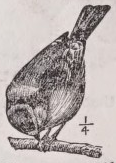
TITMOUSE (Anglo-Saxon Mase and Tytrnase, German Meise, Swedish Mes, Dutch Mees, French Mésange), the name long in use for several species of small English birds, which are further distinguished from one another by some characteristic appellation. These go to make up the genus Parus of Linnaeus, and with a very uncertain number of other genera form the Family Paridae of modern ornithology. Its 1imits are, however, very ill-defined; and here only the species best known to English readers can be noticed....
The first to be mentioned is that called from its comparatively large size the Great Titmouse, P. major, but known also in many parts as the Oxeye, conspicuous by its black head, white cheeks, and yellow breast, down which runs a black fine, while in spring the cock makes himself heard by a loud love-note that resembles the noise made in sharpening a saw. It is widely distributed throughout the British Islands, and over nearly the whole of Europe and northern Asia. The next is the Blue Titmouse, Bluecap, or Nun, P. caeruleus, smaller than the last and more common. Its names are so characteristic as to make any description needless. A third common species, but not so numerous as either of the foregoing, is the Coal-Titmouse, P. oder, distinguished by its black cap, white cheeks, and white nape. Some interest attaches to this species because of the difference observable between the race inhabiting the scanty remnants of the ancient Scottish forests and that which occurs throughout the rest of Britain. The former is more brightly tinted than the latter, having a clear bluish grey mantle and the lower part of the back greenish, hardly either of which colours are to be seen in the same parts of more southern examples, which last have been described as forming a distinct species, P. britannieus. But it is to be observed that the denizens of the old Scotch fir-woods are nearly midway in coloration between the dingy southern birds and those which prevail over the greater part of the Continent. It would therefore seem unreasonable to speak of two species only: there should be either three or one, and the latter alternative is to be preferred, provided the existence of the local races be duly recognized. Much the same thing is to be noticed in the next species to be mentioned, the Marsh-Titmouse, P. palustris, which, sombre as is its plumage, is subject to considerable local variation in its very extensive range, and has been called P. borealis in Scandinavia, F alpestris in the Alps, and P. lugubris in south-eastern Europe, to say nothing of forms like P. baicalensis, P. camchatkensis, and others, whose names denote its local variations in northern Asia, while no great violence is exercised if to these be tacked on P. atricapilla with several geographical races which inhabit North America. A fifth British species is the rare Crested Titmouse, P. cristatus, only found in limited districts in Scotland, though common enough, especially in pine-woods, in many parts of Europe.
It is impossible to state how many species of Parus exist, their recognition at present being wholly subjective to the view taken by the investigator of the group. Its latest monographer is Dr Gadow (Gat. B. Br. Museum, viii pp. 3-53), who recognizes fortyeight, besides several sub-species. North-American ornithologists include some fifteen as inhabitants of Canada and the United States; but scarcely two writers agree on this point, owing to the existence of so many local forms. Of the species inhabiting the Indian and Ethiopian Regions there is no space here to treat, and for the same reason the presumably allied forms of Australia and New Zealand must be left unnoticed. During the greater part of the year the various species of the genus Parus associate in family parties in a way that has been already described (Birds, vol. iii., p. 766), and only break up into pairs at the be ginn ing of the breeding-season. The nests are nearly always placed in a hollow stump, and consist of a mass of moss, feathers, and hair, the last being worked almost into a kind of felt. Thereon the eggs, often to the number of eight or nine, are laid, and these have a translucent white shell, freckled or spotted with rust-colour. The first plumage of the young closely resembles that of the parents; but, so far as is known, it has always a yellower tinge, very apparent on the parts, if there be such, which in the adult are white. Few birds are more restless in disposition, and if “irritability” be the test of high organization, as a much bepraised systematist asserts, the Paridae should stand very near the top of the list. Most of the European species and some of the North-American become familiar, haunting the neighbourhood of houses, especially in winter, and readily availing themselves of such scraps of food, about the nature of which they are not particular, as they can get. By gardeners every Titmouse is generally regarded as an enemy, for it is supposed to do infinite damage to the buds of fruit-trees and bushes; but the accusation is wholly false, for the buds destroyed are always found to be those to which a grub—the bird’s real object—has got access, so that there can be little doubt that the Titmouse is a great benefactor to the horticulturist, and hardly ever more so than when the careless spectator of its deeds is supposing it to be bent on mischief.
Akin to the genus Parus, but in many respects differing from it, is Acredula, containing that curious-looking bird the Long-tailed or Bottle-Titmouse, with its many local races or species, which must be here passed over without a word. The bird itself, having its tail longer than its body, is unlike any other found in the northern hemisphere, while its nest is a perfect marvel of construction, being in shape nearly oval with a small hole in one side. The exterior is studded with pieces of lichen, worked into a firm texture of moss, wool, and spiders’ nests, and the inside is profusely lined with soft feathers—2379 having been, says Macgillvray, counted in one example. Not inferior in beauty or ingenuity is the nest built by the Penduline Titmouse, Aegithalus peηdulimιs, of the south of Europe, which differs, however, not merely in composition but in being suspended to a bough, while the former is nearly always placed between two or more branches.
The so-called Bearded Titmouse, Panurus biarmwus, has habits wholly unlike those of any of the foregoing, and certainly does not be!ong to the Family Paridae, though its real affinity has not yet been clearly shown. It was formerly found in many parts of England, especially in the eastern counties, where it bore the name of Reed-Pheasant; but through the draining of meres, the destruction of reed-beds, and (it must be added) the rapacity of collectors it now only exists as a native in a very few localities. It is a beautiful little bird of a bright tawny colour, variegated with black and white, while the cock is further distinguished by a bluish grey head and a black tuft of feathers on each side of the chin. Its chief food seems to be the smaller kinds of freshwater mollusks, which it finds among the reed-beds it seldom quits.
The general affinities of the Paridae seem to lie rather with the Sittidae (cf. Nuthatch, vol. xvii. p. 665) and the Tree-Creepers; and those systematists who would ally them to the Laniidae (Shrike, vol. xxi. p. 845), or still more interpose the last between the former Families, have yet to find grounds for so doing. (a. n.)