AAR, or Aare, the most considerable river in Switzerland, after the Rhine and Rhone. It rises in the glaciers of the Finster-aarhorn, Schreckhorn, and Grimsel, in the canton of Bern; and at the Handeck in the valley of Hash forms a magnificent water-fall of above 150 feet in height. It then falls successively into the lakes Brienz and Thun, and, emerging from the latter, flows through the cantons of Bern, Soleure, and Aargau, emptying itself into the Rhine, opposite Waldshut, after a course of about 170 miles. Its principal tributary streams are the Kander, Saane, and Thiele on the left, and the Emmen, Surin, Aa, Reuss, and Limmat, on the right. On its banks are situated Unterseen, Thun, Bern, Soleure or Solothurn, Aarburg, and Aarau. The Aar is a beautiful silvery river, abounding in fish, and is navigable from the Rhine as far as the Lake of Thun. Several small rivers in Germany have the same name.
9th ed. Encyclopædia Britannica, vol. 1, p. 2 [159 words — estimated reading time: 1 minute]
AARAU, the chief town of the canton of Aargau in Switzerland, is situated at the foot of the Jura mountains, on the right bank of the river Aar, 41 miles N.E. of Bern. It is well built, and contains a town-hall, barracks, several small museums, and a library rich in histories of Switzerland. There is a cannon foundry at Aarau, and among the principal manufactures are silk, cotton, and leather; also cutlery and mathematical instruments, which are held in great repute. The slopes of the neighbouring mountains are partially covered with vines, and the vicinity of the town is attractive. About ten miles distant along the right bank of the Aar are the famous baths of Schinznach. Population, 5449.
9th ed. Encyclopædia Britannica, vol. 1, p. 3 [121 words — estimated reading time: 1 minute]
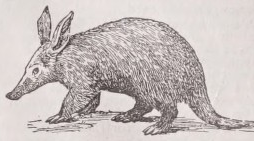
An edentatemammal, of the genus Orycteropus, somewhat resembling a pig, common in some parts of Southern Africa. It burrows in the ground, and feeds entirely on ants, which it catches with its long, slimy tongue.
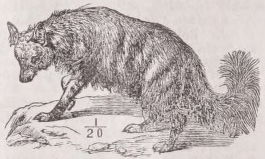
AARD-VARK(earth-pig), an animal very common in South Africa, measuring upwards of three feet in length, and having a general resemblance to a short-legged pig. It feeds on ants, and is of nocturnal habits, and very timid and harmless. Its flesh is used as food, and when suitably preserved is considered a delicacy. The animal is the only known species of its genus (Orycteropus), and belongs to the order Edentata of the mammalia. The same prefix Aard appears in the name of the Aard-wolf (Proteles Lalandii), a rare animal found in Caffraria, which is said to partake of the characters of the dog and civet. See Mammalia.
9th ed. Encyclopædia Britannica, vol. 1, p. 3 [111 words — estimated reading time: 1 minute]
AARGAU (French, Argovie), one of the cantons of Switzerland, derives its name from the river which flows through it, Aar-gau being the province or district of the Aar. It is bounded on the north by the Rhine, which divides it from the duchy of Baden, on the east by Zurich and Zug, on the south by Lucerne, and on the west by Bern, Soleure or Solothurn, and Basel. It has an area of 502 ½ square miles. By the census of 1870, the number of inhabitants was 198,873, showing an increase during the preceding ten years of 4665. Aargau stands sixth among the Swiss cantons in density of population, having 395 inhabitants to the square mile. The statistics of 1870 show that of the inhabitants 107,703 were Protestants, 89,180 Catholics, and 1541 Jews. German is the language almost universally spoken.
Aargau is the least mountainous canton of Switzerland. It forms part of a great table-land to the north of the Alps and the east of the Jura, having a general elevation of from 1200 to 1500 feet. The hills do not rise to any greater height than 1800 feet above this table-land, or 3000 feet above the level of the sea. The surface of the country is beautifully diversified, undulating tracts and well-wooded hills alternating with fertile valleys watered by the Aar and its numerous tributaries, and by the rivulets which flow northward into the Rhine. Although moist and variable, the climate is milder than in most parts of Switzerland....
The minerals of Aargau are unimportant, but remarkable palaeontological remains are found in its rocks. The soil to the left of the Aar is a stiff clay, but to the right it is light and productive. Agriculture is in an advanced state, and great attention is given to the rearing of cattle. There are many vineyards, and much fruit is grown. The canton is distinguished by its industry and its generally diffused prosperity. Many of the inhabitants are employed in the fishings on the Aar, and in the navigation of the river. In the villages and towns there are considerable manufactures of cotton goods, silk, and linen. The chief exports are cattle, hides, cheese, timber, raw cotton, yarn, cotton cloths, silk, machinery, and wooden wares; and the imports include wheat, wine, salt, leather, and iron. The most important towns are Aarau, Baden, Zofingen, and Laufenburg, and there are mineral springs at Baden, Schinznach, Leerau, and Niederweil. The Swiss Junction Railway crosses the Rhine near Waldshut, and runs south through the canton to Turgi, whence one line proceeds S.E. to Zurich, and another S.W. to Aarau and Olben.
Until 1798, Aargau formed part of the canton of Bern, but when the Helvetic Republic was proclaimed, it was erected into a separate canton. In 1803 it received a considerable accession of territory, in virtue of the arrangement under which the French evacuated Switzerland. According to the law whereby the cantons are represented in the National Council by one member for every 20,000 inhabitants, Aargau returns ten representatives to that assembly. The internal government is vested in a legis.- lative council elected by the body of the people, while a smaller council of seven members is chosen by the larger body for the general administration of affairs. The resources of Aargau are stated to amount to about a million sterling; its revenue in 1867 was nearly £82,000, and the expenditure slightly greater. There is a public debt of about £40,000. The canton is divided into eleven districts, and these again are subdivided into forty-eight circles. There is a court of law for each district, and a superior court for the whole canton, to which cases involving sums above 160 francs can be appealed. Education is compulsory; but in the Roman Catholic districts the law is not strictly enforced. By improved schools and other appliances great progress has been made in education within the last thirty or forty years.
9th ed. Encyclopædia Britannica, vol. 1, p. 3 [667 words — estimated reading time: 4 minutes]
AARHUUS, a city and seaport of Denmark, situated on the Cattegat, in lat. 56° 9' N., long. 10° 12' E. It is the chief town of a fertile district of the same name, one of the subdivisions of Jutland. The cathedral of Aarhuus is a Gothic structure, and the largest church in Denmark. The town also contains a lyceum, museum, and library. Aarhuus is a place of extensive trade. It has a good and safe harbour, has regular steam communication with Copenhagen, and is connected by rail with Viborg and the interior of the country. Agricultural produce, spirits, leather, and gloves are exported, and there are sugar refineries, and manufactures of wool, cotton, and tobacco. Population (1870), 15,020.
9th ed. Encyclopædia Britannica, vol. 1, p. 3 [119 words — estimated reading time: 1 minute]
AARON, the first high-priest of the Jews, eldest son of Amram and Jochebed, of the tribe of Levi, and brother of Moses and Miriam. When Moses was commissioned to conduct the Israelites from Egypt to Canaan, Aaron was appointed to assist him, principally, it would appear, on account of his possessing, in a high degree, persuasivereadiness of speech. On the occasion of Moses’ absence in Mount Sinai (to which he had gone up to receive the tables of the law), the Israelites, regarding Aaron as their leader, clamorously demanded that he should provide them with a visible symbolic image of their God for worship. He weakly complied with the demand, and out of the ornaments of gold contributed for the purpose cast the figure of a calf, this form being doubtless chosen in recollection of the idols of Egypt. In obedience to instructions given by God to Moses, Aaron was appointed high-priest; his sons and descendants, priests; and his tribe was set apart as the sacerdotalcaste. The office of high-priest was held by Aaron for nearly forty years, till the time of his death, which took place on Mount Hor, when he was 123 years old.
9th ed. Encyclopædia Britannica, vol. 1, p. 3 [201 words — estimated reading time: 2 minutes]
the son of Amram and Jochebed, of the tribe of Levi. Aaron was three years older than his brother Moses; and when God appeared in the burning bush, Moses having excused himself from the undertaking committed to him, by urging that he was slow of speech, Aaron, who was an eloquent man, was made his interpreter and spokesman; and in effecting the deliverance of the Hebrews we therefore find them constantly associated. During the march of the children of Israel through the wilderness, Aaron and his sons were appointed by God to exercise for ever the office of priests in the tabernacle.
Moses having ascended the mountain to receive the law from God, Aaron, his sons, and seventy elders, followed him, Exod. xxiv, 1, 2, 9–11; not indeed to the summit, but “afar off,” “and they saw the God of Israel,” that is, the glory in which he appeared, “as it were the paved work of a sapphire stone, and as it were the body of heaven for clearness;”--a clear and dazzlingazure, a pure, unmingled splendour like that of the heavens. “And upon the nobles of Israel,” Aaron, his sons, and the seventy elders, “he laid not his hand,”--they were not destroyed by a sight which must have overwhelmed the weakness of mortal men had they not been strengthened to bear it; “and they did eat and drink,”--they joyfully and devoutly feasted before the Lord, as a religious act, upon the sacrifices they offered. After this they departed, and Moses remained with God on the very summit of the mount forty days.
During this period, the people, grown impatient at the long absence of Moses, addressed themselves to Aaron in a tumultuous manner, saying, “Make us gods which shall go before us: for, as for this Moses, the man that brought us up out of the land of Egypt, we wot not what is ...become of him.” Aaron sinfully yielded to the importunities of the people; and having ordered them to bring the pendants and the ear-rings of their wives and children, he melted them down, and then made a golden calf, probably in imitation of the Egyptian Apis, an ox or calf dedicated to Osiris. In this instance the image was dedicated to Jehovah the true God; but the guilt consisted in an attempt to establish image worship, which, when even ultimately referring to God, he has forbidden. Neither are images to be worshipped, nor the true God by images;--this is the standing unrepealed law of Heaven. The calf was called a golden calf, as being highly ornamented with gold. Having finished the idol, the people placed it on a pedestal, and danced around it, saying, “These be thy gods, O Israel;” or, as it is expressed in Nehemiah, “This is thy God,” the image or symbol of thy God, “which brought thee up out of the land of Egypt.” Moses, having hastened from the mount by the command of God, testified to the people, by breaking the tables of the law in their presence, that the covenant between God and them was now rendered of none effect through their offence. He also indignantly reproved Aaron, whose sin indeed had kindled against him the anger of the Lord, so that he would “have destroyed him but that Moses prayed for him.”
After the tabernacle was built, Moses consecrated Aaron to the high priesthood with the holy oil, and invested him with his priestly robes,--his garments “of glory and beauty;” but Aaron’s weakness was again manifested in concurring with Miriam, his sister, to censure and oppose Moses, through envy. Aaron, as being the elder brother, could not perhaps brook his superiority. What the motive of Miriam might be does not appear; but she being struck with leprosy, this punishment, as being immediately from God, opened Aaron’s eyes; he acknowledged his fault, and asked forgiveness of Moses both for himself and his sister.
Aaron himself became also the object of jealousy; but two miraculous interpositions confirmed him in his office of high priest, as of Divine appointment. The first was the destruction of Korah, who sought that office for himself, and of the two hundred and fifty Levites who supported his pretensions, Num. xvi. The second was the blossoming of Aaron’s rod, which was designed “to cause the murmurings of the Israelites against him to cease,” by showing that he was chosen of God. Moses having, at the command of God, taken twelve rods of an almond tree from the princes of the twelve tribes, and Aaron’s separately, he placed them in the tabernacle before the sanctuary, after having written upon each the name of the tribe which it represented, and upon the rod of Aaron the name of Aaron. The day following, when the rods were taken out, that of Aaron “was budded, and brought forth buds, and bloomed blossoms, and yielded almonds.” This rod therefore was laid up by the ark, to perpetuate the remembrance of the miracle, and to be a token of Aaron’s right to his office.
Aaron married Elisheba, the daughter of Amminadab, of the tribe of Judah, by whom he had four sons, Nadab and Abihu, Eleazar and Ithamar, Exodus vi, 23. The two first were killed by fire from heaven, as a punishment for presuming to offer incense with strange fire in their censers, Lev. x, 1, 2. From the two others the succession of high priests was continued in Israel.
The account of the death of Aaron is peculiarly solemn and affecting. As he and Moses, in striking the rock at Meribah, Num. xvi, had not honoured God by a perfect obedience and faith, he in his wrath declared unto them that they should not enter into the promised land. Soon after, the Lord commanded Moses, “Take Aaron, and Eleazar his son, and bring them up to mount Hor; and strip Aaron of his garments,”--his splendid pontificalvestments,--“and put them upon Eleazar, his son; and Aaron shall be gathered unto his people, and shall die there.” This command was carried into effect in the presence of all Israel, who were encamped at the foot of the mountain; and his son being invested with the father’s priestly dress, Aaron died, and all the people mourned for him thirty days. His sepulchre was left unmarked and unknown, perhaps to prevent the superstitious reverence of future ages. In Deuteronomy it is said that Aaron died at Mosera; because that was the name of the district in which mount Hor was situated.
The PRIESTHOOD being established in Aaron and his family, the nature of this office among the Israelites, and the distinction between the high priest and the other priests, require here to be pointed out.
Before the promulgation of the law by Moses, the fathers of every family, and the princes of every tribe, were priests. This was the case both before and after the flood; for Cain and Abel, Noah, Abraham, Job, Abimelech, Laban, Isaac, and Jacob, themselves offered their own sacrifices. But after the Lord had chosen the family of Aaron, and annexed the priesthood to that line, then the right of sacrificing to God was reserved to that family only. The high priesthood was confined to the first-born in succession; and the rest of his posterity were priests simply so called, or priests of the second order. Both in the high priest and the second or inferior priests, two things deserve notice,--their consecration and their office. In some things they differed, and in others agreed. In their _consecration_ they differed thus: the high priest had the chrism, or sacred ointment, poured upon his head, so as to run down to his beard, and the skirts of his garment, Exod. xxx, 23; Lev. viii, 12; Psa. cxxxiii, 2. But the second priests were only sprinkled with this oil, mixed with the blood of the sacrifice, Lev. viii, 30. They differed also in their _robes_, which were a necessary adjunct to consecration. The high priest wore at the ordinary times of his ministration in the temple, eight garments;--linen drawers--a coat of fine linen close to his skin--an embroideredgirdle of fine linen, blue and scarlet, to surround the coat--a robe all of blue with seventy-two bells, and as many embroidered pomegranates upon the skirts of it; this was put over the coat and girdle--an ephod of gold, and of blue, purple, scarlet, and fine linen, curiously wrought, on the shoulders of which were two stones engraved with the names of the twelve tribes; this was put over the robe, and girt with a curious girdle of the same--a breastplate, about a span square, wrought with gold, blue, purple, scarlet, and fine linen, and fastened upon the ephod by golden chains and rings; in this breastplate were placed the urim and thummim, also twelve several stones, containing the names of the twelve tribes--a mitre of fine linen, sixteen cubits long, to wrap round his head--and lastly, a plate of gold, or holy crown, two fingers broad, whereon was engraved, “Holiness to the Lord;” this was tied with blue lace upon the front of the mitre. Beside these garments, which he wore in his ordinary ministration, there were four others, which he wore only upon extraordinary occasions, viz. on the day of expiation, when he went into the holy of holies, which was once a year. These were: linen drawers--a linen coat--a linen girdle--a linen mitre, all white, Exod. xxviii; Lev. xvi, 4. But the inferior priests had only four garments: linen drawers--a linen coat--a linen girdle--a linen bonnet. The priest and high priest differed also in their _marriage restrictions_; for the high priest might not marry a widow, nor a divorced woman, nor a harlot, but a virgin only; whereas the other priests might lawfully marry a widow, Lev. xxi, 7.
In the following particulars the high priest and inferior priests agreed in their consecration: both were to be void of bodily blemish--both were to be presented to the Lord at the door of the tabernacle--both were to be washed with water--both were to be consecrated by offering up certain sacrifices--both were to have the blood of a ram put upon the tip of the right ear, the thumb of the right hand, and the great toe of the right foot, Exod. xxix, 20. In the time of consecration, certain pieces of the sacrifice were put into the priest’s hand, which was called “filling his hand;” hence the Hebrew phrase, “to fill the hand,” signifies consecration.
In the discharge of their offices, the high priest differed from the other priests in these particulars: the high priest only, and that but once a year, might enter into the holy of holies--the high priest might not mourn for his nearest relations by uncovering his head, or tearing any part of his garments, except the skirt; whereas the priest was allowed to mourn for these six,--father, mother, son, daughter, brother, and sister if she had no husband, Lev. xxi, 2, 10, 11; but they agreed in these respects: they both burnt incense and offered sacrifices--they both sounded the trumpet, either as an alarm in war, or to assemble the people and their rulers--they both slew the sacrifices--both instructed the people--and both judged of leprosy.
For the more orderly performance of these offices, the high priest had his sagan, who, in case of the high priest’s pollution, performed his duty. The high priest and his sagan resembled our bishop and his suffragan.
Aaron was a TYPE of Christ, not personally, but as the high priest of the Jewish church. All the priests, as offering gifts and sacrifices, were in their office types of Christ; but Aaron especially, 1. As the high priest. 2. In entering into the holy place on the great day of atonement, and reconciling the people to God; in making intercession for them, and pronouncing upon them the blessing of Jehovah, at the termination of solemn services. 3. In being anointed with the holy oil by _effusion_, which was prefigurative of the Holy Spirit with which our Lord was endowed. 4. In bearing the names of all the tribes of Israel upon his breast and upon his shoulders, thus presenting them always before God, and representing them to him. 5. In being the medium of their inquiring of God by urim and thummim; and of the communication of his will to them. But though the offices of Aaron were typical, the priesthood of Christ is of a different and higher ORDER than his, namely, that of MELCHIZEDECK. See CALF, PRIEST, TYPE, EPHOD, BREASTPLATE, URIM.
AARSSENS, Francis Van (1572-1641), one of the greatest diplomatists of the United Provinces. He represented the States-General at the Court of France for many years, and was also engaged in embassies to Venice, Germany, and England. His great diplomatic ability appears from the memoirs he wrote of his negotiations in 1624 with Richelieu, who ranked him among the three greatest politicians of his time. A deep stain rests on the memory of Aarssens from the share he had in the death of Barneveldt, who was put to death by the States-General, after the semblance of a trial, in 1619.
9th ed. Encyclopædia Britannica, vol. 1, p. 4 [102 words — estimated reading time: 1 minute]
And the anger of the LORD was kindled against Moses, and he said, Is not Aaron the Levite thy brother? I know that he can speak well. And also, behold, he cometh forth to meet thee: and when he seeth thee, he will be glad in his heart.
Then the anger of the LORD burned against Moses, and He said, “Is not Aaron the Levite your brother? I know that he can speak well, and he is now on his way to meet you. When he sees you, he will be glad in his heart.
And afterward Moses and Aaron went in, and told Pharaoh, Thus saith the LORD God of Israel, Let my people go, that they may hold a feast unto me in the wilderness.
After that, Moses and Aaron went to Pharaoh and said, “This is what the LORD, the God of Israel, says: ‘Let My people go, so that they may hold a feast to Me in the wilderness.’”
And the LORD spake unto Moses and unto Aaron, and gave them a charge unto the children of Israel, and unto Pharaoh king of Egypt, to bring the children of Israel out of the land of Egypt.
Then the LORD spoke to Moses and Aaron and gave them a charge concerning both the Israelites and Pharaoh king of Egypt, to bring the Israelites out of the land of Egypt.
And Amram took him Jochebed his father’s sister to wife; and she bare him Aaron and Moses: and the years of the life of Amram were an hundred and thirty and seven years.
And Amram married his father’s sister Jochebed, and she bore him Aaron and Moses. Amram lived 137 years.
And Eleazar Aaron’s son took him one of the daughters of Putiel to wife; and she bare him Phinehas: these are the heads of the fathers of the Levites according to their families.
Aaron’s son Eleazar married one of the daughters of Putiel, and she bore him Phinehas. These were the heads of the Levite families by their clans.
When Pharaoh shall speak unto you, saying, Shew a miracle for you: then thou shalt say unto Aaron, Take thy rod, and cast it before Pharaoh, and it shall become a serpent.
“When Pharaoh tells you, ‘Perform a miracle,’ you are to say to Aaron, ‘Take your staff and throw it down before Pharaoh,’ and it will become a serpent.”
This site uses cookies to remember your display preferences (search sources and editions, Bible version, auto-link, images, light/dark theme). No personal data whatsoever is collected. Privacy Policy