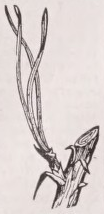
ACER. See Maple.
[3 words — estimated reading time: 1 minute]
ACER. See Maple.
ACERBI, Giuseppe (Joseph), an Italian traveller, born at Castel-Goffredo, near Mantua, on the 3d May 1773, studied at Mantua, and devoted himself specially to natural science. In 1798 he undertook a journey through Denmark, Sweden, Finland, and Lapland; and in the following year he reached the North Cape, which no Italian had previously visited. He was accompanied in the latter part of the journey by the Swedish colonel Skiöldebrand, an excellent landscape-painter. On his return Acerbi stayed for some time in England, and published his Travels through Sweden, &c. (London, 1802), which was translated into German (Weimar, 1803), and, under the author’s personal superintendence, into French (Paris, 1804). The French translation received numerous corrections, but even in this amended form the work contains many mistakes. Acerbi rendered a great service to Italian literature by starting the Biblioteca Italiana (1816), in which he opposed the pretensions of the Academy della Crusca. Being appointed Austrian consul-general to Egypt in 1826, he entrusted the management of the Biblioteca to Gironi, contributing to it afterwards a series of valuable articles on Egypt. While in the East he obtained for the museums of Vienna, Padua, Milan, and Pavia many objects of interest. He returned from Egypt in 1836, and took up his residence in his native place, where he occupied himself with his favourite study till his death in August 1846.
ACERNUS, the Latinised name by which Sebastian Fabian Klonowicz, a celebrated Polish poet, is generally known, was born at Sulmierzyce in 1551, and died at Lublin in 1608. He was for some time burgomaster and president of the Jews’ civil tribunal in the latter town, where he had taken up his residence after studying at Cracow. Though himself of an amiable disposition, his domestic life was very unhappy, the extravagance and misconduct of his wife driving him at last to the public hospital of Lublin, where he ended his days. He wrote both Latin and Polish poems, and the genius they displayed won for him the name of the Sarmatian Ovid. The titles of fourteen of his works are known; but a number of these were totally destroyed by the Jesuits and a section of the Polish nobility, and copies of the others are for the same reason exceedingly rare. The Victoria Deorum ubi continetur Veri Herois Educatio, a poem in forty-four cantos, cost the poet ten years’ labour.
ACERRA, in Antiquity, a little box or pot, wherein were put the incense and perfumes to be burned on the altars of the gods, and before the dead. It appears to have been the same with what was otherwise called thuribulum and pyxis. The censers of the Jews were acerrae; and the Romanists still retain the use of acerrae, under the name of incense pots.
The name acerra was also applied to an altar erected among the Romans, near the bed of a person recently deceased, on which his friends offered incense daily till his burial. The real intention probably was to fumigate the apartment. The Chinese have still a somewhat similar custom.
ACERRA, a town of Italy, in the province of Terra di Lavoro, situated on the river Agno, 7 miles N.E. of Naples, with which it is connected by rail. It is the ancient Acerrae, the inhabitants of which were admitted to the privileges of Roman citizenship so early as 332 B.C., and which was plundered and burnt by Hannibal during the second Punic war. A few inscriptions are the only traces time has left of the ancient city. The town stands in a fertile district, but is rendered very unhealthy by the malaria rising from the artificial water-courses of the surrounding Campagna. It is the seat of a bishop, and has a cathedral and seminary. Flax is grown in the neighbourhood. Population, 11,717.