
Word of the Day: Catachrestical
Alhambra
Encyclopedia Britannica
ALHAMBRA, the ancient fortress and residence of the Moorish monarchs of Granada, lies on a hill overlooking the city of Granada, on the north. The name, signifying in Arabic “the red,” is derived from the colour of the sun-dried tapia, or bricks made of fine gravel and clay, of which the outer walls are built. This famous Moorish palace was erected at various dates, chiefly between 1248 and 1354, under the reigns of Ibn-l-Ahmar and his successors. The splendid decorations, and in particular the exquisite painting of the interior, are ascribed to Yusuf I., who died in 1354. Immediately after the expulsion of the Moors in 1492, their conquerors began, by innumerable acts of vandalism, to spoil the marvellous beauty of the Alhambra. The open work was filled up with whitewash, the painting and gilding effaced, the furniture soiled, torn, or removed. Charles V. rebuilt portions in the modern style of the period, and destroyed the greater part of the Winter Palace to make room for a modern structure which has never been completed. Philip V. Italianised the rooms, and completed the degradation by running up partitions which blocked up whole apartments, gems of taste and patient ingenuity. In subsequent centuries the carelessness of the Spanish authorities permitted this pearl of Moorish art to be still further defaced; and in 1812 some of the towers were blown up by the French under Sebastiani, while the whole buildings narrowly escaped the same fate. In 1821 the ancient pile was shattered by an earthquake. Directions were given in 1862, by Isabella, then queen of Spain, for the restoration of the Alhambra to its original condition. The work has been carried on with considerable skill, but the sums devoted to it have been too small for its satisfactory accomplishment....
The hilly terrace on which the Alhambra stands is about 2430 feet in length by 674 in breadth at the widest part. A strongly-fortified wall, flanked by thirteen square towers, encloses an area of 35 acres, within which the palace is built. Approaching from the city, the visitor passes through the Gate of Pomegranates and enters the grounds of the Alhambra, which are well wooded, and in spring are covered by sweet-scented wild flowers. The gardens, though weedy and ravined, are a charming resort, adorned by beautiful waterfalls and sparkling fountains, and enlivened by the song of the nightingale. Passing the pillars of Charles V., a steep ascent leads to the chief entrance to the Alhambra, the Gate of Judgment—a massive archway, surmounted by a square tower 62 feet high, which, while serving as an outwork of the fortress and as an entrance-hall to the palace, was principally used as an open-air court of justice, according to the patriarchal custom of the east. The pillars of the gate are of sculptured marble, and the horse-shoe arch is 28 feet high. A narrow passage leads to the Plaza de los Algibes, the Place of the Cisterns, so called from the tanks underneath filled with water from the Darro, which foams through the ravine to the north of the hill. The Plaza is about 225 feet long by 187 wide. To the left rises Alcazaba, the ruined fortress of the Alhambra, with the Torre de la Vela or Watch Tower, where the Christian flag was first hoisted on the expulsion of the Moors in 1492. It commands a noble prospect. Below lies the city of Granada, with its hundred churches; and above rise overhanging heights, with white houses glancing out from the green foliage, reminding one of the saying of the Arabic poet, that Granada is like a pearl set round with emerald. In the Place of the Cisterns stands an isolated Moorish tower, the Torre del Vino, erected in 1345; and to the right lies the palace of Charles V., displacing so much that was curious in Moorish art. It is a majestic but cold-looking structure in the Renaissance style, unfinished and roofless, and presenting a desolate and ruinous aspect. Behind this edifice lies the Moorish palace, the exterior being severe, plain, and almost forbidding in appearance, according to the peculiarity of Moorish architecture, by which they contrived to heighten the splendour of the interior by contrast with the bare and unadorned structure of the outer walls. But within, the palace stands unrivalled in the gorgeous splendour of its halls and the exquisite beauty of its decorations. Everywhere are seen evidences of the delicate taste and the artistic luxury of the Moors. Spacious courts, with marble pillars and fretted ceilings, partitions coloured and gilt like the sides of a Stamboul casket, and filagree stuccos of veil-like transparency, all distinguished by airy lightness and grace, are among the main features of this palace of the voluptuous caliphs of Granada, who held dominion over that sunny land which their poets described as a terrestrial paradise. The colours chiefly employed are blue, red, and a golden yellow. In the hey-day of Moorish prosperity the palace must have been the most delicious of royal residences. Odoriferous gardens, in which the orange and the myrtle bloomed, alternated with sparkling fountains and soft couches, inviting to a luxurious repose. Everything contributed to render the whole the most splendid abode of Oriental magnificence, to which only the fantastic creations of the Arabian Nights can be fitly compared.
The present entrance is by a small insignificant door, from which a corridor conducts to the Patio de la Berkàh, the Court of the Blessing. This court is 140 feet long by 74 broad; and in the centre there is a large pond set in the marble pavement, full of gold-fish, from which some have called this the Court of the Pond. It is also known as the Court of the Myrtles, from the myrtles which grow along its sides. There are galleries on the north and south sides; that on the south 27 feet high, and supported by a marble colonnade. Underneath it, to the right, was the principal entrance, and over it are three elegant windows with arches and miniature pillars. The columns supporting the galleries are light in structure, and arches, slender and bending gracefully like palms, spring from the capitals and meet overhead. From this court the walls of the Torre de Comares are seen rising over the roof to the north, and its tower and colonnades are reflected in the crystal mirror of the pond.
The Hall of Ambassadors (Sala de Ambajadores) is the largest in the Alhambra, and occupies all the Tower of Comares. It is a square room, the sides being 37 feet in length, while the centre of the dome is 75 feet high. This was the grand reception-room, and the throne of the sultan was placed opposite the entrance. The azulejos are nearly 4 feet high all round, and the colours vary at intervals. Over them is a series of oval medallions with inscriptions, interwoven with flowers and leaves. There are nine windows, three on each façade, and the ceiling is admirably diversified with inlaid work of white, blue, and gold, in the shape of circles, crowns, and stars—a kind of imitation of the vault of heaven. The walls are covered with varied stucco-work of most delicate pattern, surrounding many ancient escutcheons.
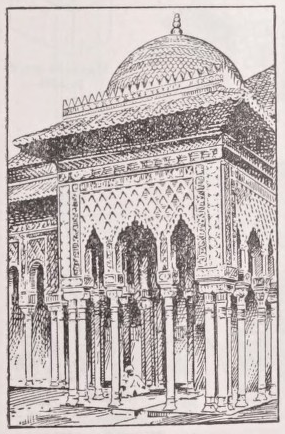
Another of the more celebrated courts of the palace is the Patio de los Leones, the Court of the Lions. This is an oblong court, 116 feet in length by 66 in breadth, surrounded by a low gallery supported on 124 white marble columns. A pavilion projects into the court at each extremity, with filigree walls and light-domed roof, elaborately ornamented. The square is paved with coloured tiles, and the colonnade with white marble; while the walls are covered 5 feet up from the ground with blue and yellow tiles, with a border above and below enamelled blue and gold. The columns supporting the roof and gallery are irregularly placed, with a view to artistic effect; and the general form of the piers, arches, and pillars is most graceful. They are adorned by varieties of foliage, &c.; about each arch there is a large square of arabesques; and over the pillars is another square of exquisite filigree work. In the centre of the court is the celebrated Fountain of Lions, a magnificent alabaster basin supported by the figures of twelve lions in white marble, not designed with sculptural accuracy, but as emblems of strength and courage. When the fountain was in good order a great volume of water was thrown up, which fell into the basin, passed through the lions, and issued from their mouths.
The Hall of the Abencerrages derives its name from a legend according to which Boabdil, the last king of Granada, having invited the chiefs of that illustrious line to a banquet, massacred them here. This room is a perfect square, with a lofty dome, and trellised windows at its base. The roof is exquisitely decorated in blue, brown, red, and gold, and the columns supporting it spring out into the arch form in a remarkably beautiful manner. Opposite to this hall is the Hall of the Two Sisters, so called from two very beautiful white marble slabs laid as part of the pavement. These slabs measure 15 feet by 7½, and are without flaw or stain. There is a fountain in the middle of this hall, and the roof is composed of stalactites, nearly 5000 pieces entering into its construction. The whole decorations here are of the most exquisite description.
Among the other wonders of the Alhambra are the Hall of Justice; the mosque; the Mirador de Lindaraja, or boudoir of the sultana; the Patia de la Reja; the Tocador de la Reina, or queen’s boudoir; and the Sala de los Banos, in all which are to be seen the same delicate and beautiful architecture, the same costly and elegant decorations. There must also be noticed the celebrated vase of the Alhambra, a splendid specimen of Moorish ceramic art, dating from 1320, and belonging to the first period of Moorish porcelain. It is 4 feet 3 inches high; the ground is white, and the enamelling is in blue, white, and gold.
A new hall, called the Hall of the Shields or Escutcheons, has recently been discovered; and the palace contains, besides the more important halls already mentioned, ranges of bed-rooms and summer-rooms, a whispering gallery and labyrinth, and vaulted sepulchres.
The towers of the fortress have also much of the ornamented character of the palace. Separated from the Alhambra by a ravine lies Generalife, the Garden of the Architect, probably in the first instance an outwork of the fortress, afterwards the summer villa of the sultans of Granada. It is impossible to conclude the description of the Alhambra without remarking how admirably every thing was planned to render this palace the most voluptuous of all retreats—the numerous fountains which cooled the air, the judicious disposition of doors and windows securing a free ventilation, the shady gardens, and the noble views of the hills and plains around. Some idea of the beauty of the original is afforded by the Alhambra Court in the Crystal Palace at Sydenham, imitating the Moorish palace in gorgeousness of colouring, elaborateness of ornamentation, and quaint grace of architectural style.
One of the most striking features of the Alhambra is the appliance of poetical conceits and passages from the Koran to enhance and form part of the ornamentation. “There is no God but Allah,” “There is no conqueror but God,” “Glory be given to our Lord,” and other similar inscriptions are everywhere to be observed.
(See Mr Owen Jones’s Plans, Elevations, and Sections of the Alhambra, 2 vols. fol., 1848.)
9th ed. Encyclopædia Britannica, vol. 1, p. 570
[1,968 words — estimated reading time: 12 minutes]
[1,968 words — estimated reading time: 12 minutes]
Alt. of Alhambresque
No thesaurus entries found for "Alhambra".
No Bible verses found for "Alhambra".