
The chamois.
Word of the Day: Catachrestical
Gems
Encyclopedia Britannica
GEMS(ψήφοι, gemmae), engraved with designs, whether adapted for sealing (σ≠pαγιs, sigillum, intaglio), or mainly for artistic effect (imagiues ectypae, cameo), exist in a very large number of undoubtedly genuine examples, extending from the mists of Babylonian antiquity to the decline of Roman civilization, and again starting with a new but unnatural impulse on the revival of art. Apart from workmanship they possess the charm3 of colour deep, rich, and varied, of material unequalled for its endurance, and of scarcity which in many instances has been enhanced by the strangeness of the lands whence they came, or the fortuity of their occurrence. These qualities united within the small compass of a gem were precisely such as were required in a seal as a thing of constant use, so inalienable in its possession as to become naturally a personal ornament and an attractive medium of artistic skill, no less than the centre of traditions or of religious and legeudary associations. As regards the nations of classical antiquity all seals are classed as gems, though in many cases the material is not such as would strictly come under that heading. On the other hand, gems properly so called were not always seals. Many of the Babylonian cylinders could not have been so employed without great difficulty, and when Herodotus (i. 195) speaks of every Babylonian wearing a seal (σφpηγi<s), it may have been in most cases no other than a talisman having an inherent power derived from the subject of its design, consisting perhaps mostly of figures of protecting deities. He adds that every Babylonian carried also a staff on which it was unlawful for him not to have the figure of an apple, a rose, a lily, an eagle, or something else, as his badge or ςπίσηρον, from which it ...may perhaps be inferred that having selected some such badge for his staff he would necessarily have the same for the seal with which he attested his name. But if that had been the case, then the great mass of existing cylinders could not have been seals in the ordinary sense. In Greece and Rome within historic times, gems were worn engraved with designs to show that the bearer was an adherent of a particular worship, the follower of a certain philosopher, or the attached subject of an emperor. It cannot be said that these gems may not have been used systematically as seals, but it is clear that they primarily served a different purpose. Again, when the sense of personal ornament naturally attaching to a seal increased, and the resources both of material and skill were enlarged, the process of engraving gems in cameo, that is, with the design in relief mostly in such stones as by their differently coloured layers could be made to present a variety of surfaces, came largely into fashion (see article Cameo, and figs. 18,19 in Plate L). As a rule these cameos are of a date subsequent to that of Alexander the Great; but there are exceptions in an Egyptian cameo in the Louvre, said to belong to the 12th dynasty, about 3000 b.c., and in some few Etruscan scarabs, which havingdesigns in intaglio on the face have also reliefs engraved on the back, apparently in the same archaic manner of art as the intaglios. Such a scarab in carnelian was found at Orvieto in 1874 in a tomb along with vases dating from the beginning of the 5th century b.c., and it will be seen from the engraving of this gem (Archäol. Zeit., 1877, pl. xi., fig. 3, compare figure of Siren on back of scarab engraved in Wieseler, Denkmäler der alten Kunst, No. 752) that, while the design on the face presents evidently the same subject which occurs on a scaraboid found in the treasury of Curium in Cyprus by General Cesnola (see his Cyprus, pl. xxxix., fig. 5, p. 381), the half-length figure of a Gorgon on the back seems to be the same in subject and treatment as a carnelian fragment, apparently cut from the back of a scaraboid, now in the British Museum. As further examples of the same rare form of cameo, the following scaraboids in the British Museum may be mentioned :—(1) a carnelian cut from back of a scaraboid, with head of Gorgon surrounded by wings; (2) carnelian scaraboid: Gorgon running to left, on face of gem an intaglio of Thetis giving armour to Achilles; (3) carnelian scaraboid: head of negro in profile, on face an intaglio of a harp ; (4) steatite scaraboid: head of Achelous, full face, with intaglio of citharist (Plate I., No. 13) ; (5) scaraboid in burnt carnelian: head of Achelous, full face, with intaglio of Ajax carrying body of Patroclus; and four porcelain scaraboids from Camirue, each with a negro’s head in relief on the back.
In gem engraving the principal modern implement is a wheel or minute copper disc, driven in the manner of a lathe, and moistened with olive oil mixed with emery or diamond dust. There is no proof of its use among the ancients, but M. Soldi, a practical authority on the subject, believes {Revue Arch., 1874, xxviii. p. 147) that it was known before the time of Pliny, whose expression fervor terebrarum, as applied to the cutting of very hard stones, would fittingly characterize the rapid movement of the wheel. At the same time these words, apparently the only ancient statement on the question, may equally refer to the motion of the drill, an instrument of constant use in antiquity, which in this case was employed to drive an iron tool fitted with a diamond point or splinter. In intaglios, when the larger spaces had been sunk with the drill, the design was worked out in detail by a tool with a diamond point, and finally polished, but not, it would appear, to the extent to which polishing is carried in modern work, for this reason, no doubt, that their finer tools left less of roughness to be smoothed away. Still a gem highly polished in the interior of the design need not be taken to be modern on that account, since it is known that many genuine ancient gems have been repolished in modern times, and since it is not known whether ancient engravers may not sometimes have resorted to excess of this process; while on the other hand an intaglio dim in the surface of its design is not necessarily antique, since modern engravers have observed this peculiarity, and have imitated it with a success which, were there no other suspicions, might escape detection. Except in the hardest stones, much of the ancient gem engraving seems to have been done by a simple copper tool duly moistened and supplied with emery {σpdpυs or σ7z√pιs, naxium). The Ethiopians in the time of Xerxes employed a flint instrument, if that is what Herodotus means (vii. 69) when he says that their arrows were tipped “not with iron but with a sharp stone, with which they also engrave their seals.” With such a tool steatite could be easily engraved, and it should be remembered that among very early gems this material is of frequent occurrence, while in the later art of Greece and Rome it can scarcely be said to exist; aud the inference is that, when processes had been invented to cut harder stones, the softer substances were discarded. Still it would not be correct to found more than a general argument as to the comparative ages of gems on the different degrees of resistance in the stones them3elves, even when dealing with the works of one nationality, much less so in a review of ancient gems as a whole, for this reason, among others, that the decline of art is in technical matters often very like its infancy. It would be easy to show from published criticisms how certain classes of rude intaglios have been regarded now as the very earliest efforts of the art, now as debased; and at times it is difficult to choose between these judgments. In the present state of knowledge it may seem idle to inquire where the infancy of the art was passed. One thinks in Egypt, which otherwise is known for its intimate skill in working hard stones. Another says Assyria, which doubtless had a civilization as remote as that of Egypt, but has left no similar evidence of the mastery of obdurate substances. The architectural and the artistic remains of the two nations present this broad distinction, that they are of much harder material in the one case than in the other, whence it would be reasonable to expect that at least the invention of the pointed tools had proceeded from Egypt, though of course if the idea of engraving gems originated with soft stones and simple implements such as flints, that origin may well have been in Assyria. Possibly the marked difference in the shape of the gems peculiar to these two nations bespeaks little contact between them in this matter. The favourite shapes in Assyria were the cylinder pierced lengthways, and sometimes fitted with a swivel so as to be used as a seal, and the cone also pierced but not requiring a swivel, since the design was cut on its base. When inscribed, a cylinder generally states three things,—the name of the owner, his father’s name, and the name of his protecting deity. But there are exceptions, as for example, a cylinder in the Bibliothèque at Paris inscribed, “Alchaloum, servant of Jehastukur,” which from the Semitic form of name “Alchaloum” has been thought to have belonged to a Jewish captive in Babylon. A cylinder supposed to be the seal of Sennacherib, in the British Museum, is not inscribed. Another, purporting to be the seal of Igli, son of Uruck, the oldest king of Assyria, is rejected by Μ. Oppert as not having any such antiquity. An agate seal from Khorsabad reads, “Nipishi, of King Tiglath Pileser, king of Assyria, son of Haou Liklikhus, king of Assyria.” But, as has already been said, many of the cylinders could not have been employed as seals without difficulty, and it appears to result from the most recent study of the designs on them that frequently their main function was to act as talismans in the system of magic generated among the Chaldaeans. In what seems to be the oldest examples the design is sunk by a pointed tool pushed backward and forward in long straight lines. In the next stage round cavities are sunk here and there in the design by means of a drill, when greater depth is required, while the shallow parts are worked out with the pointed instrument. By practice in utilizing both methods the Assyrians reached whatever skill they could boast in this branch of art. The materials are haematite, jasper, calcedony, sard, basalt, agate, lapis lazuli, rock crystal, alabaster, porcelain, quartz, glazed clay. Mr King classes them under four periods, beginning as early as 2234 B.c.
In Egypt the favourite form of gem was a scarab (beetle), having a flat surface underneath, on which was engraved a hieroglyphic design. The common materials are green jasper and porcelain. From the soft nature of the porcelain, and from the strict adherence to the scarab shape, it may be inferred that they were used much less as seals than as a sort of badges or ornaments, and this is confirmed by the finding of large numbers of them in foreign countries, as at Camirus in Rhodes and in Etruria, where the hieroglyphics could not have been understood. No doubt it may be true that these specimens had been manufactured by Phoenicians for export to these countries merely as articles of ornament, but had the originals been strictly held by the Egyptians to be seals, it would have been the height of dishonesty in the Phoenicians to reproduce them in this way. In Egypt, however, the art of gem engraving was not confined altogether to scarabs, as may be seen among other interesting exceptions in the oblong intaglio of green jasper in the Louvre {Gazette Archéoh, 1878, p. 41) with a design on both sides, representing on the obverse, as known from the cartouche, Thothmes II. (1800 b.c. ) slaying a lion, and on the reverse the same king drawing his bow against his enemies from a war chariot. In the Louvre also is an Egyptian gem, said to belong to the 12th dynasty, 3000 b.c. But uninteresting in themselves as are the scarabs of Egypt, they have this accidental importance in the history of gem engraving that they furnished the Phoenicians with a model which they first improved as regards the intaglio by a freer spirit of design, gathered partly from Egypt and partly from Assyria (see the Phoenician scarabs from Tharras in Sardinia and from Cyprus). The scarab thus improved they communicated to the Etruscans, under whose skilful hands it received often a degree of delicacy in the workmanship which has not been equalled in the gems of any other country. The best specimens are due to the influence of Greek art in the 6th century b.c. or somewhat later. The subjects engraved are Greek in origin, and the habit of inscribing the names of the subjects is an early Greek habit, but with this difference, that the Greeks would be correct in the naming, while the Etruscan artists are perhaps as often wrong as right. The name of Tydeus, for instance (TYTE), is assigned in one case to a figure scraping himself with a strigil, and in another to a fallen warrior, who otherwise would be identified as Capaneus. Again a figure washing his hair is called Peleus, and Achilles sulking becomes Theseus, to the exercise of much ingenuity in times past. With these and other examples it should no longer be necessary to cast about for an unusual form of the legend of the Seven against Thebes, when five only of their names are found beside five figures on what is the most celebrated of existing scarabs—a carnelian in the Berlin Museum (Winckelmann, Alte Denkmäler, No. 105). Another scarab of first importance is a banded onyx in Florence representing the Salii carrying their shields, inscribed Angils and Alee. For Etruscan scarabs see Etruria, vol. viii. p. 640.
While the Phoenicians have left actual specimens to show with what skill they could adopt the systems of gem engraving prevailing at their time in Egypt and Assyria, the Israelites, on the other hand, have left records to prove, if not their skill, at least the estimation in which they held engraved gems. “The sin of Judah is written with a pen of iron and with the point of a diamond” (Jerem. xvii. 1). To pledge his word Judah gave Tamar his signet, bracelets, and staff (Gen. xxviii. 18); whence, if this passage be compared with the frequent use of “seal” in a metaphorical sense in the Bible, and with the usage of the Babylonians already cited from Herodotus, it may be concluded that among the Israelites also every man of mark at least wore a signet. Their acquaintance with the use of seals in Egypt and Assyria is seen in the statement that Pharaoh gave Joseph his seal as a badge of investiture (Gen. xli. 42), and that the stone which closed the den of lions was sealed by Darius with his own signet and with the signet of his lords (Daniel vi. 17). Then as to the stones which were most prized, Ezekiel (xxviii. 13), speaking of the prince of Tyre, mentions the sardius, topaz, and diamond, the beryl, onyx, and jasper, the sapphire, emerald, and carbuncle, stones which again occur in that most memorable of records, the description of the breastplate of the high priest (Exodus xxviii. 16-21, and xxxix. 8). Twelve stones grouped in four rows, each with three specimens, may be arranged on a square, measuring a palm, not a span, so as to have the rows placed either vertically or horizontally. If they are to cover the whole square, then they must be cut in an oblong form, and if the names engraved on them are to run lengthwise, as is the manner of Assyrian cylinders, then the stone3, to be legible, must be grouped in four horizontal rows of three each. There is in fact no reason to suppose that the gems of the breastplate were in any other form than that of cylinders such a3 abounded to the knowledge of the Israelites, with this possibility, however, that they may have been cut lengthways into half-cylinders like a fragmentary one of sard in the British Museum, which has been mounted in bronze, and, as a remarkable exception, has been set with three small precious stones now missing. It could not have been a seal, because of this setting, and because the inscription is not reversed. It reads: “Nabu .... [son of] Iddina-Nergal (Î). . . . son of Nabu-zira-iddin .... Khi (l)-su-ba ....,” according to Mr Pinches. The names of the twelve tribes, not their standards, as has been thought, may have been engraved in this fashion, just as on the two onyx stones in the preceding verses (Exodus xxviii. 9-11), where there can be no question but that actual names were incised. On these two stones the order of the namee was according to primogeniture, and this, it is likely, would apply to the breastplate also. The accompanying diagram will show how the stones, supposing them to have been cylinders or half cylinders may have been arranged consistently with the descriptions of the Septuagint. In the arrangement of Josephus the jasper is made to change places with the sapphire, and the amethyst with the agate, while our version differs partly in the order and partly iu the names of the stones, but probably in all these accounts the names had in some cases other meanings than those which they now carry. From the fact that to each tribe was assigned a stone of different colour, it may be taken that in each case the colour was one which belonged prescriptively to the tribe and was symbolic, as in Assyria, where the seven planets appropriated each a special colour (see Brandis in the Berlin Hermes, 1867, p. 259 sq., and De Sacy, Revue Archéologique, 1869, and compare Revelation xxi. 13, where the twelve gates are grouped in four threes, and 19, 20, where the twelve precious stones of the walls are given). The precious stones which occur among the cylinders of the British Museum are sard, emerald, lapis lazuli (sapphire of the ancients), agate, onyx, jasper, and rock crystal. Both Aelian (Far. Hist., iv. 34) and Diodorus (i. 75) speak of an object known as an image of truth worn round the neck of the judge, who of course was a priest, in ancient Egypt; but how far this may have suggested or corresponded with the Jewish breastplate is not to be made out.
The records of gem engravers in Greece begin in the island of Samos, where Mnesarchus, the father of the philosopher Pythagoras, earned by his art more of praise than of wealth. Thence also came Theodorus, who made for Polycrates the seal of emerald (Herodotus, iii. 41), which, according to the curious story, was cast in vain into the deep sea on purpose to be lost. That the design on it was a lyre, as is stated in one authority, is unlikely, now that Benndorfs ingenious reading of Pliny {Nat. Hist., xxxiv. 83) has shown that the portrait statue of Theodorus made by himself wa3 in all probability a figure holding in one hand a graving tool, and in the other, not, as previously supposed, a quadriga so diminutive that a fly could cover it with its wiugs, but a scarab with the engraving of a quadriga on its face {Zeitschrift für die Oesterreich. Gymnasien, 1873, pp. 401-411), whence it is not unreasonable to conclude that this scarab in fact represented the famous seal of Polycrates. Shortly after 600 b.c. there was a law of Solon’s forbidding engravers to retain impressions of the seals they made, and this date would fall in roundly with that of Theodorus and Mnesarchus, as if there had in fact been just about then a special activity and unusual skill. That the art had been practised perhaps for several centuries before in Greece is probable from the general usage of sealing implied in Solon’s law, from the extraordinary degree to which it obtained soon after his time, and from the influence which was exercised on the Greeks in such matters by the Phoenicians, Egyptians, and Assyrians. Yet it is singular to find, as Pliny points out (xxxiii. 4), no direct mention of seals in Homer, not even in tiιe passage {Iliad, vi. 168) where Bellerophon himself carries the tablets on which were written the orders against his life. Then as regards the rings or seals of Prometheus, of Midas, of...
9th ed. Encyclopædia Britannica, vol. 10, p. 136
[7,596 words — estimated reading time: 45 minutes]
[7,596 words — estimated reading time: 45 minutes]
An organ stop with conical tin pipes.
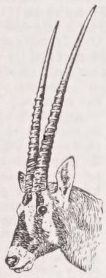
Gemsbok
Encyclopedia Britannica
GEMSBOK{Oryx gazella, Gray), a species of antelope, abounding on the dry yet fertile plains of South Africa, where it feeds on the bulbs of water-root and other kinds of succulent vegetation, by means of which the antelopes of those regions are able to subsist without water for months together. It is a large and powerful animal, measuring about 5 feet in length and over 3 feet in height at the shoulders. Its horns, situated on the same plane with its forehead, exceed 2 feet in length, are. almost straight, and are obscurely ringed throughout their lower half. The colour of the upper part of the body is a rusty grey, aud of the uuder part white, while these are separated from each other by a well-defined black baud on each side. These bands unite on the breast, and are continued as a single black band until reaching the lower jaw, when they again divide and form two transverse bands on the head, terminating at the base of the horns. The head otherwise is white, as also are the limbs, with the exception of the thighs, which are black. The striking appearance presented by this antelope is in great part due to the absence of any blending in the different colours of its body. The gemsbok avoids the woods, living on the open plains in pairs or in small groups of four or five. Possessing powerful weapons of attack in its long spear-like horns, and with ample courage to use them, this animal, especially when wounded, is a formidable antagonist both to man and to the numerous beasts of prey which are attracted to the karroos of the Cape by the presence of this and other ruminant species. It is said to defend itself not unfrequently with success against the lion. Its flesh is esteemed as a delicacy, and its hide forms a valuable leather.
9th ed. Encyclopædia Britannica, vol. 10, p. 141
[318 words — estimated reading time: 2 minutes]
[318 words — estimated reading time: 2 minutes]
No thesaurus entries found for "gems".
King James Bible KJV Bible
Berean Standard Bible BSB Bible
0 KJV and 8 BSB verses contain “gems”
And in cutting of stones, to set them, and in carving of timber, to work in all manner of workmanship.
to cut gemstones for settings, and to carve wood, so that he may be a master of every craft.