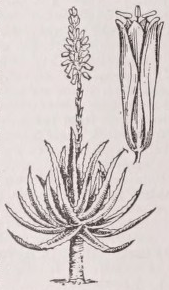
1. al'o, plural aloes, pronounced aloze, and popularly al'oez, in three syllables, according to the Latin. [Latin aloe; Gr; Heb. plu aloe trees.]
2. In botany, a genus of monogynian hexanders, of many species; all natives of warm climates, and most of them, of the southern part of Africa.
3. Among the Mohammedans, the aloe is a symbolic plant, especially in Egypt; and every one who returns from a pilgrimage to Mecca, hangs it over his street door, as a token that he has performed the journey.
4. In Africa, the leaves of the Guinea aloe are made into durable ropes. Of one species are made fishing lines, bow strings, stockings and hammocs. The leaves of another species hole rain water.
2. A genus of succulent plants, some classed as trees, others as shrubs, but the greater number having the habit and appearance of evergreenherbaceous plants; from some of which are prepared articles for medicine and the arts. They are natives of warm countries.
ALOE. Aloes is a medicinal substance used as a purgative, and produced from various species of aloe, such as A. spicata, vulgaris, socotrina, indica, and purpurascens, all belonging to the natural order Liliaceae. Several kinds of aloes are distinguished in commerce—Barbadoes, soco-trine, hepatic, Indian, and Cape aloes. The first two are those commonly used for medicinal purposes. Aloes is the inspissated juice of the leaves of the plant. When the leaves are cut the juice flows out, and is collected and evaporated. After the juice has been obtained, the leaves are sometimes boiled, so as to yield an inferior kind of aloes. The active principle is called aloein. Aloes is used in the form of extract, pill, tincture, and wine. It is irritant, and requires to be used with caution.
The plant called American aloe belongs to a different order, viz., Amaryllidaceae. The plant is called Agave Americana. The juice of the plant, taken immediately before flowering, is used in America for the manufacture of an intoxicatingbeverage. In Ecuador the spongy substance of the flower stem is used instead of tinder, and in the schools the green leaves serve as paper. A punishment among the Aztecs was introducing the spiny points of the leaves into the skin. The plant often delays flowering for many years, and then pushes up a flowering stalk with great rapidity, sometimes at the rate of 1 foot or even 2 feet in twenty-four hours. The fibrous matter procured from the agave by maceration supplies pita flax....
The aloes or lign aloes of the Bible (Numb. xxiv. 6, and Psalm xlv. 8) is quite different from the medicinalaloes. The Hebrew words ahalim and ahaloth, and the Greek word aloe, are. rendered aloes in our version of the Scriptures. The substance is supposed by some to be the fragrant wood of Aquilaria Agallochum, a plant belonging to the natural order Aquilariaceae. There are, however, considerable doubts as to the correctness of this view, more especially as the tree is a native of Cochin China, Silhet, and Northern India, and is not found in Chaldea or Syria. From the allusion made to the trees of lign aloes by Balaam, it seems probable that they were known as growing in Syria. It is quite possible, however, that the precious fragrant substance called aloes, and mentioned in Scripture along with cinnamon, cassia, myrrh, and spices, may have been brought from India. As a perfume it is noted in Psalm xlv. 8; Prov. vii. 17; Song of Sol. iv. 14. The use of aloes in perfuming the coverings of the dead is referred to in John xix. 39, 40.
9th ed. Encyclopædia Britannica, vol. 1, p. 597 [443 words — estimated reading time: 3 minutes]
עלר, a plant with broad leaves, nearly two inches thick, prickly and serrated. It grows about two feet high. A very bitter gum is extracted from it, used for medicinal purposes, and anciently for embalming dead bodies. Nicodemus is said, John xix, 39, to have brought one hundred pounds’ weight of myrrh and aloes to embalm the body of Jesus. The quantity has been exclaimed against by certain Jews, as being enough for fifty bodies. But instead of ἑκατὸν it might originally have been written δέκατον, _ten_ pounds’ weight. However, at the funeral of Herod there were five hundred ἀρωματόφορους, _spice bearers_; and at that of R. Gamaliel, eighty pounds of opobalsamum were used.
The wood which God showed Moses, that with it he might sweeten the waters of Marah, is called _alvah_, Exod. xv, 25. The word has some relation to aloe; and some interpreters are of opinion that Moses used a bitter sort of wood, that so the power of God might be the more remarkable. Mr. Bruce mentions a town, or large village, by the name of Elvah. It is thickly planted with trees; is the _oasis parva_ of the ancients; and the last inhabited place to the west that is under the jurisdiction of Egypt. He also observes that the Arabs call a shrub or tree, not unlike our hawthorn, either in wood or flower, by the name of elvah. “It was this,” say they, “with which Moses sweetened the waters of Marah; and with this, too, did Kalib Ibn el Walid sweeten those of Elvah, once bitter, and give the place the name of this circumstance.” It may be that God directed Moses to the very wood proper for the purpose. M. Neibuhr, when in these parts, inquired after wood capable of this effect, but could gain no information of any such. It will not, however, from hence follow ...that Moses really used a bitter wood; but, as Providence usually works by the proper and fit means to accomplish its ends, it seems likely that the wood he made use of was, in some degree at least, corrective of that quality which abounded in the water, and so rendered it potable. This seems to have been the opinion of the author of Ecclesiasticus, xxxviii, 5. That other water, also, requires some correction, and that such a correction is applied to it, appears from the custom in Egypt in respect to that of the Nile, which, though somewhat muddy, is rendered pure and salutary by being put into jars, the inside of which is rubbed with a paste made of bitter almonds. The first discoverers of the Floridas are said to have corrected the stagnant and fetid water they found there, by infusing in it branches of sassafras; and it is understood that the first inducement of the Chinese to the general use of tea, was to correct the water of their ponds and rivers.
The LIGN-ALOE, or agallochum, Num. xxiv, 6; Psalm xlv, 9; and Cantic. iv, 14. אהלת, masculine, אהל, whose plural is אהלים, is a small tree about eight or ten feet high. That the flower of this plant yielded a fragrance, is assured to us in the following extract from Swinburne’s Travels, letter xii: “This morning, like many of the foregoing ones, was delicious. The sun rose gloriously out of the sea, and all the air around was perfumed with the effluvia of the aloe, as its rays sucked up the dew from the leaves.” This extremely bitter plant contains under the bark three sorts of wood. The first is black, solid, and weighty; the second is of a tawny colour, of a light spongy texture, very porous, and filled with a resin extremely fragrant and agreeable; the third kind of wood, which is the heart, has a strong aromatic odour, and is esteemed in the east more precious than gold itself. It is used for perfuming habits and apartments, and is administered as a cordial in fainting and epileptic fits. These pieces, called calunbac, are carefully preserved in pewter boxes, to prevent their drying. When they are used they are ground upon a marble with such liquids as are best suited to the purpose for which they are intended. This wood, mentioned Cantic. iv, 14, in conjunction with several other odoriferous plants there referred to, was in high esteem among the Hebrews for its exquisite exhalations.
The scented aloe, and each shrub that showers Gum from its veins, and odours from its flowers.
Thus the son of Sirach, Ecclesiasticus xxiv, 15: “I gave a sweet smell like the cinnamon and aspalathus. I yielded a pleasant odour like the best myrrh; like galbanum and onyx, and fragrantstorax, and like the fume of frankincense in the tabernacle.” It may not be amiss to observe that the Persian translator renders _ahalim_, sandal wood; and the same was the opinion of a certain Jew in Arabia who was consulted by Neibuhr.
1. , in medicine, is the inspissated juice of the aloe. The juice is collected from the leaves, which are cut and put in a tub, and when a large quantity is procured, it is boiled to a suitable consistence; or it is exposed to the sun, till all the fluid part is exhaled. There are several kinds sold in the shops; as the socotrine aloes from Socotora, an isle in the Indian ocean; the hepatic or common Barbadoes aloes; and the fetid or caballine aloes
As the valleys are they spread forth, as gardens by the river’s side, as the trees of lign aloes which the LORD hath planted, and as cedar trees beside the waters.
They spread out like palm groves, like gardens beside a stream, like aloes the LORD has planted, like cedars beside the waters.
And there came also Nicodemus, which at the first came to Jesus by night, and brought a mixture of myrrh and aloes, about an hundred pound weight.
Nicodemus, who had previously come to Jesus at night, also brought a mixture of myrrh and aloes, about seventy-five pounds.
This site uses cookies to remember your display preferences (search sources and editions, Bible version, auto-link, images, light/dark theme). No personal data whatsoever is collected. Privacy Policy