
A Hebrew or Israelite.
Word of the Day: Catachrestical
Originally, one belonging to the tribe or kingdom of Judah; after the return from the Babylonish captivity, any member of the new state; a Hebrew; an Israelite.
Jew
Encyclopedia Britannica
JEW, The Wandering. The legend of a Jew doomed to wander until the day of judgment, for an insult offered to Christ, is first mentioned by Roger of Wendover in the Chronicle completed by Matthew Paris, who received the story from an Armenian bishop, who visited England in the year 1228. As told in Matthew’s Historia Major, the legend runs that the wanderer’s name was Cartaphilus, that he was doorkeeper of Pilate’s palace, and that as Jesus was led out to be crucified he struck him on the neck, saying, “Go, Jesus, go on faster; why dost thou linger Ί ” Jesus replied, “I go, but thou shalt remain waiting till I return.” The Armenian bishop, if his French servant and interpreter is to be trusted, said that this wanderer had dined with him shortly before his leaving home, and that he was now a penitent man and had been baptized by Ananias, who also baptized Paul, under the name of Joseph. At the time of the crucifixion he was thirty years of age; whenever he reaches the age of one hundred he becomes faint, and when he becomes conscious again he is as young as when his doom was pronounced. He never smiles, refuses all gifts, and narrates many ancient events to those who come from far and near to listen. On the same authority rests the somewhat later account by Philippe de Mousket in his Chronique rimée. The English chronicler states that the bishop’s statement was in reply to a question whether he had seen or heard of one Joseph, said to have been present at the crucifixion to be preserved in the world as a witness of that event. It would appear, therefore, that there was already in existence a legend of an undying Jew, although nothing was intimated of his insult to Christ. The idea of wandering did not enter into the legend until a later period, when ...persons pretending to be the undying Jew appeared in various parts of Europe. Near the middle of the 16th century the legend appears in Germany, brought there by a man who professed to be the “Ewige Jude” himself. He appeared at Hamburg, in 1547, giving his name as Ahasuerus, and stating that he had been a shoemaker in Jerusalem who would not suffer Christ to rest at his door when fainting under the weight of the cross. He struck Jesus, and bade him move on. Jesus said, “I will stand here and rest, but thou shalt go on until the last day.” This story, however, also rests upon the authority of an irresponsible reporter. It is attributed to Dr Paulus von Eizen, bishop of Schleswig, whose long conversations with Ahasuerus are given, in a work by one Chrysostomus Dudulaeus Westphalus,—probably a pseudonym. This was published some years after the death of Paulus von Eizen, which occurred in 1598, and its aim is to make the story as sensational as possible as a “warning.” This earliest known book on the legend, published at Leipsic, 1602, professes to be derived from a previous one :— Strange Report of a Jew born at Jerusalem, who pretends he was present at the crucifixion of Christ; newly printed at Leyden. Other small works appeared somewhat later, as at “Augspurg, 1619,” and elsewhere, and were continued throughout the 17th century, these containing rumours of the Jew’s appearance in Hamburg, Dantzic, Naumburg, Lübeck, Brussels, Moscow, and Madrid. Rudolph Botoreus, parliamentary advocate of Paris (Comm. histor., 1604), mentions contemptuously the rumours of the appearance of this Jew in Germany, Spain, and Italy, and the popular credulity. The most important account of any of these monomaniacs or pretenders is that given of one in Paris (1644) by The Turkish Spy (book iii., letter i.). “One day I had the curiosity to discourse with him in several languages; and I found him master of all those I could speak. I conversed with him five or six hours together in Arabic.” “The common people are ready to adore him; and the very fear of the multitude restrains the magistrates from offering any violence to this impostor.” From a letter of Madame de Mazarin to Madame de Bouillon, it appears that an individual appeared in England in the beginning of the 18th century professing to have been an officer of rank in Jerusalem who for an insult given to Jesus was doomed to live and wander. It is said that the universities sent professors to cross-examine him, and that many were satisfied of the truth of his story. Several pretenders of the kind appeared in England in the last century. Brand remembered to have seen one going about the streets of Newcastle muttering “Poor John alone.” It is difficult, however, to discover whether in all these cases the rôle of the Wandering Jew was assumed or was added to aged beggars by popular credulity.
The names given to these wanderers are various. Cartaphilus is probably κάρτα φίλος, the “much beloved,” in allusion to St John, who was believed to “tarry” until the coming of Christ. Joseph was perhaps caught from the legend of Joseph of Arimathaea, who was said to have wandered into Britain in the year 63, when his flowering •staff indicated the spot where Glastonbury abbey should be built. The Turkish Spy in Paris gives his name as Michob Ader; Libavius (Praxis Alchymiae) as Butadaeus. In Brussels he was called Isaac Laquedem, a name believed by Grasse to be the French la combined with kedem, Heb. for “aforetime.” Mr Karl Blind has suggested that his name in Germany, Ahasuerus, may have been formed out of a corruption of As-Vidar, “god Vidar,”—the Teutonic deity who was to survive the destruction of the world and conquer the wolf Fenris by thrusting his foot covered with an enormous shoe down the monster’s throat (Gentleman's Magazine, July 1880). This ingenious suggestion would account for the transformation of the wanderer between 1228, when the Armenian bishop described him as Pilate’s doorkeeper, and 1547, when he claims to have been a shoemaker. For a long time there were kept at Bern and also at Ulm enormous pairs of shoes said to have been left by the Wandering Jew on his visits to those places.
The legend of the Wandering Jew seems clearly related 'to a class of myths, found in every part of the world, in •which certain saints or heroes are represented as having never died. Many of these myths,—as those of King Arthur, Charlemagne, Barbarossa, Tell,—are no doubt ethnically connected; but the corresponding myths found among the Incas, and among various American tribes, may lead us to seek for a common root of them all in human nature,—in the unwillingness of men to believe that their heroes can be really dead. In a primitive race, which had not yet conceived the idea of animistic immortality, the notion of a continued existence in happy isles, valleys, or grottoes, would naturally arise. The earliest instance of this earthly immortality would appear to be that of the Persian Yima, king of the Golden Age, who, in the Zend-Avesta, “gathers around him men and animals in flocks, and fills the earth with them, and after the evils of winter had come over his territories leads a select number of the beings of the good creation to a secluded spot, where they enjoy uninterrupted happiness” (Haug’s Essays, &c., p. 277). In a corresponding phase of development the Semitic races ascribed a similar terrestrial immortality to Enoch, Elijah, and some others. The Arabs have very particular accounts of the secret abodes of these; and there are indications that in Eastern folklore Moses was believed to be sleeping in his unknown sepulchre.
By the action of religious dualism on this belief there arose evil counterparts of the immortal heroes, who instead of dwelling in blissful retreats were doomed to wander without finding even the repose of the grave. Of this class Cain was the most conspicuous, and the Bedouin still feels his presence in the feverish desert-winds (Cain-winds), as the Picardy peasant says of a destructive gale, C'est le juif errant qui passe. Esau, Ishmael, and others have been evil wanderers in the superstitions of various localities; but there is one tradition of high antiquity which would appear to have especially prepared the way for our legend. It is related by G. Weil (The Bible, the Koran, and the Talmud, p. 127) that, according to this tradition, the golden calf was made by Al Samiri. Moses was about to put this man to death when Allah declared he should be banished. “Ever since that time he (Samiri) roams like a wild beast throughout the world; every one shuns him, and purifies the ground on which his feet have stood; and he himself, whenever he approaches men, exclaims, Touch me not !” There also arose a belief that this monster dwelt with his progeny on a rocky island in the Arabian
Gulf, from which emanated the plague (Sale, Korane xx ∙)∙
These traditions were inherited by the folklore of Christendom. The mantle of Enoch and Elijah, and other saintly sleepers, fell upon the seven supposed to be slumbering in a cave near Ephesus, near to the slumbering St John, belief in whose earthly immortality is mentioned in the New Testament (John xxi. 23). On the other hand, the mantle of Cain and other evil wanderers would seem to have fallen on Nero, who for some time after his death was believed by friend and foe to be still living. At a later period, after Rome had been Christianized, the idea of a perpetual enemy of the Messiah was temporarily detached from any one man and personified as Antichrist, —a restless invisible spirit appointed by the adversary to resist the rival kingdom. This more abstract conception was prolific of evil wanderers. When, in course of the diffusion of Christianity throughout Europe, its missionaries came in contact with popular beliefs in deities which in many cases had been developed from traditional heroes and warriors,—such as Odin, Waldemar, Vidar,—these imaginary potentates were degraded into phantoms, demons; the brand of Cain was set on their names by solemn anathema, and thenceforth all regions of space had their doomed wanderers,—the Wild Huntsman in the air, the Flying Dutchman on the sea, and various forestphantasms like the Gros Veneur of Fontainebleau and Diedrich of Bern on the earth. The Jewish race, however, was the one race which did not yield to Christianity; its special identification with Antichrist was therefore inevitable. Many superstitions affecting them had long been accumulating. There was a belief that the seven whistlers —plovers or sometimes wild geese—were Jews that had been transformed because they had assisted in the crucifixion of Christ, and to see or hear those birds was regarded as ominous of disaster. The Witch Sabbaths were so called because the Jews were supposed to assemble at them. Their wealth was believed to be obtained from Satan. There was also a belief that they carried about plagues. This idea may partly have been derived from the tradition of Samiri and his island, already mentioned, but possibly derived some confirmation from the actual results of crowding the Jews into the confined and neglected quarters of cities, in disregard of sanitary laws. From innumerable sources like these gathered the cloud of fanaticism which sent its thunderbolts upon the Jewish people. The legend of the Wandering Jew, when it was pieced together, represented precisely the popular belief that this race, having betrayed its supernatural mission, had received a supernatural doom. The legendary figure was invested with the fatal associations of most of the demons which Christianity had degraded. He passed in the storm, presided at orgies, diffused diseases, instigated revolutions, burned cities. He was not only associated with European demons but with those of the Jewish race also. There was a wild fable about Judas,—that he had fulfilled a fearful dream of his mother before his birth, living, despite her throwing him into the sea, to “kill his father and sell his God,”—which reappears in our legend. Judas was said to have become page to Pilate, as Cartaphilus was his doorkeeper. Death refused to touch Judas until his doom had been fulfilled, as it spared the Wandering Jew. In the familiar legend of the discovery of the True Cross, the Jew who, after torture, points out its place of concealment to Helena is named Judas; and M. Magnin has plausibly suggested that the story of the Wandering Jew grew up in connexion with the True Cross legend. As Cain was a prototype of Judas, so was Judas of such doomed wanderers as Malchus in Italy and Ahasuerus in Germany. M. Gaston Paris believes the legend of Malchus to be the earlier. He was said to have struck Jesus with an iron bar, and to have been condemned to walk until judgment-day around a subterranean column, against which he often dashes his head in the vain hope of death.
The respect shown by peasants to persons pretending to bo the Wandering Jew was such as might have been expected for Cain with a mark upon his brow defending him from the hand of man. Such a mark was indeed supposed to be on the Wandering Jew’s forehead. Xemola says it was a red cross concealed by a black bandage, on which account the Inquisition vainly tried to find him. While persecuting actual Jews, the peasantry had some compassion for this imaginary one, and in some parts of Germany two harrows were sometimes left in the field, set up together with teeth downward, it being believed that so the wanderer might obtain a night’s rest.
The Wandering Jew has been a favourite subject of poetry and romance. Goethe {Dichtung und Wahrheit, xv.) has given the scheme of a dramatic poem on the theme which he had contemplated. It has been dealt with by C. F. D. Schubart, Der ewige Jude, 1787; A. W. Schlegel, Warnung, 1811; Aloys Schreiber, Der ewige Jude, 1807; W. Müller, Wanderliedern, 1830; Edgar Quinet, Ahasuerus, 1833; Chamisso, Neuer Ahasuer, 1836; F. Hauttral, Ahasueriad, 1838; Julius Mosen, Ahasuer, 1838; Ludwig Köhler, Der neue Ahasuer, 1841; Nicolas Lenau, Ahasuer, 1843. H. C. Andersen, Ahasueri/s, 1847; E. Grenier, La mort du Juif-Errant, 1857. Béranger (1831) and Wordsworth have written lyrical poems on the subject. Shelley evokes the Wandering Jew six times, notably in his Queen Mali. In 1812 a comedy based on the legend by Craignez was performed in Paris. Klingemann’s tragedy Ahasuerus (1827) was successful as a play. Eugene Sue’s romance (1844), which stimulated popular interest in the legend, has also been often acted. Several German novels have been founded on the legend, the most important being those of Franz Horn, Th. Oelckers, and F. Laun. In England, where the legend had been made familiar by the ballad in Percy's Reliques, there was acted at Drury Lane, in 1797, a comedy by Andrew Franklin, entitled The Wandering Jew, or Love's Masquerade. George Croly’s novel Salathicl is on this subject. See Dr J. G. Th. Grasse, Die Sage υom Ewigen Juden, historisch entwickelt, &c., Dresd. and Leipsic, 1844; Herzog’s RealEncyclopädie; Friedrich Helbig, Die Sage vom “Ewigen Juden," ihre practische Wandlung und Fortbildung, Berlin, 1874; C. Schoebel, La legende du Juif-Errant, Paris, 1877; Gaston Paris, Le Juif-Errant, Paris, 1880. (Μ. D. C.)
9th ed. Encyclopædia Britannica, vol. 13, p. 673
[2,594 words — estimated reading time: 15 minutes]
[2,594 words — estimated reading time: 15 minutes]
1. An instrument of music, which, when placed between the teeth, gives, by means of a bent metal tongue struck by the finger, a sound which is modulated by the breath; -- called also Jew's-trump.
2. The shackle for joining a chain cable to an anchor.
Alt. of Jewstone
A euphorbiaceous shrub of the genus Pedilanthus (P. tithymaloides), found in the West Indies, and possessing powerful emetic and drastic qualities.
1. An ornament worn by ladies, usually consisting of a precious stone, or set with one or more; a pendant worn in the ear.
2. A precious stone.
3. A name expressive of fondness. A mother calls her child, her jewel
1. An ornament of dress usually made of a precious metal, and having enamel or precious stones as a part of its design.
2. A precious stone; a gem.
3. An object regarded with special affection; a precious thing.
Jewel
Encyclopedia Britannica
JEWEL, or Jewell, John (1522-1571), bishop of Salisbury, was born May 24th 1522, at Berry Narbor, near Ilfracombe, Devonshire. At the age of thirteen he entered Merton College, Oxford, where he had for tutor John Parkhurst, afterwards bishop of Norwich, from whom his mind received a bias towards Protestantism. Becoming tutor in Corpus Christi College in 1539, he in his turn took the opportunity of inculcating Protestant principles on his pupils; and in 1546 he received an allowance from a private fund instituted for the benefit of indigent scholars who publicly professed the doctrines of the Reformed faith. After the accession of Mary in 1553 he was expelled by the fellows from the college on account of his opinions, and in a moment of weakness he was induced to sign his adherence to a form of doctrine essentially Romanistic. He, however, speedily repented of his momentary faithlessness to his convictions, and in order to escape the penalties of martyrdom he fled in 1555 to Frankfort, where he publicly abjured his former recantation. On the death of Mary he returned to England. He was one of the learned Protestant doctors appointed to dispute before Elizabeth at Westminster with a like number of Catholics. In the beginning of 1560 he was created bishop of Salisbury, and in the same year he published, with the sanction of the queen and bishops, his Apologia Ecdesiae Anglicanae, which was in fact an argument against the decision of the pope to exclude the Reformers from the council of Trent, convoked to be held in December of that year. The work, as was to be expected, excited very great attention at the time; it was condemned at the meeting of the council, who appointed two divines to reply to its arguments. It was translated into English by Anna, wife of Sir Nicholas ...Bacon, and Elizabeth ordered that a copy of it should be chained in every parish church in England. Its chief English opponent was Thomas Harding, who in 1565 published a Confutation of the Apology, to which Jewel replied in 1567 by the Defence of the Apology. The general argument of Jewel is that unity or predominance of opinion is not a test of truth, and, although he denied that Rome had the support of the fathers, he rested his general case on the fact that the foundation on which the Church of England was built was not that of the fathers but of the apostles and Jesus Christ. His views were strongly anti-sacramentarian, as he held that the Lord’s Supper had nothing more than a commemorative use. Jewel died suddenly at Monkton Farleigh, a small village in his diocese, September 22, 1571.
Joαηηis Juclli vita ctmors, T. Hurnfrcdo autore, was published at London in 1573. The Apology, translated with notes and life by Isaacson, appeared in 1823, and the other biographies of Jewel are one by Le Bas in the Theological Library, 1835, and a short sketch published by the Society for the Promotion of Christian Knowledge, 1850. His works, which are mostly controversial, were collected by Dr R. W. Jelf, and published in 8 vols, at Oxford, 1848.
9th ed. Encyclopædia Britannica, vol. 13, p. 675
[528 words — estimated reading time: 4 minutes]
[528 words — estimated reading time: 4 minutes]
1. JEW'EL-HOUSE
The place where the royal ornaments are reposited.
Adorned with jewels.
One who makes or deals in jewels and other ornaments.
One who makes, or deals in, jewels, precious stones, and similar ornaments.
Jewellery
Encyclopedia Britannica
JEWELLERY (Latin, gaudium ∙ 1 French, jouel, joyau). Personal ornaments appear to have been among the very first objects on which the invention and ingenuity of man were exercised; and there is no record of any people so rude as not to employ some kind of personal decoration. Natural objects, such as small shells, dried berries, small perforated stones, feathers of variegated colours, were combined by stringing or tying together to ornament the head, neck, arms, and legs, the fingers, and even the toes, whilst the cartilages of the nose and ears were frequently perforated for the more ready suspension of suitable ornaments.
Amongst modern Oriental nations we find almost every kind of personal decoration, from the simple caste mark on the forehead of the Hindu to the gorgeous examples of beaten gold and silver work of the various cities and provinces of India. Nor are such decorations mere ornaments without use or meaning. The hook with its corresponding perforation or eye, the clasp, the buckle, the button, grew step by step into a special ornament, according to the rank, means, taste, and wants of the wearer, or became an evidence of the dignity of office. That these ornaments were considered to have some representative purpose even after death is abundantly proved; for it is in truth to the tombs of the various ancient peoples that we must look for evidence of the early existence of the jeweller’s art....
That the Ass*yrians used personal decorations of a very distinct character, and possibly made of precious materials, is proved by the bas reliefs. In the British Museum we have a representation of Samsi Vul IV., king of Assyria (825 b.c.). He wears a cross (Plate XL fig. 1) very similar to the Maltese cross of modern times. The still more ancient Egyptian jewellery is distinctly brought before us by the objects themselves, placed with the embalmed bodies of the former wearers in sarcophagi, only to be opened in our own time. The most remarkable collection of Egyptian art in this direction is to be found in the jewellery taken from the coffin of Queen Aah-hotep, discovered by M. Mariette in the entrance to the valley of the Tombs of the Kings in 1859, and now preserved in the Bûlâk museum. In these objects we find the same ingenuity and perfect mastery of the materials as characterize the monumental work of the Egyptians. Hammered work, incised and chased work, the evidence of soldering, the combination of layers of gold plates, together with coloured stones, are all there,—the handicraft being complete in every respect.
A diadem of gold and enamel, found at the back of the head of the mummy of the queen (fig. 2), was fixed in the back hair, showing the cartouche in front. The box holding this cartouche has on the upper surface the titles of the king, “the son of the sun, Aahmes, living for ever and ever,” in gold on a ground of lapis lazuli, with a chequered ornament in blue and red pastes, and a sphinx couchant on each side. A necklace of the order or decoration of the Fly (fig. 3) is entirely of gold, having a hook and loop to fasten it round the neck. A small porcelain cylinder (fig. 4) is ornamented with interlaced lotus flowers in intaglio, having a ring for suspension, and fig. 5 is a gold drop, inlaid with turquoise or blue paste, in the shape of a fig. A gold chain (fig. 7) is formed of wires closely plaited and very flexible, the ends terminating in the heads of water fowl, and having small rings to secure the collar behind. To the centre is suspended by a small ring a scarabeus of solid gold inlaid with lapis lazuli. These scarabei were in constant use in Egyptian ornaments, and were worn in rings by the military caste. We have an example of a bracelet, similar to those in modern use (fig. 6), and worn by all persons of rank. It is formed of two pieces joined by a hinge, and is decorated with figures in repoussé with a ground inlaid with lapis lazuli. A signet ring (fig. 8) has a square revolving bezel on which are four serpents interlaced.
The discoveries of Dr Schliemann at Mycenae and at Hissarlik, the assumed site of ancient Troy, supply further illustrations of ancient jewellery and gold work. In extent and in the wonderful character of the design and workmanship, the relics found at Mycenae present the most perfect examples, although some of the objects brought from the “burnt city” at Hissarlik give evidence of singular skill and ingenuity in the methods of combining the various portions of an ornament and finesse in working the gold. From Mycenae the objects ranged over most of the personal ornaments still in use: necklaces with gold beads and pendants, butterflies (fig. 16), cuttlefish (fig. 10), single and concentric circles, rosettes, and leafage, with perforations for attachment to clothing, crosses (fig. 9), and stars formed of combined crosses, with crosses in the centre forming spikes,—all elaborately ornamented in detail. The spiral forms an incessant decoration from its facile production and repetition by means of twisted gold wire. Grasshoppers or tree crickets in gold repoussé suspended by chains and probably used for the decoration of the hair, and a griffin (fig. 17), having the upper part of the body of an eagle and ’the lower parts of a lion, with wings decorated with spirals, are among the more remarkable examples of perforated ornaments for attachment to the clothing. -There are also perforated ornaments belonging to necklaces, with intaglio engravings of such subjects as Hercules and the Nemean lion, and a duel of two warriors, possibly Hector and Achilles, one of whom stabs his antagonist in the throat. Another has a representation of a lion, very archaic in treatment, the style resembling that of the fore part of the lion found on the statue of Sardis, attributed to Croesus, 560 b.c. There are also pinheads and brooches formed of two stags lying down (fig. 15), the bodies and necks crossing each other, and the horns meeting symmetrically above the heads, forming a finial. The heads of these ornaments were of gold, with silver blades or pointed pins inserted for use. The bodies of the two stags rest on fronds of the date-palm growing out of the stem which receives the pin. Another remarkable series is composed of figures of women with doves (fig. 20). Some have one dove resting on the head; others have three doves, one on the head and the others resting on arms. The arms in both instances are extended to the elbow, the hands being placed on the breasts. These ornaments are also perforated, and were evidently sewed on the dresses, although there is some evidence that an example with three doves has been fastened with a pin.
Mention must be made of an extraordinary diadem found upon the head of one of the bodies discovered in the same tomb with many objects similar to those noticed above. It is 25 inches in length, covered with shieldlike or rosette ornaments in repoussé, the relief being very low but perfectly distinct, and further ornamented by thirty-six large leaves of repoussé gold attached to it. As an example of design and perfection of detail, another smaller diadem found in another tomb may be noted (fig. 11). It is of gold plate, so thick as to require no “piping” at the back to sustain it; but in general the repoussé examples have a piping of copper wire. Diadems of similar form are found on statues of Aphrodite, and also on statuettes of Hercules in ivory, in the Assyrian collection at the British Museum. Fig. 13 represents a remarkably elegant pendant ornament, the design being of an exceptionally beautiful character. A cross of thin gold work formed of four leaves (fig. 18), a finial-like ornament (fig. 19), and the head of a pin or brooch evidently suggested by a butterfly (fig. 14), are all characteristic of the gold work of Mycenae.
The gold ornaments found at Hissarlik, in what Dr Schliemann calls the “Treasury of Priam,” partake in most instances of the same characteristics as those found in the sepulchres at Mycenae. There are necklaces, brooches, bracelets (fig. 29), hair-pins (fig. 23), earrings (figs. 21, 22, 25, 26, 27, 28), with and without pendants, beads, and twisted wire drops. The majority of these are ornamented with spirals of twisted wire, or small rosettes, with fragments of stones in the centres. The twisted wire ornaments were evidently portions of necklaces. A circular plaque decorated with a rosette (fig. 30) is very similar to those found at Mycenae, and a conventionalized eagle (fig. 31) is characteristic of much of the detail found at that place as well as at Hissarlik. They were all of pure gold, and the wire must have been drawn through a plate of harder metal—probably bronze. The principal ornaments differing from those found at Mycenae are diadems or head fillets of pure hammered gold (fig. 24) cut into thin plates, attached to rings by double gold wires, and fastened together at the back with thin twisted wire. To these pendants (of which those at the two ends are nearly three times the length of those forming the central portions) are attached small figures, probably of idols. It has been assumed that these were worn across the forehead by women, the long pendants falling on each side of the face. If, however, the position on which they were found was formerly part of a temple instead of a palace, it may be suggested that they were used as veils for the priests when giving forth the oracles from the shrine.
Jewellery and gold work of a very similar character has been found at Cyprus within the last few years by Major Cesnola. The rings (Plate XII. figs. 5 and 6) have a great resemblance to the Greek, whilst the beetle, which is of green stone set in gold (fig. 6), has a very Egyptian-like appearance. The great similarity in design and workmanship between these Eastern examples and the gold jewellery and personal ornaments found in Peru and Mexico (figs. 1,2, 3, 4) is not a little remarkable. These, however, are more rude in design, though equally good in workmanship.
Greek, Etruscan, and Roman ornaments partake of very similar characteristics. Of course there is variety in design and sometimes in treatment, but it does not rise to any special individuality. Fretwork is a distinguishing feature of all, together with the wave ornament, the guilloche, and the occasional use of the human figure. The workmanship is often of a character which modern gold workers can only rival with their best skill, and can never surpass. The pendant oblong ornament for containing a scroll (Plate XL fig. 34) is an example of this, as also the Italo-Greek earring (fig. 32). The earring (fig. 36) is an exquisite illustration of Greek skill in the introduction of the human figure; the rosette for concealing the hook and the winged ornament at the back of the Cupid are beautifully wrought. The other earrings (figs. 33, 35, 37) are all characteristic. The Etruscan examples are of the same character. The pendant (fig. 40), the rosette (fig. 38), and the plaque of gold (fig. 38) repeat some of the forms found at Mycenae, with possibly a little more classic grace of detail and refinement of workmanship. The brooch (fig. 41) is perhaps the most characteristic example of purely classic design, essentially Greek in its principal details, whilst the workmanship is all that can be desired.
The granulation of surfaces practised by the Etruscans was long a puzzle and a problem to the modern jeweller, until Signor Castellani of Rome discovered gold workers in the Abruzzi to whom the method had descended through many generations, and, by inducing some of these men to go to Naples, revived the art, of which he contributed examples to the London Exhibition of 1872, successfully applied to modern designs.
The Merovingian jewellery of the 5th century, the Anglo-Saxon of a later date, and the Celtic as leading to the Gothic or mediaeval, have each distinguishing features. In the first two the characteristics are thin plates of gold, decorated with thin slabs of garnet, set in walls of gold soldered vertically like the lines of cloisonné enamel, with the addition of very decorative details of filigree work, beading, and twisted gold. In Plate XII. figs. 9 and 13 we have examples of Anglo-Saxon fibulae, the first being decorated with a species of cloisonne, in which garnets are inserted, while the other is in hammered work in relief. A pendant (fig. 8) is also set with garnets. The buckles (figs. 10, 11, 12) are remarkably characteristic examples, and very elegant in design. A girdle ornament in gold, set with garnets (fig. 14), is an example of Carlovingian design of a high class. The Celtic ornaments are of hammered work, adapted to uses now comparatively unknown, but display another style of workmanship,—details in repoussé, fillings in with amber, rock crystal with a smooth rounded surface cut en cabochon, with the addition of vitreous pastes. The minute filigree and plaited work, in combination with niello and enamel, communicate to the ornaments of this class found in Ireland and Scotland an unmistakable Oriental spirit alike in design and workmanship.
In figs. 15 and 17 are illustrations of two brooches. The first is 13th century; the latter is probably 12th century, and is set with paste, amber, and blue. The brooch in the form of a figure of St Christopher bearing the infant Saviour, and supported by his staff (fig. 16), is of silver gilt. Chaucer mentions such a brooch as worn by the yeoman :—“A Crystofre on his brest of silvyr scheue.”
Rings are the chief specimens now seen of mediaeval jewellery from the 10th to the 13th century. They are generally massive and simple. Through the 16 th century a variety of changes arose; in the traditions and designs of the Cinquecento we have plenty of evidence that the workmen used their own designs, and the results culminated in the triumphs of Albert Dürer, Benvenuto Cellini, and Hans Holbein. The goldsmiths of the Italian republics must have produced works of surpassing excellence in workmanship, and reaching the highest point in design as applied to handicrafts of any kind. The use of enamels, precious stones, niello work, and engraving, in combination with skilful execution of the human figure and animal life, produced effects which modern art in this direction is not likely to approach, still less to rival.
In Plate XII. illustrations are given of various characteristic specimens of the Renaissance, and later forms of jewellery. A crystal cross set in enamelled gold (fig. 18) is German work of the 16th century. The pendant reliquary (fig. 19), enamelled and jewelled, is of 16th century Italian work, and so probably is the jewel (fig. 20) of gold set with diamonds and rubies.
The Darnley or Lenox jewel (fig. 21), now in the possession of the Queen, was made about 1576-7 for Lady Margaret Douglas, countess of Lenox, the mother of Henry Darnley. It is a pendant golden heart set with a heart-shaped sapphire, richly jewelled and enamelled with emblematic figures and devices. It also has Scottish mottoes around and within it. The earring (fig. 22) of gold, enamelled, hung with small pearls, is an example of 17th century Russian work, and another (fig. 23) is Italian of the same period, being of gold and filigree with enamel, also with pendant pearls. A Spanish earring, of 18th century work (fig. 24), is a combination of ribbon, cord, and filigree in gold; and another (fig. 25) is Flemish, of probably the same period: it is of gold open work set with diamonds in projecting collets. The old French-Normandy pendant cross and locket (fig. 26) presents a characteristic example of peasant jewellery; it is of branched open work set with bosses and ridged ornaments of crystal. The earring (fig. 27) is French of 17th century, also of gold open work set with crystals. A small pendant locket (fig. 28) is of rock crystal, with the cross of Santiago in gold and translucent crimson enamel; it is 16th or 17th century Spanish work. A pretty earring of gold open scroll work (fig. 29), set with minute diamonds and three pendant pearls, is Portuguese of 17th century, and another earring (fig. 30) of gold circular open work, set also with minute diamonds, is Portuguese work of 18th century. These examples fairly illustrate the general features of the most characteristic jewellery of the dates quoted.
During the 17th and 18th centuries we see only a mechanical kind of excellence, the results of the mere tradition of the workshop,—the lingering of the power which when wisely directed had done so much and so well, but now simply living on traditional forms, often combined in a most incongruous fashion. Gorgeous effects were aimed at by massing the gold, and introducing stones elaborately cut in themselves, or clustered in groups. Thus diamonds were clustered in rosettes and bouquets; rubies, pearls, emeralds, and other coloured special stones were brought together for little other purpose than to get them into a given space in conjunction with a certain quantity of gold. The question was not of design in its relation to use as personal decoration, but of the value which could be got into a given space to produce the most striking effect.
The traditions of Oriental design as they had come down through the various periods quoted, were comparatively lost in the wretched results of the rococo of Louis XIV. and the inanities of what modern revivalists of the Anglo-Dutch call “Queen Anne.” In the London Exhibition of 1851, the extravagances of modern jewellery had to stand a comparison with the Oriental examples contributed from India. Since then we have learnt more about these works, and have been compelled to acknowledge, in spite of what is sometimes called inferiority of workmanship, how completely the Oriental jeweller understood his work, and with what singular simplicity of method he carried it out. The combinations are always harmonious, the result aimed at always achieved; and, if in attempting to work to European ideas the jeweller failed, this was rather the fault of the forms he had to follow, than due to any want of skill in making the most of a subject in which half the thought and the intended use were foreign to his experience.
A collection of peasant jewellery got together by Castellani for the Paris Exhibition of 1867, and now in the South Kensington Museum, illustrates in an admirable manner the traditional jewellery and personal ornaments of a wide range of peoples in Europe. This collection, and the additions made to it since its acquisition by the nation, show the forms in which these objects existed over several generations among the peasantry of France (chiefly Normandy), Spain, Portugal, Holland, Denmark, Germany, and Switzerland, and also show how the forms popular in one country are followed and adopted in another, almost invariably because of their perfect adaptation to the purpose for which they were designed.
So far we have gone over the progress and results of the jeweller’s art in the past. We have now to speak of the production of jewellery as a modern art industry, in which large numbers of men and women are employed in the larger cities of Europe, but which also has its special localities in which it flourishes, and out of which an important national commerce arises.
Nearly all the great capitals of Europe produce jewellery, but Paris, Vienna, London, and Birmingham are the most important centres. An illustration of methods and processes and the various kinds of jewellery produced at the present day in the manufacture as carried on in London and Birmingham will be sufficient for all practical purposes, and as giving an insight into the technique and artistic manipulation of this branch of art industry; but, by way of contrast, it may be interesting to give in the first place a description of the native working jeweller of Hindustan. Travelling very much after the fashion of a tinker in England, his “budget” contains tools, materials, fire pots, and all the requisites of his handicraft. The gold to be used is generally supplied by the patron or employer, and is frequently in gold coin, which the travelling jeweller undertakes to convert into the ornaments required. He squats down in the corner of a courtyard, or under cover of a veranda, lights his fire, cuts up the gold pieces entrusted to him, hammers, cuts, shapes, drills, solders with the blow-pipe, files, scrapes, and burnishes until he has produced the desired effect. If he has stones to set or coloured enamels to introduce, he never seems to make a mistake; his instinct for harmony...
9th ed. Encyclopædia Britannica, vol. 13, p. 675
[5,597 words — estimated reading time: 35 minutes]
[5,597 words — estimated reading time: 35 minutes]
Jewels in general.
1. The art or trade of a jeweler.
2. Jewels, collectively; as, a bride's jewelry.
A Hebrew woman. Acts 24:24 .
A Hebrew woman.
1. A very large serranoid fish (Promicrops itaiara) of Florida and the Gulf of Mexico. It often reaches the weight of five hundred pounds. Its color is olivaceous or yellowish, with numerous brown spots. Called also guasa, and warsaw.
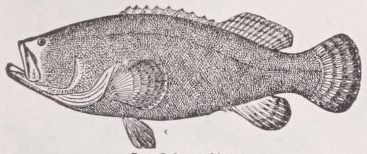
2. A similar gigantic fish (Stereolepis gigas) of Southern California, valued as a food fish.
4. A large herringlike fish; the tarpum.
Pertaining to the Jews or Hebrews. Titus 1:14 .
Of or pertaining to the Jews or Hebrews; characteristic of or resembling the Jews or their customs; Israelitish.
Cunning Roget’s Thesaurus §702
N. cunning, craft, cunningness, craftiness, subtlety, artificiality, maneuvering, temporization, circumvention, chicane, chicanery, sharp practice, knavery, jugglery, concealment, guile, doubling, duplicity, foul play, diplomacy, politics, machiavelism, jobbery, backstairs influence, art, artifice, device, machination, plot, maneuver, stratagem, dodge, sidestep, artful dodge, wile, trick, trickery, ruse, ruse de guerre, finesse, side blow, thin end of the wedge, shift, go by, subterfuge, evasion, white lie, juggle, tour de force, tricks of the trade, tricks upon travelers, espieglerie, net, trap, ulysses, machiavel, sly boots, fox, reynard, scotchman, jew, yankee, intriguer, intrigant, floater, indian giver, keener, repeater
V. be cunning, have cut one's eyeteeth, contrive, live by one's wits, maneuver, intrigue, gerrymander, finesse, double, temporize, stoop to conquer, reculer pour mieux sauter, circumvent, steal a march upon, overreach, throw off one's guard, surprise, snatch a verdict, waylay, undermine, introduce the thin end of the wedge, play a deep game, play tricks with, ambiguas in vulgum spargere voces, flatter, make things pleasant, have an ax to grind, dodge, sidestep, bob and weave
Adj. cunning, crafty, artful, skillful, subtle, feline, vulpine, cunning as a fox, cunning as a serpent, deep, deep laid, profound, designing, contriving, intriguing, strategic, diplomatic, politic, machiavelian, timeserving, artificial, tricky, tricksy, wily, sly, slim, insidious, stealthy, underhand, subdolous, deceitful, slippery as an eel, evasive, crooked, arch, pawky, shrewd, acute, sharp, sharp as a tack, sharp as a needle|, canny, astute, leery, knowing, up to snuff, too clever by half, not to be caught with chaff, tactful, diplomatic, politic, polite
Phr. diamond cut diamond, a' bis ou a blanc, fin contre fin, "something is rotten in the state of denmark"
Parsimony Roget’s Thesaurus §819
N. parsimony, parcity|, parsimoniousness, stinginess, stint, illiberality, tenacity, avarice, greed, miser, niggard, churl, screw, skinflint, crib, codger, muckworm, scrimp, lickpenny, hunks, curmudgeon, harpagon, harpy, extortioner, jew, usurer, hessian, pinch fist, pinch penny
V. be parsimonious, grudge, begrudge, stint, pinch, gripe, screw, dole out, hold back, withhold, starve, famish, live upon nothing, skin a flint, drive a bargain, drive a hard bargain, cheapen, beat down, stop one hole in a sieve, have an itching palm, grasp, grab
Adj. parsimonious, penurious, stingy, miserly, mean, shabby, peddling, scrubby, penny wise, near, niggardly, close, fast handed, close handed, strait handed, close fisted, hard fisted, tight fisted, tight, sparing, chary, grudging, griping, illiberal, ungenerous, churlish, hidebound, sordid, mercenary, venal, covetous, usurious, avaricious, greedy, extortionate, rapacious
Adv. with a sparing hand
Phr. desunt inopioe multa avaritiae omnia, "hoards after hoards his rising raptures fill", "the unsunn'd heaps of miser's treasures", words relating to the sentiment and moral powers
Heterodoxy Roget’s Thesaurus §984
N. heterodoxy, error, false doctrine, heresy, schism, schismaticism, schismaticalness, recusancy, backsliding, apostasy, atheism, bigotry, fanaticism, iconoclasm, hyperorthodoxy, precisianism, bibliolatry, sabbatarianism, puritanism, anthropomorphism, idolatry, superstition, dissent, sectarism, sectarianism, noncomformity, secularism, syncretism, religious sects, protestantism, arianism, adventism, jansenism, stundism, erastianism, calvinism, quakerism, methodism, anabaptism, puseyism, tractarianism, ritualism, origenism, sabellianism, socinianism, deism, theism, materialism, positivism, latitudinarianism &c. high church, low church, broad church, free church, ultramontanism, papism, papistry, monkery, papacy, anglicanism, catholicism, romanism, popery, scarlet lady, church of rome, greek church, paganism, heathenism, ethicism, mythology, polytheism, ditheism, tritheism, dualism, heathendom, judaism, gentilism, islamism, islam, mohammedanism, babism, sufiism, neoplatonism, turcism, brahminism, hinduism, buddhism, sabianism, gnosticism, hylotheism, mormonism, christian science, heretic, apostate, antichrist, pagan, heathen, painim, paynim, giaour, gentile, pantheist, polytheist, idolator, schismatic, sectary, sectarian, sectarist, seceder, separatist, recusant, dissenter, nonconformist, nonjuror, bigot, fanatic, abdal, iconoclast, latitudinarian, deist, theist, unitarian, positivist, materialist, homoiousian, homoousian, limitarian, theosophist, ubiquitarian, skeptic, protestant, huguenot, orthodox dissenter, congregationalist, independent, episcopalian, presbyterian, lutheran, calvinist, methodist, wesleyan, ana, baptist, mormon, latter-day saint, irvingite, sandemanian, glassite, erastian, sublapsarian, supralapsarian, gentoo, antinomian, swedenborgian, adventist, bible christian, bryanite, brownian, christian scientist, dunker, ebionite, eusebian, faith curer, curist, familist, jovinianist, libadist, quaker, restitutionist, shaker, stundist, tunker &c, ultramontane, anglican, oxford school, tractarian, puseyite, ritualist, puritan, catholic, roman, catholic, romanist, papist, jew, hebrew, rabbinist, rabbist, sadducee, babist, motazilite, mohammedan, mussulman, moslem, shiah, sunni, wahabi, osmanli, brahmin, brahman, parsee, sufi, buddhist, magi, gymnosophist, fire worshiper, sabian, gnostic, rosicrucian &c
Adj. heterodox, heretical, unorthodox, unscriptural, uncanonical, antiscriptural, apocryphal, unchristian, antichristian, schismatic, recusant, iconoclastic, sectarian, dissenting, dissident, secular &c, (lay) 997, pagan, heathen, heathenish, ethnic, ethnical, gentile, paynim, pantheistic, polytheistic, judaical, mohammedan, brahminical, buddhist, romish, protestant, bigoted, (obstinate) 606, superstitious, fanatical, idolatrous, visionary
Phr. "slave to no sect", superstitione tollenda religio non tollitur
King James Bible KJV Bible
Berean Standard Bible BSB Bible
428 KJV and 293 BSB verses contain “Jew” — showing the first 20. Show all 454 verses (searchable)
And the servant brought forth jewels of silver, and jewels of gold, and raiment, and gave them to Rebekah: he gave also to her brother and to her mother precious things.
Then he brought out jewels of silver and gold, and articles of clothing, and he gave them to Rebekah. He also gave precious gifts to her brother and her mother.
And the children of Israel did according to the word of Moses; and they borrowed of the Egyptians jewels of silver, and jewels of gold, and raiment:
Furthermore, the Israelites acted on Moses’ word and asked the Egyptians for articles of silver and gold, and for clothing.
For the LORD had said unto Moses, Say unto the children of Israel, Ye are a stiffnecked people: I will come up into the midst of thee in a moment, and consume thee: therefore now put off thy ornaments from thee, that I may know what to do unto thee.
For the LORD had said to Moses, “Tell the Israelites, ‘You are a stiff-necked people. If I should go with you for a single moment, I would destroy you. Now take off your jewelry, and I will decide what to do with you.’”
And they came, both men and women, as many as were willing hearted, and brought bracelets, and earrings, and rings, and tablets, all jewels of gold: and every man that offered offered an offering of gold unto the LORD.
So all who had willing hearts, both men and women, came and brought brooches and earrings, rings and necklaces, and all kinds of gold jewelry. And they all presented their gold as a wave offering to the LORD.
We have therefore brought an oblation for the LORD, what every man hath gotten, of jewels of gold, chains, and bracelets, rings, earrings, and tablets, to make an atonement for our souls before the LORD.
So we have brought to the LORD an offering of the gold articles each man acquired—armlets, bracelets, rings, earrings, and necklaces—to make atonement for ourselves before the LORD.”
And take the ark of the LORD, and lay it upon the cart; and put the jewels of gold, which ye return him for a trespass offering, in a coffer by the side thereof; and send it away, that it may go.
Take the ark of the LORD, set it on the cart, and in a chest beside it put the gold objects you are sending Him as a guilt offering. Then send the ark on its way,
And the Levites took down the ark of the LORD, and the coffer that was with it, wherein the jewels of gold were, and put them on the great stone: and the men of Beth-shemesh offered burnt offerings and sacrificed sacrifices the same day unto the LORD.
And the Levites took down the ark of the LORD and the chest containing the gold objects, and they placed them on the large rock. That day the men of Beth-shemesh offered burnt offerings and made sacrifices to the LORD.
And when Jehoshaphat and his people came to take away the spoil of them, they found among them in abundance both riches with the dead bodies, and precious jewels, which they stripped off for themselves, more than they could carry away: and they were three days in gathering of the spoil, it was so much.
Then Jehoshaphat and his people went to carry off the plunder, and they found on the bodies an abundance of goods and valuables—more than they could carry away. They were gathering the plunder for three days because there was so much.
And Hezekiah had exceeding much riches and honour: and he made himself treasuries for silver, and for gold, and for precious stones, and for spices, and for shields, and for all manner of pleasant jewels;
Hezekiah had very great riches and honor, and he made treasuries for his silver, gold, precious stones, spices, shields, and all kinds of valuable articles.
Be it known unto the king, that the Jews which came up from thee to us are come unto Jerusalem, building the rebellious and the bad city, and have set up the walls thereof, and joined the foundations.
Let it be known to the king that the Jews who came from you to us have returned to Jerusalem. And they are rebuilding that rebellious and wicked city, restoring its walls, and repairing its foundations.