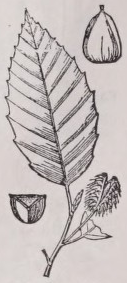
A tree arranged by Linne under the genus fagus, with the chestnut. The beech grows to a large size, with branches forming a beautiful head, with thick foliage. The bark is smooth and of a silvery cast. The mast or nuts are the food of swine, and of certain wild animals, and yield a good oil for lamps. When eaten by man, they are said to occasion giddiness and headache.
BEECH, a well-known tree, the Fagus sylvatιca. For the cultivation and properties of it see Arboriculture, vol. ii. p. 317. The name beech is from the Anglo-Saxon boc, bece, or beoce (Ger. Buche, Swedish, bok), words meaning at once a book and a beech-tree. The connection of the beech with the graphic arts is supposed to have originated in the fact that the ancient Runic tablets were formed of thin boards of beech-wood, “The origin of the word,” says Prior {Popular Names of British Plants'), “is identical with that of the Sanskrit bôkô, letter, bôkôs, writings; and this correspondence of the Indian and our own is interesting as evidence of two things, viz., that the Brahmins had the art of writing before they detached themselves from the common stock of the Indo-European race in Upper Asia, and that we and other Germans have received alphabetic signs from the East by a northern route, and not by the Mediterranean.” Beech-mast, the fruit of the beechtree, was formerly known in England as buck; and the county of Buckingham is so named from its fame as a beechgrowing country. Buckwheat {Buclιeιveizen) derives its name from the similarity of its angular seeds to beech-mast. The generic name Fagus is derived from φάγω, to eat; but the φηγός of Theophrastus was probably the sweet chestnut (cesculus) of the Romans. Beech-mast has been used as food in times of distress and famine; and in autumn it yields an abundant supply of food to park-deer and other game, and to pigs, which are turned into beech-woods in order to utilize the fallen mast. In France it is used for feeding pheasants and domestic poultry. Well-ripened beech-mast yields from 17 to 20 per cent, of a non-drying oil, suitable for illumination, and said to be used in some parts of France and ...other Continental countries in cooking, and as a substitute for butter
9th ed. Encyclopædia Britannica, vol. 3, p. 503 [332 words — estimated reading time: 2 minutes]
Oil expressed from the mast or nuts of the beech-tree. It is used in Picardy, and in other parts of France, instead of butter; but is said to occasion heaviness and pains in the stomach.
BEECHEY, Frederick William, a distinguished naval officer and navigator, son of Sir William Beechey, R.A., was born in London, in 1796. In 1806, at the age of ten, he entered the navy, and was for several years engaged in active service during the wars with France and America. In 1818 he served under Franklin in Buchan’s Arctic expedition, of which at a later period he published a narrative; and in the following year he accompanied Parry in the “Hecla.” In 1821 he took part in the survey of the Mediterranean coast, under the direction of Captain, afterwards Admiral, Smyth. He and his brother, H. W. Beechey, made an overland survey of the north coast of Africa, of which a full and valuable account was published in 1827. In 1825 he was appointed to the “Blossom,” which was intended to explore Behring’s Straits in concert with Franklin and Parry. He passed Behring’s Straits and penetrated as far as lat. 71° 23' 31" N., and long. 156° 2Γ 30" W., reaching a point only 146 miles west of that reached by Franklin’s expedition from the Mackenzie River. The whole voyage lasted more than three years; and in the course of it Beechey discovered several islands in the Pacific, and an excellent harbour near Cape Prince of Wales. A full narrative of his voyage was published in 1825-28. From 1835 to 1847 Captain Beechey was employed on the coast survey of South America and Ireland. He was then appointed by Government to preside over the Marine Department of the Board of Trade. In 1854 he was made rear-admiral, and in the following year wae elected president of the Geographical Society. He died on the 29th Nov. 1856....
BEECHEY, Sir William, R.A., a fashionable portraitpainter, born at Burford in December 1753, was originally bred as a conveyancer, but a strong love for painting induced him to become a pupil at the Royal Academy in 1772. Some of his smaller portraits gained him considerable reputation; he began to be employed by the nobility, and in 1793 became associate of the Academy. In the same year he was made portrait-painter to Queen Charlotte, an appointment which increased his celebrity. He painted the portraits of the members of the royal family, and of nearly all the most famous or fashionable persons of the time. What is considered his finest production is a review of cavalry, a large composition, in the foreground of which he introduced portraits of George III., the Prince of Wales, and the duke of York, surrounded by a brilliant staff on horseback. It was painted in 1798, and obtained for thi artist the honour of knighthood, and the rank of R.A. The earlier portraits of Beechey were carefully drawn and well finished; but in his later days the extent of his employment rendered him less careful in his design. His works are generally vigorous, but are wanting in grace and dignity. He was a good, but not an eminent portrait painter. He died in January 1839, at the advanced age of eighty-six.
9th ed. Encyclopædia Britannica, vol. 3, p. 503 [291 words — estimated reading time: 2 minutes]
This site uses cookies to remember your display preferences (search sources and editions, Bible version, auto-link, images, light/dark theme). No personal data whatsoever is collected. Privacy Policy