
An insect of the genus Apis. [ See Apis .] The species are numerous, of which the honey-bee is the most interesting to man. It has been cultivated from the earliest periods, for its wax and honey. It lives in swarms or societies, of from 10, 000 to 50, 000 individuals. These swarms contain three classes of bees, the females or queen bees, the males or drones, and the neuters or working bees. Of the former, there is only one in each hive or swarm, whose sole office is to propagate the species. It is much larger than the other bees. The drones serve merely for impregnating the queen, after which they are destroyed by the neuters. These last are the laborers of the hive. They collect the honey, form the cells, and feed the other bees and the young. They are furnished with a proboscis by which they suck the honey from flowers, and a mouth by which they swallow it, and then convey it to the hive in their stomachs, where they disgorge it into the cells. The pollen of flowers settles on the hairs with which their body is covered, whence it is collected into pellets, by a brush on their second pair of legs, and deposited in a hollow in the third pair. It is called bee bread, and is the food of the larvae or young. The adult bees feed on honey. The wax was supposed to be formed from pollen by a digestive process, but it is now ascertained that it is formed from the honey by a similar process. The females and neuters have a barbed sting, attached to a bag of poison, which flows into the wound inflicted by the sting. When a hive is overstocked, a new colony is sent out under the direction of a queen bee This is called swarming.
Word of the Day: Catachrestical
Bee
Webster's Dictionary 1913
p. p. of Be; -- used for been.
1. An insect of the order Hymenoptera, and family Apidae (the honeybees), or family Andrenidae (the solitary bees.) See Honeybee.
2. A neighborly gathering of people who engage in united labor for the benefit of an individual or family; as, a quilting bee; a husking bee; a raising bee.
Bee
Encyclopedia Britannica
BEE
THE bee, from its singular instincts, its active industry, and the useful products resulting from its labours, has, from the remotest times, attracted general attention and interest. No nation upon earth has had so many historians as this remarkable class of insects. The patience and sagacity of the naturalist have had an ample field for exercise in the study of the structure, physiology, and domestic economy of bees; their preservation and increase have been objects of assiduous care to the agriculturist; and their reputed perfection of policy and government have long been the theme of admiration, and have supplied copious materials for argument and allusion to the poet and the moralist in every age. It is a subject that has been celebrated by the muse of Virgil, and illustrated by the philosophic genius of Aristotle. Cicero and Pliny record that Aristomachus devoted sixty years to the study of these insects; and Philiscus is said to have retired into a remote wood, that he might pursue his observations on them without interruption. A very great number of authors have written express treatises on bees; periodical works have been published relating exclusively to their management and economy; arid learned societies have been established for the sole purpose of conducting researches on this subject....
In so complicated a branch of natural history, correct observation and induction require laborious and long-continued efforts. But, on the subject of bees, the inquirer after truth had, besides, many obstacles to encounter from the very general diffusion of errors, which had been transmitted without due examination from one author to another. The history of the opinions of successive writers sufficiently proves how gradual and slow has been the growth of an accurate knowledge of these insects,—what is now known being the result of the persevering labours of ages. The accumulation of curious and interesting facts, indeed, which has accrued from the researches of Swammerdam, Maraldi, Reaumur, Schirach, Huber, Dzierzon, and Von Siebold, constitutes almost a new science. It will therefore be proper, in this place, to give a connected and systematic account of the natural history of the bee; and the principal features of internal conformation will be described along with the particular functions. Our descriptions will apply, more especially, to the common and best-known species, the A∕>is mellifica, which is the one particularly prized on account of the rich products it affords.
We shall begin with a brief account of the different sorts of bees inhabiting the hive, and of the respective offices of each; we shall then proceed to consider their comparative physiology, including the leading particulars relating to the functions of their various organs, sensitive pow ers, in stincts, secretions, and diseases. We shall also explain the theory of parthenogenesis and the impregnation of queens, and shall follow the bees in their different labours, from the period when the swarm has settled in a new habitation,—detailing the complex structure of their combs, their curious processes of architecture, and the pains they bestow on rearing their progeny, and in sending forth new swarms; and, in the last place, we shall notice the best systems of modern bee-keeping, and give some account of hives and apiarian implements.
The leading feature in the natural history of bees, and one which distinguishes them from almost all other insects, is their singular distribution into three different kinds, constituting to all appearance so many different modifications of sex. The drone (fig. I), which is characterized by a thicker body, a round head, a more flattened shape, and more obtusely terminated abdomen, within which are contained the male organs of generation, is undoubtedly the male of the species. It is distinguished also by the absence of a sting, and by the humming noise that accompanies its flight. The queen-bee (fig. 2), which is unequivocally recognized as the female, is larger than any of the others, has the abdomen of greater length, and is provided with a sting and two ovaria of considerable size. The worker bees (fig. 3) compose the third class, and are distinguished by the smallness of their size, their lengthened proboscis, the peculiar structure of their legs and thighs, which are adapted to the collection of certain materials obtained from vegetables, and by the apparent absence of every trace of generative organs,—we say apparent, because, as will be shown, rudiments of ovaria do exist, which, however, are not perceptible without a very minute and careful dissection. Till recently the worker bees were regarded as devoid of sex, and were accordingly termed neuters. It is their function to perform all the laborious offices for the community, to construct the interior of their habitation, to explore the country in search of nourishment and other materials, to collect and bring them to the hive, and apply them to different purposes, to attend upon the queen, and supply all her wants, to defend the hive from the attacks of depredators, and to carry on hostilities against the various enemies of the tribe. The life of the queen is chiefly engrossed with the duties of laying eggs. The drones producing neither wax nor honey, and depending on the rest for their subsistence, are idle spectators of the others’ labours. They appear to be formed only for the momentary but important duty of impregnation, since they perish when this purpose is accomplished. There is commonly only one perfect queen existing at a time within each hive, and she usually appears to be treated by all the other bees with every mark of affection and of deference. The number of workers is very different in different hives; sometimes there are only a few thousands; at other times from twenty to forty, or even fifty thousand. The drones, even in the spring, seldom compose more than one-thirtieth or one-fortieth of the whole; and, at other seasons, there are none to be found in the hive when a fertile queen is present. In order to form some estimate of the number of bees wdιich can occupy a certain space, Hunter counted what number of drowned bees could be contained in an alehouse pint, and found it to be 2160; so that if a swarm were to fill two quarts, their numbers would be nearly 9000. Reaumur, with the same view of ascertaining their numbers, employed the more accurate method of weighing them; he found that a collection, weighing one ounce, consisted of 336 bees, and, therefore, that 16 ounces, or one pound, would consist of 5376 bees.
Notwithstanding the difference in conformation, instincts, and offices between the queen-bee and the workers, it is now established on the most incontrovertible evidence that they both originally proceed from the same kind of egg or larva, which is capable of being converted, according to circumstances, either into a worker or a queen. It has been proved that the former, although exhibiting no appearance of sexual organs on a superficial examination, are in reality females, and have the rudiments of these organs, which, however, not being developed, are incapable of exercising theiι* proper functions, although it sometimes happens that they become sufficiently so to enable a worker to lay unfecundated eggs. It may be remarked that the idea of the worker bees being radically females had been suggested long ago by Dr Warder in his Monarchy of Bees, in which he terms them “True Amazons;” but no attention had been paid to his opinion. The real merit of this great discovery, which affords a key to a multitude of hitherto inexplicable facts, unquestionably belongs to Schirach. When first announced to the world it was received with suspicion by the greater number of naturalists, and with complete incredulity by others. It was, indeed, at variance with the whole tenor of the observations of Swammerdam, Maraldi, and Reaumur. Wilhelmi, the brother-in-law of Schirach, though an eye-witness of the experiments from which this theory had been deduced, for a long time refused to admit the doctrine, but at length became one of its most strenuous supporters. It is noticed in a vein of sarcastic ridicule by John Hunter in his otherwise excellent paper on bees in the Philosophical Transactions. Needham wrote a Memoir for the Imperial Academy of Brussels in 1777 for the express purpose of refuting it, and he then inveighs in strong language against those naturalists who had deigned to give it the least countenance. Bonnet, after exercising a laudable scepticism, and making a diligent inquiry, in which he displays a genuine spirit of philosophy, yielded a reluctant assent. But the truth of the doctrine has since been placed beyond the reach of controversy by a multiplied series of observations and experiments in different parts of Europe and America.
In considering the physiology of the bee, the first function that claims our notice is that of nutrition. The food of bees is principally of two kinds, namely, the fluid secretions of vegetables contained in the nectaries of the flowers, and the dust of the anthers, which has been termed by botanists the pollen, but which, when collected by the bees, has received a variety of appellations, such as farina, bee-bread, &c. Occasionally, however, we find bees feeding upon other saccharine substances besides honey, such as honey-dew, syrup, &c.
The organs by which they collect food are extremely complex, comprising instruments adapted to the reception of liquid aliment as well as those fitted for the division of solid materials. Reaumur has given a most elaborate description of these organs, and corrects some errors into which Swammerdam had fallen. For the purpose of taking up fluids, bees are provided, in common with all hymenopterous insects, with a long and flexible proboscis or trunk, which may be considered as a lengthened tongue, though, strictly speaking, it is formed by a prolongation of the under lip. It is not tubular, as Swammerdam had supposed, but solid throughout; and the minute depression at its extremity is not the aperture of any canal through which liquids can be absorbed. The trunk of the bee performs strictly the office of a tongue, and not that of a tube for suction; for when it takes up honey or any other fluid aliment, the under or the upper surfaces are more immediately applied to it, and rolled from side to side, and the bee thus licks up what adheres to it, while the extremity of the trunk is frequently not applied at all to the substance taken up. The trunk is supported on a pedicle, which admits of being bent back or propelled forwards, and thus can retract or stretch out the trunk to a considerable extent. Protection is given to it by a double sheath; the external part consisting of two scales furnished by the expansion of one of the portions of the labial palpi, and the internal formed by the prolongation of the two external portions of the jaw. The whole member thus consists of five principal parts, on which account .Fabricius termed it lingua quinquefida.
For the purpose of mechanically dividing solid materials, the mouth is furnished with two strong mandibles and four palpi; they are but little employed in eating, but are of great use in enabling the insect to seize and break down hard substances for other purposes. In the worker bee all these parts are of larger dimensions than in the other kinds. The teeth are two in number, and have the form of concave scales with sharp edges; they are fixed to the ends of the jaws, and play horizontally as in other insects. Reaumur describes and delineates a large aperture above the root of the proboscis, which is so surrounded with fleshy parts as not to be readily seen unless the proboscis be extended and bent downwards. This he considers as the mouth or orifice of the gullet; on the upper side of which, and of course opposite to the root of the proboscis, a small fleshy and pointed organ is seen, which he regards as the tongue, assisting in the deglutition of the food. Through this orifice, it is presumed, all the aliment, whether liquid or solid, passes; the former being conveyed to it by the trunk, which, by its contractile power, presses forward the fluids it has collected between itself and the inner sheath, and the latter being received directly after its comminution by the teeth, behind which it is situated. Latreille, however, whose authority is great on a point of this nature, thinks that Reaumur has deceived himself with regard to such an aperture, and disbelieves its existence. He conceives that the food simply passes on by the sides of the tongue, finding its way from thence into the oesophagus and so on to the stomach.
The bee has two stomachs. The first is a large transparent membranous bag, pointed in front and swelling out into two pouches behind. It performs an office in some respects analogous to that of the crop in birds; for it receives and retains for a time the fluid of the nectaries, which does not appear to differ in any respect from honey. Hunter observes that whatever time the contents of this reservoir may be retained he never found them altered so as to give the idea of digestion having taken place. The coats of this reservoir are muscular, by which means it is capable of throwing up the honey into the mouth, so that it is regurgitated into the honey cells or imparted to other bees. None of it ever passes out from the extremity of the trunk as Swammerdam had believed. For the purpose of digestion a second stomach is provided, which takes its origin from the middle of the two posterior lobes of the former, and is of a lengthened cylindrical shape. Its communication with the intestine is not direct, but takes place by a projecting or inverted pylorus, thickest at its most prominent part, with a very small opening in the centre, of a peculiar construction. This inward projecting part is easily seen through the coats of the reservoir, especially if full of honey. A similar kind of structure takes place at the communication of the first with the second stomach, and having the properties of a valve, must effectually prevent all regurgitation from the latter into the former. *
The pollen, or fertilising dust of flowers, is collected by the bees for the purpose of feeding the young. It is stored in the cells until required, and then partly digested by the nurses with honey, and a kind of chyle formed of it. When natural pollen cannot be obtained the bees will eagerly take farina, either of rye, chestnuts, or pease, as a substitute, which appears to answer the same purpose. The bees, by means of the pencil of hair which grows on the tarsi, first collect a certain quantity of pollen, ar.d then knead it together into a ball, and place it in the space situated at the middle joint or tibia of the hinder leg, which has been termed the basket. This portion of the leg is smooth and concave, somewhat like the bowl of a spoon, with stout hairs of moderate length rising from its left edge and nearly straight. Other hairs on the right side are much longer and are curved, rising up with a high arch and crossing more than half the width of the hollow, making a large basket-like enclosure for a load of pollen. In order to gather large quantities at once, the bees are sometimes observed to roll their bodies on the flower, and then brushing off the pollen which adheres to them with the feet, form it into two masses, which they dispose of as before mentioned; and it is said that in moist weather, when the particles of pollen cannot be readily made to adhere, they return to their hive dusted all over with pollen, which they then brush off with their feet. The part in Nature’s economy thus unconsciously performed by the bee in common with other insects is most important. By this means the pollen is carried from flower to flower, or from the stamens to the pistils, and plants are made fertile which without such aid would often remain barren.
It was long the received opinion that wax was but a modification of pollen, which required for this conversion only a slight pressure and a kind of kneading by the feet of the bees. But it hae been completely proved, by the researches of Duchet, Hunter, and Huber, that wax is a secretion from the abdomen of the bee, and that it depends not at all on the pollen which the insect may consume (indeed, it is doubtful if it consumes any), but on the quantity of honey or other saccharine substance which it receives into its stomach. The first light thrown on this subject was in a letter of Wilhelmi to Bonnet in 1768, in which he says that wax, instead of being ejected by the mouth, exudes from the rings which enclose the posterior part of the body. Of this we may satisfy ourselves by drawing out the bee from the cell in which it is working with wax, by means of the point of a fine needle; and we may perceive, in proportion as the body is elongated, that the wax will make its appearance under the rings in the form of small scales. Duchet, in his Culture des Abeilles, gives a full statement of the principal circumstances attending the production of wax, which he very j ustly ascribes to the conversion of honey into this substance in the body of the bee. These facts appear to have been entirely overlooked till the subject was again brought forward by Hunter, in his paper in the Philosophical Transactions for 1792. Huber was engaged in prosecuting his inquiries on this subject at the same period with Hunter, and discovered, in 1793, the existence of regular receptacles or pouches, from the coats of which the wax is secreted, and within which it accumulates till its edges raise the scales, and become apparent externally. These plates of wax are withdrawn by the bee itself, or some of its fellow-labourers, and are applied in a manner hereafter to be described.
Huber has shown, by a series of well-conducted experiments, that, in a natural state, the quantity of wax secreted is in proportion to the consumption of honey, but that an equal or even greater quantity will be formed if the bee be fed on a solution of sugar in water. Warmth and rest promote this process of secretion; for the bees, after feeding plentifully on saccharine food, hang together in a cluster without moving, for several hours, at the end of which time large plates of wax are found under the abdominal rings. This happened when bees were confined and restricted from any other sort of nourishment, whilst those that were fed on pollen and fruits alone did not produce any wax. In the second volume of Huber’s Nouvelles Observations sur les Abeilles, he describes minutely the anatomy of the pouches or receptacles for the wax, which are parts peculiar to the working bees, being totally absent iu the males and queens, The cavities are lined with a membrane, which presents a number of folds, forming an hexagonal net-work, not unlike the appearance in the second stomach of ruminant quadrupeds, and evidently destined to perform the office of secretion.
Among the secretions peculiar to the bee, the poison which is poured into the wounds made by the sting deserves to be noticed. It is said to owe its mischievous efficacy to certain pungent salts. If a bee is provoked to strike its sting against a plate of glass, a drop of poison will be discharged; and if this is placed under a microscope, the salts may be seen to concrete, as the liquor dries, into clear, oblong, pointed crystals. The sting consists of a finely-pointed tubular instrument, open along the whole length of its upper surface, this opening being closed by two slender horny barbs each having about ten serrations on its outer edge. These barbs are not projected in advance of the sting as usually described, neither are they within the sting, but complete its outer tubular surface, down the centre of which the poison is injected from a little bag at the root of the sting. The serrations prevent the worker bee from withdrawing its sting from an eneniy; and, consequently, it is torn from the body, with a portion of the intestines, causing the death of the bee.
Respiration is effected by means totally different from those which are usual in the higher classes of the Animal Kingdom. As the blood, or fluid corresponding to the blood, cannot be presented to the air in any separate organ, the air must be conducted to the blood wherever such a fluid is met with. For this purpose tracheae, or air-tubes, having several external openings or spiracles, are made...
9th ed. Encyclopædia Britannica, vol. 3, p. 484
[26,125 words — estimated reading time: 2.5 hours]
[26,125 words — estimated reading time: 2.5 hours]
Bee larkspur
Webster's Dictionary 1913
Bee line
Webster's Dictionary 1913
A bird that feeds on bees. There are several species included in the genus merops, of which the apiaster of Europe is remarkable for the brilliancy of its plumage.
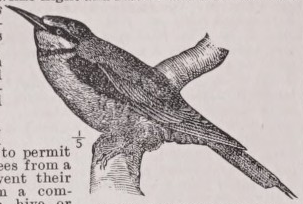
1. A bird of the genus Merops, that feeds on bees. The European species (M. apiaster) is remarkable for its brilliant colors.
2. An African bird of the genus Rhinopomastes.
1. A plant; a species of Ophrys or twyblade, whose flowers represent singular figures of bees, flies and other insects.
3. A soft, unctuous matter with which bees cement the combs to the hives, and close up the cells; called also propolis.
4. A case, box, or other hollow vessel, which serves as a habitation for bees. Hives are made of various materials, as of boards, the hollow trunk of a tree, and withes of straw, or of glass.
5. One who keeps bees.
A tree arranged by Linne under the genus fagus, with the chestnut. The beech grows to a large size, with branches forming a beautiful head, with thick foliage. The bark is smooth and of a silvery cast. The mast or nuts are the food of swine, and of certain wild animals, and yield a good oil for lamps. When eaten by man, they are said to occasion giddiness and headache.
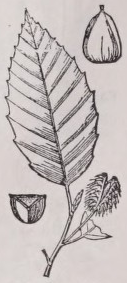
A tree of the genus Fagus.
Beech
Encyclopedia Britannica
BEECH, a well-known tree, the Fagus sylvatιca. For the cultivation and properties of it see Arboriculture, vol. ii. p. 317. The name beech is from the Anglo-Saxon boc, bece, or beoce (Ger. Buche, Swedish, bok), words meaning at once a book and a beech-tree. The connection of the beech with the graphic arts is supposed to have originated in the fact that the ancient Runic tablets were formed of thin boards of beech-wood, “The origin of the word,” says Prior {Popular Names of British Plants'), “is identical with that of the Sanskrit bôkô, letter, bôkôs, writings; and this correspondence of the Indian and our own is interesting as evidence of two things, viz., that the Brahmins had the art of writing before they detached themselves from the common stock of the Indo-European race in Upper Asia, and that we and other Germans have received alphabetic signs from the East by a northern route, and not by the Mediterranean.” Beech-mast, the fruit of the beechtree, was formerly known in England as buck; and the county of Buckingham is so named from its fame as a beechgrowing country. Buckwheat {Buclιeιveizen) derives its name from the similarity of its angular seeds to beech-mast. The generic name Fagus is derived from φάγω, to eat; but the φηγός of Theophrastus was probably the sweet chestnut (cesculus) of the Romans. Beech-mast has been used as food in times of distress and famine; and in autumn it yields an abundant supply of food to park-deer and other game, and to pigs, which are turned into beech-woods in order to utilize the fallen mast. In France it is used for feeding pheasants and domestic poultry. Well-ripened beech-mast yields from 17 to 20 per cent, of a non-drying oil, suitable for illumination, and said to be used in some parts of France and ...other Continental countries in cooking, and as a substitute for butter
9th ed. Encyclopædia Britannica, vol. 3, p. 503
[332 words — estimated reading time: 2 minutes]
[332 words — estimated reading time: 2 minutes]
Beech tree
Webster's Dictionary 1913
The beech.
Charcoal from beech wood.
The beech.
Beechey
Encyclopedia Britannica
BEECHEY, Frederick William, a distinguished naval officer and navigator, son of Sir William Beechey, R.A., was born in London, in 1796. In 1806, at the age of ten, he entered the navy, and was for several years engaged in active service during the wars with France and America. In 1818 he served under Franklin in Buchan’s Arctic expedition, of which at a later period he published a narrative; and in the following year he accompanied Parry in the “Hecla.” In 1821 he took part in the survey of the Mediterranean coast, under the direction of Captain, afterwards Admiral, Smyth. He and his brother, H. W. Beechey, made an overland survey of the north coast of Africa, of which a full and valuable account was published in 1827. In 1825 he was appointed to the “Blossom,” which was intended to explore Behring’s Straits in concert with Franklin and Parry. He passed Behring’s Straits and penetrated as far as lat. 71° 23' 31" N., and long. 156° 2Γ 30" W., reaching a point only 146 miles west of that reached by Franklin’s expedition from the Mackenzie River. The whole voyage lasted more than three years; and in the course of it Beechey discovered several islands in the Pacific, and an excellent harbour near Cape Prince of Wales. A full narrative of his voyage was published in 1825-28. From 1835 to 1847 Captain Beechey was employed on the coast survey of South America and Ireland. He was then appointed by Government to preside over the Marine Department of the Board of Trade. In 1854 he was made rear-admiral, and in the following year wae elected president of the Geographical Society. He died on the 29th Nov. 1856....
BEECHEY, Sir William, R.A., a fashionable portraitpainter, born at Burford in December 1753, was originally bred as a conveyancer, but a strong love for painting induced him to become a pupil at the Royal Academy in 1772. Some of his smaller portraits gained him considerable reputation; he began to be employed by the nobility, and in 1793 became associate of the Academy. In the same year he was made portrait-painter to Queen Charlotte, an appointment which increased his celebrity. He painted the portraits of the members of the royal family, and of nearly all the most famous or fashionable persons of the time. What is considered his finest production is a review of cavalry, a large composition, in the foreground of which he introduced portraits of George III., the Prince of Wales, and the duke of York, surrounded by a brilliant staff on horseback. It was painted in 1798, and obtained for thi artist the honour of knighthood, and the rank of R.A. The earlier portraits of Beechey were carefully drawn and well finished; but in his later days the extent of his employment rendered him less careful in his design. His works are generally vigorous, but are wanting in grace and dignity. He was a good, but not an eminent portrait painter. He died in January 1839, at the advanced age of eighty-six.
9th ed. Encyclopædia Britannica, vol. 3, p. 503
[291 words — estimated reading time: 2 minutes]
[291 words — estimated reading time: 2 minutes]
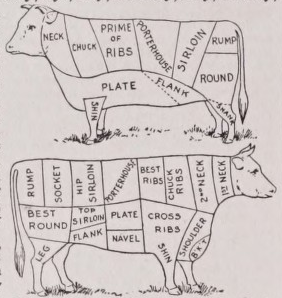
1. An animal of the bovine genus, whether ox, bull or cow; but used of those which are full grown or nearly so. In this, which is the original sense, the word has a plural, beeves.
2. The flesh of an ox, bull, or cow, when killed. In popular language, the word is often applied to the live animal; as, an ox is good beef; that is, is well fattened. In this sense, the word has no plural.
Of, pertaining to, or resembling, beef.
Animal Roget’s Thesaurus §366
N. animal, animal kingdom, fauna, brute creation, beast, brute, creature, critter, wight, created being, creeping thing, living thing, dumb animal, dumb creature, zoophyte, mammal, bird, reptile, amphibian, fish, crustacean, shellfish, mollusk, worm, insect, arthropod, microbe, microbe, animalcule, alligator, crocodile, saurian, dinosaur, snake, serpent, viper, eft, asp, aspick, frog, toad, trout, bass, tuna, muskelunge, sailfish, sardine, mackerel, ant, mosquito, bee, honeybee, tardigrade, spider, biped, quadruped, flocks and herds, live stock, domestic animals, wild animals, game, ferae naturae, beasts of the field, fowls of the air, denizens of the sea, black game, black grouse, blackcock, duck, grouse, plover, rail, snipe, horse, cattle, kine, ox, bull, bullock, cow, milch cow, calf, heifer, shorthorn, sheep, lamb, lambkin, ewe, ram, tup, pig, swine, boar, hog, sow, steer, stot, tag, teg, bison, buffalo, yak, zebu, dog, cat, dog, hound, pup, puppy, whelp, cur, mongrel, house dog, watch dog, sheep dog, shepherd's dog, sporting dog, fancy dog, lap dog, toy dog, bull dog, badger dog, mastiff, blood hound, grey hound, stag hound, deer hound, fox hound, otter hound, harrier, beagle, spaniel, pointer, setter, retriever, newfoundland, water dog, water spaniel, pug, poodle, turnspit, terrier, fox terrier, skye terrier, dandie dinmont, collie, feline, puss, pussy, grimalkin, gib cat, tom cat, fox, reynard, vixen, stag, deer, hart, buck, doe, roe, caribou, coyote, elk, moose, musk ox, sambar, bird, poultry, fowl, cock, hen, chicken, chanticleer, partlet, rooster, dunghill cock, barn door fowl, feathered tribes, feathered songster, singing bird, dicky bird, canary, warbler, finch, aberdevine, cushat, cygnet, ringdove, siskin, swan, wood pigeon, vermin, varmint, pest
Adj. animal, zoological equine, bovine, vaccine, canine, feline, fishy, piscatory, piscatorial, molluscous, vermicular, gallinaceous, rasorial, solidungulate, soliped
Sibilation Roget’s Thesaurus §409
N. sibilance, sibilation, zip, # hiss, sternutation, high note, goose, serpent, snake (animal sounds) 412, insect, bug, bee, mosquito, wasp, fly, tea kettle, pressure cooker, air valve, pressure release valve, safety valve, tires, air escaping from tires, punctured tire, escaping steam, steam, steam radiator, steam release valve
Agent Roget’s Thesaurus §690
N. doer, actor, agent, performer, perpetrator, operator, executor, executrix, practitioner, worker, stager, bee, ant, working bee, termite, white ant, laboring oar, servant of all work, factotum, workman, artisan, craftsman, handicraftsman, mechanic, operative, working man, laboring man, demiurgus, hewers of wood and drawers of water, laborer, navvy, hand, man, day laborer, journeyman, charwoman, hack, mere tool, beast of burden, drudge, fag, lumper, roustabout, maker, artificer, artist, wright, manufacturer, architect, builder, mason, bricklayer, smith, forger, vulcan, carpenter, ganger, platelayer, blacksmith, locksmith, sailmaker, wheelwright, machinist, mechanician, engineer, sempstress, semstress, seamstress, needlewoman, workwoman, tailor, cordwainer, minister, servant, representative, (deputy) 759, coworker, party to, participator in, particeps criminis, dramatis personae, personnel
Phr. quorum pars magna fui, faber est quisque fortunae suae
Sociality Roget’s Thesaurus §892
N. sociality, sociability, sociableness, social intercourse, consociation, intercourse, intercommunity, consortship, companionship, comradeship, clubbism, esprit de corps, conviviality, good fellowship, good company, joviality, jollity, savoir vivre, festivity, festive board, merrymaking, loving cup|, hospitality, heartiness, cheer, welcome, welcomeness, greeting, hearty welcome, hearty reception, warm reception, urbanity, familiarity, good fellow, jolly fellow, bon enfant, bawcock, social circle, family circle, circle of acquaintance, coterie, society, company, social gathering, social reunion, assembly, barbecue, bee, corn-husking, corn-shucking, house raising, barn raising, husking, husking-bee, infare, party, entertainment, reception, levee, at, home, conversazione, soiree, matine, evening party, morning party, afternoon party, bridge party, garden party, surprise party, kettle, kettle drum, partie carre, dish of tea, ridotto, rout|, housewarming, ball, festival &c, smoker, smoker-party, sociable, stag party, hen party, tamasha|, tea-party, tea-fight*, (amusement) 840, "the feast of reason and the flow of soul", birthday party, christmas party, new year's eve party, thanksgiving day dinner, bonenkai, wedding reception, visiting, round of visits, call, morning call, interview, assignation, tryst, trysting place, appointment, club
V. be sociable, know, be acquainted, associate with, sort with, keep company with, walk hand in hand with, eat off the same trencher, club together, consort, bear one company, join, make acquaintance with, make advances, fraternize, embrace, be at home with, feel at home with, make oneself at home with, make free with, crack a bottle with, receive hospitality, live at free quarters, find the latchstring out, visit, pay a visit, interchange visits, interchange cards, call at, call upon, leave a card, drop in, look in, look one up, beat up one's quarters, entertain, give a party, be at home, see one's friends, hang out, keep open house, do the honors, receive, receive with open arms, welcome, give a warm reception, to kill the fatted calf
Adj. sociable, companionable, clubbable, conversable, cosy, cosey, chatty, conversational, homiletical, convivial, festive, festal, jovial, jolly, hospitable, welcome, welcome as the roses in may, fted, entertained, free and easy, hall fellow well met, familiar, on visiting terms, acquainted, social, neighborly, international, gregarious
Adv. en famille, in the family circle, sans fa on, sans ceremonie, arm in arm
Phr. "a crowd is not company", "be bright and jovial among your guests tonight", "his worth is warrant for his welcome", "let's be red with mirth", "welcome the coming speed the parting guest"
King James Bible KJV Bible
Berean Standard Bible BSB Bible
487 KJV and 813 BSB verses contain “bee” — showing the first 20. Show all 1,102 verses (searchable)
And on the seventh day God ended his work which he had made; and he rested on the seventh day from all his work which he had made.
And by the seventh day God had finished the work He had been doing; so on that day He rested from all His work.
Twelve years they served Chedorlaomer, and in the thirteenth year they rebelled.
For twelve years they had been subject to Chedorlaomer, but in the thirteenth year they rebelled.
Wherefore the well was called Beer-lahai-roi; behold, it is between Kadesh and Bered.
Therefore the well was called Beer-lahai-roi. It is located between Kadesh and Bered.
And Abraham planted a grove in Beer-sheba, and called there on the name of the LORD, the everlasting God.
And Isaac came from the way of the well Lahai-roi; for he dwelt in the south country.
Now Isaac had just returned from Beer-lahai-roi, for he was living in the Negev.
And it came to pass after the death of Abraham, that God blessed his son Isaac; and Isaac dwelt by the well Lahai-roi.
After Abraham’s death, God blessed his son Isaac, who lived near Beer-lahai-roi.
And Isaac digged again the wells of water, which they had digged in the days of Abraham his father; for the philistines had stopped them after the death of Abraham: and he called their names after the names by which his father had called them.
Isaac reopened the wells that had been dug in the days of his father Abraham, which the Philistines had stopped up after Abraham died. And he gave these wells the same names his father had given them.
And they said, We saw certainly that the LORD was with thee: and we said, Let there be now an oath betwixt us, even betwixt us and thee, and let us make a covenant with thee;
“We can plainly see that the LORD has been with you,” they replied. “We recommend that there should now be an oath between us and you. Let us make a covenant with you