
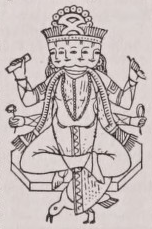
The chief deity of the Indian nations, considered as the creator of all things.
BRAHMANISM is a term commonly used to denote a system of religious institutions originated and elaborated by the Brahmans, the sacerdotal and, from an early period, the dominant caste of the Hindu community. In like manner, as the language of the Aryan Hindus has undergone continual processes of modification and dialectic division, so their religious belief has passed through various stages of development broadly distinguished from one another by certain prominent features. The earliest phases of religious thought in India of which a clear idea can now be formed are exhibited in a body of writings, looked upon by later generations in the light of sacred writ, under the collective name of Veda (“knowledge”) or&ruti (“revelation”). The Hindu scriptures consist of four separatè collections, or Sanhitäs, of sacred texts, or Mantras, including hymns, incantations, and sacrificial forms of prayer, viz., the Rich (nom. sing, rik) or Rigυeda, the Säman or Sämaveda, the Yajush or Yajxιrveda, and the Atharυan or Atharvaveda. Each of these four text-books has attached to it a body of prose writings, called Brähmanas, which presuppose the Sanhitäs, purporting as they do to explain chiefly the ceremonial application of the texts and the origin and import of the sacrificial rites for which these were supposed to have been composed. Besides the Brähmanas proper, these theological works, and in a few isolated cases some of the Sänhitäs, include two kinds of appendages, the Aranyakas and Upanishads, both of which, and especially the latter, by their language and contents, generally betray a more modern origin than the works to which they are annexed. The subject of the former class of these treatises is on the whole similar to that of the Brähmanas, which they ...supplement, giving at the same time somewhat more prominence to the mystical sense of the rites of worship. The Upanishads, on the other hand, are taken up to a great extent with speculations on the problems of the universe and the religious aims of man,—subjects often touched upon in the earlier v/ritings, but here dealt with in a more mature and systematic way. Two of the Sanhitäs, the Säman and the Yajush, owing their existence to purely ritual purposes, and being, besides, the one almost entirely, the other partly, composed of verses taken from the Rigveda are only of secondary importance for our present inquiry. The hymns of the Rigυeda constitute the earliest lyrical effusions of the Aryan settlers in India which have been handed down to posterity. They are certainly not all equally old; on the contrary they evidently represent the literary activity of many generations of bards, though their relative age cannot as yet be determined with anything like certainty. The tenth and last book of the collection, however, at any rate has all the characteristics of a later appendage, and in language and spirit many of its hymns approach very nearly to the level of the contents of the Atharvan. Of the latter collection about one-sixth is found also in the Rigveda, and especially in the tenth book; the larger portion peculiar to it, though including no doubt some older pieces, appears to owe its origin to an age not long anterior to the composition of the Brâhmanas.
The state of religious thought among the ancient bards, as reflected in the hymns of the Rigveda, is that of a worship of the grand and striking phenomena of nature regarded in the light of personal conscious beings, endowed with a power beyond the control of man, though not insensible to his praises and actions. It is a nature-worship purer than that met with in any other polytheistic form of belief w e are acquainted with,—a mythology still comparatively little affected by those systematizing tendencies which, in a less simple and primitive state of thought, lead to the construction of a well-ordered pantheon and a regular organization of divine government. To the mind of the early Vedic worshipper the various departments of the surrounding nature are not as yet clearly defined, and the functions which he assigns to their divine representatives continually flow into one another. Nor has he yet learned to care to determine the relative worth and position of the objects of his adoration; but the temporary influence of the phenomenon to which he addresses his praises bears too strongly upon his mind to allow him for the time to consider the claims of rival powers to which at other times he is wont to look up with equal feelings of awe and reverence. It is this immediateness of impulse under which the human mind in its infancy strives to give utterance to its emotions that imparts to many of its outpourings the ring of monotheistic fervour.
The generic name given to these impersonations, viz., deva (“ the shining ones ”), points to the conclusion, sufficiently justified by the nature of the more prominent objects of Vedic adoration as well as by common natural occurrences, that it was the beautiful phenomena of light which first and most powerfully swayed the Aryan mind. In the primitive worship of the manifold phenomena of nature it is not, of course, so much their physical aspect that impresses the human heart as the moral and intellectual forces w , hich are supposed to move and animate them. The attributes and relations of some of the Vedic deities, in accordance with the nature of the objects they represent, partake in a high degree of this spiritual element; but it is not improbable that in an earlier phase of Aryan worship the religious conceptions were pervaded by it to a still greater and more general extent, and that the Vedic belief, though retaining many of the primitive features, has on the whole assumed a more sensuous and anthropomorphic character. This latter element is especially predominant in the attributes and imagery applied by the Vedic poets to Indra, the god of the atmospheric region, the favourite figure in their pantheon. While the representatives of the prominent departments of nature appear to the Vedic bard as consisting in a state of independence of . one another, their relation to the mortal worshipper being the chief subject of his anxiety, a simple method of classification was already resorted to at an early time, consisting in a triple division of the deities into gods residing in the sky, in the air, and on earth. It is not, however, until a later stage,—the first clear indication being conveyed in a passage of the tenth book of the Rigveda, that this attempt at a polytheistic system is followed up by the promotion of one particular god to the dignity of chief guardian for each of these three regions. On the other hand, a tendency is clearly traceable in some of the hymns towards identifying gods whose functions present a certain degree of similarity of nature; these attempts would seem to show a certain advance of religious reflection, the first steps from polytheism towards a comprehension of the unity of divine essence. Another feature of the old Vedic worship tended to a similar result. The great problems of the origin and existence of man and universe had early begun to engage the Hindü mind; and in celebrating the praises of the gods the poet was frequently led by his religious, and not wholly disinterested, zeal to attribute to them cosmical functions of the very highest order. At a later stage of thought, chiefly exhibited in the tenth book of the Rigveda and the Atharvaveda, inquiring sages could not but perceive the inconsistency of such concessions of a supremacy among the divine rulers, and tried to solve the problem by conceptions of an independent power, endowed with all the attributes of a supreme deity, the creator of the universe, including the gods of the pantheon. The names under which this monotheistic idea is put forth are mostly of an attributive character, and indeed some of them, such as Prajäpati (“lord of creatures ”), Visυakarman (“ all-doer ”), occur in the earlier hymns as mere epithets of particular gods. But to other minds this theory of a personal creator left many difficulties unsolved. They saw, as the poets of old had seen, that everything around them, that man himself, was directed by some inward agent; and it needed but one step to perceive the essential sameness of these spiritual units, and to recognize their being but so many individual manifestations of one universal principle. Thus a pantheistic conception was arrived at, put forth under various names, such as Purυsha (“soul”), Käma (“desire”), Brahman (neutr.; nom. sing, brahma) ( “devotion, prayer”). Metaphysical and theosophic speculations were thus fast undermining the simple belief in the old gods, until, at the time of the composition of the Brâhmanas and Upanishads, we find them in complete possession of the minds of the theologians. Whilst the theories crudely suggested in the later hymns are now further matured and elaborated, the tendency towards catholicity of formula favours the combination of the conflicting monotheistic and pantheistic conceptions; this compromise, which makes Präjapati, the personal creator of the world, the manifestation of the impersonal Brcιhma, the universal self-existent soul, leads to the composite pantheistic system which forms the characteristic dogma of the Brähmanical period.
The spirit of Vedic worship is pervaded by a strong belief in the efficacy of invocation and sacrificial offering. The earnest and well-expressed prayer cannot fail to draw the divine power to the worshipper and make it yield to his supplication; and offerings, so far from being mere acts of devotion which give pleasure to the god, represent the very food and drink which render him vigorous and capable of battling with the enemies of his mortal friend. This intrinsic power of invocation found an early expression in the term brdhma (neuter)(“religious devotion, prayer, hymn”); and its independent existence as an active moral principle in shaping the destinies of man became recognized in the Vedic pantheon in the conception of a god, Brihaspati or Brahmanaspati (“lord of prayer ”), the guardian of the pious worshipper. This feature in the Hindu belief could scarcely fail early to engender and foster in the minds of the people feelings of esteem and reverence towards those who possessed the inspired gift of poetical expression, as well as those who had acquired an intimate knowledge of the various forms of ritual worship. The common term used in the Veda for the officiating priest is brahman (masc.; nom. sing, brahma), originally denoting, it would seem, “one who prays, a worshipper/’ or “the composer or reciter of a hymn (brdhman, n.)” In some passages the word also signifies a special class of priests who officiated as superintendents during sacrificial ceremonies, the complicated naturo of which required the co-operation of several priests. It is probable that in most cases the function of the poet or composer of hymns was combined with that of a minister of worship. In the Vedic hymns two classes of society, the royal (or military) and the priestly classes, were evidently recognized as being raised above the level of the Vis', or bulk of the Aryan community. These social grades seem to have been in existence even before the separation of the two Asiatic branches of the Indo-European race, the Aryans of Iran and India. It is true that, although the Athrava, Rathaëstâo, and Vattrya of the Zend Avesta correspond in position and occupation to the Brähman, Räjan, and Fïs' of the Veda, there is no similarity of names between them; but this fact only shows that the common vocabulary had not yet definitely fixed on any specific names for these classes. Even in the Veda their nomenclature is by no means limited to a single designation for each of them. Moreover, Atharvan occurs not infrequently in the hymns as the personification of the priestly profession, as the proto-priest who is supposed to have obtained fire from heaven and to have instituted the rite of sacrifice; and although ratheshtha (j i standing on a car”) is not actually found in connection with the Räjan or Kshatriya, its synonym rathin is in later literature a not unusual epithet of men of the military caste. At the time of the hymns, aud even during the common IndoPersian period, the sacrificial ceremonial had already become sufficiently complicated to call for the creation of a certain number of distinct priestly offices with special duties attached to them. While this shows clearly that the position and occupation of the priest were those of a profession, the fact that the terms brähmana and brahmaputra, both denoting “the son of a brahman,” are used in certain hymns as synonyms of Brahman, seems to justify the assumption that the profession had already, to a certain degree, become hereditary at the time when these hymns were composed. There is, however, with the exception of a solitary passage in a hymn of the last book, no trace to be found in the Rigυeda of that rigid division into four castes separated from one another by unsurmountable barriers, which in later times constitutes the distinctive feature of Hindü society The idea of caste is expressed by the Sanskrit term varna, originally denoting “colour,” thereby implying differences of complexion between the several classes. The word occurs in the Veda in the latter sense, but it is used there to mark the distinction, not between the three classes of the Aryan community, but between them on the one hand and a dark-coloured hostile people on the other. The latter, called Däsas or Däsyus, consisted, no doubt, of the indigenous tribes, with whom the Aryans had to carry on a continual struggle for the possession of the land. The partial subjection of these comparatively uncivilized tribes, as the rule of the superior race was gradually spreading eastward, and their submission to a state of serfdom under the name of èüdras, added to the Aryan community an element, totally separated from it by colour, by habits, by language, and by occupation. Moreover, the religious belief of these tribes being entirely different from that of the conquering people, the pious Aryas, and especially the class habitually engaged in acts of worship, could hardly fail to apprehend considerable danger to the purity of their own faith from too close and intimate a contact between the two races. What more natural, therefore, than that measures should have been early devised to limit the intercourse between them within as narrow bounds as possible. In course of time the difference of vocation, and the greater or less exposure to the scorching influence of the tropical sky, added, no doubt, to a certain admixture of Sfidra blood, especially in the case of the common people, seem to have produced also in the Aryan population different shades of complexion, which greatly favoured a tendency to rigid class-restrictions originally awakened and continually fed by the lot of the servile race. Meanwhile the power of the sacerdotal order having been gradually enlarged in proportion to the development of the minutiae of sacrificial ceremonial and the increase of sacred lore, they began to lay claim to supreme authority in regulating and controlling the religious and social life of the people. The author of the so-called Purusha-sükta, or hymn to Purusha, above referred to, represents the four castes— the Brähmanas, Kshatriyas, Vaiéyars, and Südras — as having severally sprung from the mouth, the arms, the thighs, and the feet of Purusha, a primary being, here assumed to be the source of the universe. It is very doubtful, however, whether at the time when this hymn was composed the relative position of the two upper castes could already have been settled in so decided a way as this theory might lead us to suppose. There is, on the contrary, reason to believe that some time had yet to elapse, marked by fierce and bloody struggles for supremacy, of which only imperfect ideas can be formed from the legendary and biassed accounts of later generations, before the Kshatriyas finally submitted to the full measure of priestly pretension.
The definitive establishment of theBrähmanical hierarchy marks the beginning of the Brähmanical period properly so called. Though the origin and gradual rise of some of the leading institutions of this era can, as has been shown, be traced in the earlier writings, the chain of their development presents a break at this juncture which no satisfactory materials enable us to fill up. A considerable portion of the literature of this time has apparently been lost; and several important works, the original composition of which has probably to be assigned to the early days of Brahmanism, such as the institutes of Manu and the two great epics, the Mahabharata and Rämäyana, in the form in which they have been handed down to us, show manifest traces cf a more modern redaction. Yet it is sufficiently clear from internal evidence that Manu’s Code of Laws, though it is merely a metrical rifacimento of older materials, reproduces on the whole pretty faithfully the state of Hindu society depicted in the sources from which it was compiled. The final overthrow of the Kshatriya power was followed by a period of jealous legislation on the part of the Brahmans. For the time their chief aim was to improve their newly gained vantage-ground by surrounding everything oonnected with their order with a halo of sanctity calculated to impress the lay community with feelings of awe. In the Brähmanas and even in the Purusha Hymn, and the Atharvan, divine origin had already been ascribed to the Vedic Sanhitäs, especially to the three older collections. The same privilege was now successfully claimed for the later Vedic literature, so imbued with Brâhmanic aspirations and pretensions; and the authority implied in the designation of Sruti or revelation removed henceforth the whole body of sacred w ritings from the sphere of doubt and criticism. This concession necessarily involved an acknowledgement of the new social order as a divine institution. Its stability was, however, rendered still more secure by the elaboration of a system of conventional precepts, partly forming the basis of Manu’s Code, which clearly defined the relative position and the duties of the several castes, and determined the penalties to be inflicted on any transgressions of the limits assigned to each of them. These laws are conceived with no humane or sentimental scruples on the part of their authors. On the contrary, the offences committed by Brahmans against other castes are treated with remarkable clemency, whilst the punishments inflicted for trespasses on the rights of higher classes are the more severe and inhuman the lower the offender stands in the social scale. The three first castes, however unequal to each other in privilege and social standing, are yet united by a common bond of sacramental rites (sanskäras), traditionally connected from ancient times with certain incidents and stages in the life of the Aryan Hindü, as conception, birth, name-giving, the first taking out of the child to see the sun, the first feeding with boiled rice, the rites of tonsure and hair cutting, the youth’s investiture with the sacrificial thread, and his return home on completing his studies, marriage, funeral, <fcc. The modes of observing these family rites are laid down in a class of writings called Grihya-sûtras, or domestic rules. The most important of these observances is the upanayana, or rite of conducting the boy to a spiritual teacher. Connected with this act is the investiture with the sacred cord, ordinarily worn over the left shoulder and under the right arm, and varying in material according to the class of the wearer. This ceremony being the preliminary act to the youth’s initiation into the study of the Veda, the management of the consecrated fire and the knowledge of the rites of purification, including the savitri, a solemn invocation to savitri, the sun, which has to be repeated every morning and evening before the rise and after the setting of that luminary, issupposed to constitute the second or spiritual birth of the Arya. It is from their participation in this rite that the three upper classes are called the twice-born. The ceremony is enjoined to take place some time between the eighth and sixteenth year of age in the case of a Brahman, between the eleventh and twenty-second year of a Kshatriya, and between the twelfth and twenty-fourth year of a Vaisya. He who has not been invested with the mark of his class within this time is for ever excluded from uttering the sacred savitri and becomes an outcast, unless he is absolved from his sin by a council of Brahmans, and after due performance of a purificatory rite resumes the badge of his caste. With one not duly initiated no righteous man is allowed to associate or to enter into connections of affinity. The duty of the Sûdra is to serve the twice-born classes, and above all the Brahmans. He is excluded from all sacred knowledge, and if he performs sacrificial ceremonies he must do so...
BRAHMAPUTRA, one of the largest rivers of India, with a total length of 1800 miles, rises near the lake Mânsarowar in the plateau of Thibet, where it is known by the name of Sânpu, flows eastward for about 1000 miles, and skirting round the eastern passes of the Himalayas not far from the Yang-tse-kiang and the great river of Cambodia, enters the plain of British India on the north-eastern frontier of Assam. It then runs westward, dividing the province of Assam into two unequal portions, turns southward into Eastern Bengal, and joins the Ganges opposite Goâlanda, the terminus of the Eastern Bengal Railway. The united stream then flows south-west, joins the Meghnâ, and after another southern stretch of about 100 miles, empties itself into the Bay of Bengal. The body of water formed by the union of these three noble rivers, the Brahmaputra, Ganges, and Meghnâ, expands during the latter part of its course into a vast estuary, studded with large islands. The Brahmaputra proper in Assam is formed by the union of three streams, in 27° 45' N. lat. and 95° 30' E. long.,—the Sânpu or Dihang, the Dibang, and another stream, which, although the least of the three, the Hindus have taken as the main branch, honouring it with the name of Brahmaputra, and sanctifying it in their mythology. This branch, which many European writers have accepted as the main Brahmaputra, takes its rise in a valley called the Brahmakunda, on the side of the eastern extremity of the Himalaya Mountains beneath the snowy range....
The upper part of the Brahmaputra is entirely in Thibet, and divides the broad plateau drained by the very elevated Thibetian lakes from the narrow plateau which divides the northern and southern Himalayan ranges, where the affluents of the Ganges spring from perennial snow. At the western extremity of the Brahmaputra basin the main river is 14,000 feet above the sea, and after a course of 600 miles it is still 11,000feet high. Nothing is known of its passage across the Himalaya Mountains. The features of the passage are probably similar to those exhibited by the gorge of the Sutlej; but it is a reproach to the science and enterprise of the 19th century to allow such a problem to remain unsolved. Eastward the basin of the Brahmaputra is bounded by that of the Yang-tse-Kiang, which here flows through tremendous gorges on its way to the plains of China and the Yellow Sea. Some contend that the basins of the Irawadi, Salwin, and Cambodia rivers, are interposed between the Brahmaputra and the Yang-tse-Kiang, although they approach each other within 150 miles. On the south, the Pâtkai Mountains, terminating in the Manipur and Chittagong hills, separate the Brahmaputra from the Irawadi and the basins of the Arakan coast. The principal tributaries of the Brahmaputra are the Dibru, Buri Dihing, Disang, Subansiri, Manâs, BAghmi, Dharlâ, and Tista. The Brahmaputra forms many islands during its course; among which that of Mijuli, enclosed by the Brahmaputra and its branch the Lohit, contains an area of 282,165 acres, ana is well inhabited and cultivated. In Assam the Brahmaputra also bears the name of the Hiranya, and above its junction with the Ganges it is called the Jamuna. The principal towns on its banks in Assam are Dibrugarh, Tezpur, Gauhati, Goalpara, and in Bengal Sirajganj. Its volume of water has been computed at Goâlpara during its lowest ebb at 146,188 cubic feet per second. During the rains, when the river attains a height of 30 to 40 feet above its common level, its body of water may fairly be computed at four times the above quantity. The Brahmaputra is navigable as far as Dibrugarh, but in the dry season only for steamers of light draught. In the rains it overflows its banks and spreads over the country for hundreds of square miles. At Goâlanda, where it joins the Ganges, the current is so strong during the rains, and the eddies and whirlpools formed by the meeting of the waters so numerous, that large and powerful river steamers are often unable to make headway, and have to lie for days until the river subsides. The main branch of the Brahmaputra formerly flowed through the eastern district of Maimansinh, but the greater part of its water now finds its way through the Jamuna. The total length, as above stated, is 1800 miles; but if its source be taken at the Brahmakunda, the length of the river only amounts to 930 miles. Until 1765 the Brahmaputra River was unknown in Europe as a first-class river, and Major Rennel, on exploring it, was surprised to find it larger than the Ganges. The tore, or upward wave caused by the sudden influence of the tide, occurs in all the passages between the islands of the estuary formed by the united streams of the Brahmaputra, Ganges, and Meghnâ. (W. W. H. )
BRÄHMA SAMÄJ, the new theistic church in India, owes its origin to Ràjâ Râm Mohan Râi, one of the leading men whom India has produced in later times. Râm Mohan Râi was born in the district of Bardwân in 1772. He mastered at an early age the Sanskrit, Arabic, and Persian languages. Impressed with the fallacy of the religious ceremonies practised by his countrymen, he impartially investigated the Hindu Shastras, the Koran, and the Bible, repudiated the polytheistic worship of the Shastras as false, and inculcated the reformed principles of monotheism as found in the ancient Upanishads of the Vedas. In 1816 he established a society, consisting only of Hindus, in which texts from the Vedas were recited and theistic hymns chanted. This, however, soon died away on account of the opposition it met from the Hindu community. In 1830 the Râjâ organized a Hindu society for prayer-meetings, which may be considered as the foundation of the present Brâhma Samâj. The following extract from the trust-deed of the building dedicated to it will show the religious belief and the purposes of its founder. The building was intended to be “a place of public meeting for all sorts and descriptions of people, without distinction, who shall behave and conduct themselves in an orderly, sober, religious, and devout manner, for the worship and adoration of the eternal, unsearchable, and immutable Being, who is the author and preserver of the universe, but not under and by any other name, designation, or title, peculiarly used for and applied to any particular being or beings by any man or set of men whatsoever; and that no graven image, statue, or sculpture, carving, painting, picture, portrait, or the likeness of anything shall be admitted within the said messuage, building, land, ...tenements, hereditament, and premises; and that no sacrifice, offering, or oblation of any kind or thing shall ever be permitted therein; and that no animal or living creature shall within or on the said messuage, <fcc., be deprived of life either for religious purposes or food, and that no eating or drinking (except such as shall be necessary by any accident for the preservation of life), feasting, or rioting be permitted therein or thereon; and that in conducting the said worship or adoration, no object, animate or inanimate, that has been, or is, or shall hereafter become or be recognized as an object of worship by any man or set of men, shall be reviled or slightingly or contemptuously spoken of or alluded to, either in preaching or in the hymns or other mode of worship that may be delivered or used in the said messuage or building; and that no sermon, preaching, discourse, prayer, or hymns be delivered, made, or used in such worship, but such as have a tendency to the contemplation of the Author and Preserver of the universe, or to the promotion of charity, morality, piety, benevolence, virtue, and the strengthening of the bonds of union between men of all religious persuasions and creeds.” The new faith at this period held to the Vedas as its basis. Râm Mohan Râi soon after left India for England, and took up his residence in Bristol, where he died in 1835. The Brâhma Samâj maintained a bare existence till 1841, when Bâbu Debendra Nâth Tagore, of the Tagore family of Calcutta, devoted himself to it. He gave a printing-press to the Samâj, and established a monthly journal called the Tattwabodhini Patrikä to which the Bengali language now owes much for its strength and elegance. About the year 1850 some of the followers of the new religion discovered that the greater part of the Vedas is polytheistic, and a schism took place,—the advanced party holding that nature and intuition form the basis of faith. Between the years 1847 and 1858 branch societies were formed in different parts of India, especially in Bengal, and the new church made rapid progress, for which it was largely indebted to the spread of English education and the labours of the Christian missionaries.
The Brâhma creed was definitively formulated as follows. (1.) The book of nature and intuition supplies the basis of religious faith. (2.) Although the Brâhmas do not consider any book written by man the basis of their religion, yet they do accept with respect and pleasure any religious truth contained in any boôk. (3.) The Brâhmas believe that the religious condition of man is progressive, like the other departments of his condition in this world. (4.) They believe that the fundamental doctrines of their religion are also the basis of every true religion. (5.) They believe in the existence of one Supreme God—a God endowed with a distinct personality, moral attributes worthy of His nature, and an intelligence befitting the Governor of the universe, and they worship Him alone. They do not believe in any of his incarnations. (6.) They believe in the immortality and progressive state of the soul, and declare that there is a state of conscious existence succeeding life in this world and supplementary to it as respects the action of the universal moral government. (7.) They believe that repentance is the only way to salvation. They do not recognize any other mode of reconcilement to the offended but loving father. (8.) They pray for spiritual welfare, and believe in the efficacy of such prayers. (9.) They believe in the providential care of the divine Father. (10.) They avow that love towards Him, and the performances of the works which He loves, constitute His worship. ([ 1.) Th?y recognize the necessity of public worship, buc do not believe that communion with the Father depends upon meeting in any fixed place at any fixed time. They maintain that they can adore Him at any time and at any place, provided that the time and the place are calculated to compose and direct the mind towards Him. (12.) They do not believe in pilgrimages, and declare that holiness can only be attained by elevating and purifying the mind. (13.) They put no faith in rites or ceremonies, nor do they believe in penances, as instrumental in obtaining the grace of God. They declare that moral righteousness, the gaining of wisdom, divine contemplation, charity, and the cultivation of devotional feelings are their rites and ceremonies. They further say, Govern and regulate your feelings, discharge your duties to God and to man, and you will gain everlasting blessedness; purify your heart, cultivate devotional feelings, and you will see Him who is unseen. (14.) Theoretically there is no distinction of caste among the Brâhmas. They declare that we are all the children of God, and therefore must consider ourselves as brothers and sisters.
For long the Brâhmas did not attempt any social reforms. But about 1860 the younger Brâhmas, headed by Bâbu Kesab Chandra Sen, tried to carry their religious theories into practice by excluding all idolatrous rites from their social and domestic ceremonies, and by rejecting the distinction of caste altogether. This, however, the older members opposed, declaring such innovations to be premature. The theoretical schism now widened into a visible separation, and henceforth the two parties of the Brâhmas were known as the Conservatives and the Progressives. The progressive Brâhmas, or, as they call their church, the u Brâhma Samâj of India,’’ have made considerable progress. They have built a chapel in Calcutta, which is crowded every Sunday evening; and they encourage the establishment of branch Samâjes in different parts of the country. The number of avowed Brâhmas probably does not exceed 3000, but the greater part of the educated natives of Bengal sympathize more or less with the movement. (w. w. h.)