
THOR. See Aesir, vol. i. p. 210, and Mythology, vol. xvii. p. 156.
[13 words — estimated reading time: 1 minute]
THOREAU, Henry David (1817-1862), one of the most strongly-marked individualities of modern times, spent the greater part of his life in the neighbourhood of the place where he was born—Concord, a village town of Massachusetts, pleasantly situated some twenty miles northwest of Boston, amidst a pastoral country of placid beauty. To Thoreau this Concord country contained all of beauty and even grandeur that was necessary to the worshipper of nature: he once journeyed to Canada; he went west on one occasion; he sailed and explored a few rivers; for the rest, he haunted Concord and its neighbourhood as faithfully as the stork does its ancestral nest. John Thoreau, his father, who married the daughter of a New England clergyman, was the son of a John Thoreau of the isle of Jersey, who, in Boston, married a Scottish lady of the name of Burns. This last-named John was the son of Philippe Thoreau and his wife Marie le Gallais, persons of pure French blood, settled at St Helier, in Jersey. From his New England Puritan mother, from his Scottish grandmother, from his Jersey-American grandfather, and from his remoter French ancestry Thoreau inherited distinctive traits: the Saxon element perhaps predominated, but the “hauntings of Celtism” were prevalent and potent. The stock of the Thoreaus was a robust one; and in Concord the family, though never wealthy nor officially influential, was ever held in peculiar respect. As a boy, Henry drove his mother’s cow to the pastures, and thus early became enamoured of certain aspects of nature and of certain delights of solitude. At school and at Harvard university he in nowise distinguished himself, though he was an intelligently receptive student; he became, however, proficient enough in Greek, Latin, and the more general ...acquirements to enable him to act for a time as a master. But long before this he had become apprenticed to the learning of nature in preference to that of man: when only twelve years of age he had made collections for Agassiz, who had then just arrived in America, and already the meadows and the hedges and the stream-sides had become cabinets of rare knowledge to him. On the desertion of schoolmastering as a profession Thoreau became a lecturer and author, though it was the labour of his hands which mainly supported him through many years of his life: professionally he was a surveyor. In the effort to reduce the practice of economy to a fine art he arrived at the conviction that the less labour a man did, over and above the positive demands of necessity, the better for him and for the community at large; he would have had the order of the week reversed,—six days of rest for one of labour. It was in 1845 he made the now famous experiment of Walden. Desirous of proving to himself and others that man could be as independent of his kind as the nest-building bird, Thoreau retired to a hut of his own construction on the pine-slope over against the shores of ΛValden Pond,—a hut which he built, furnished, and kept in order entirely by the labour of his own hands. During the two years of his residence in Walden woods he lived by the exercise of a little surveying, a little job-work, and the tillage of a few acres of ground which produced him his beans and potatoes. His absolute independency was as little gained as if he had camped out in Hyde Park; relatively he lived the life of a recluse. He read considerably, wrote abundantly, thought actively if not widely, and came to know beasts, birds, and fishes with an intimacy more extraordinary than was the case with St Francis of Assisi. Birds came at his call, and forgot their hereditary fear of man; beasts lipped and caressed him; the very fish in lake and stream would glide, unfearful, between his hands. This exquisite familiarity with bird and beast would make us love the memory of Thoreau, if his egotism were triply as arrogant, if his often meaningless paradoxes were even more absurd, if his sympathies were even less humanitarian than we know them to have been. His Walden, the record of this fascinating two years’ experience, must always remain a production of great interest and considerable psychological value. Some years before Thoreau took to Walden woods he made the chief friendship of his life, that with Emerson. He became one of the famous circle of the transcendentalists, always keenly preserving his own individuality amongst such more or less potent natures as Emerson, Hawthorne, and Margaret Fuller. From Emerson he gained more than from any man, alive or dead; and, though the older philosopher both enjoyed and learned from the association with the younger, it cannot be said that the gain was equal. There was nothing electrical in Thoreau’s intercourse with his fellow-men; he gave off no spiritual sparks. He absorbed intensely, but when called upon to illuminate in turn was found wanting. It is with a sense of relief that we read of his having really been stirred into active enthusiasm anent the wrongs done the ill-fated John Brown. With children he was affectionate and gentle, with old people and strangers considerate. In a word, he loved his kind as animals, but did not seem to find them as interesting as those furred and feathered. In 1847 Thoreau left Walden Lake abruptly, and for a time occupied himself with lead-pencil making, the parental trade. He never married, thus further fulfilling his policy of wha t t one of his essayistbiographers has termed “indulgence in fine renouncements.” At the comparatively early age of forty-five he died, on 6th May 1862. His grave is in the beautiful cemetery of Sleepy Hollow, beside those of Hawthorne and Emerson.
Thoreau’s fame will rest on Walden, the Excursions, and his Letters, though he wrote nothing which is not deserving of notice. Up till his thirtieth year he dabbled in verse, but he had little ear for metrical music, and he lacked the spiritual impulsiveness of the true poet. He had occasional flashes of insight and could record beautifully, notwithstanding: his little poem “Haze” is surcharged with concentrated loveliness. His weakness as a philosopher is his tendency to base the laws of the universe on the experience-born, thought-produced convictions of one man—himself. His weakness as a w riter is the too frequent striving after antithesis and paradox. If he had had all his own originality without the itch of appearing original, he would, have made his fascination irresistible. As it is, Thoreau holds a unique place. He was a naturalist, but absolutely devoid of the pedantry of science; a keen observer, but no retailer of disjointed facts. He thus holds sway over two domaius: he has the adherence of the lovers of fact and of the children of fancy. He must always be read, whether lovingly or interestedly, for he has all the variable charm, the strange saturninity, the contradictions, austerities, and delightful surprises, of Nature herself.
See W. E. Channing, Thoreau the Poet Naturalist, Boston, 1873; F. B. Sanborn, Biography of Thoreau (American Men of Letters Series); H. A. Page, Biography of Thoreau ; Emerson, Introduction to Excursions ; J. Russell Lowell, My Study Windows ; Will. H. Dircks, Introduction to Walden ; Professor Nichol, American Literature, pp. 312 sq. ; Mr Burroughs; Mr Henry James, &c. After Thoreau’s death were published (besides the Excursions, 1863) The Maine Woods (1864); Cape Cod (1865); Letters and Poems (1865); A Yankee in Canada (1866). In the Atlantic Monthly, in 1862, appeared “walking,” “Autumn Tints,” and “wild Apples”; in 1863 “Night and Moonlight.” His best known work, Walden, constitutes the second volume of the series called The Camelot Classics; otherwise Thoreau’s productions are not widely known in Britain.
[1,314 words — estimated reading time: 8 minutes]
THORIUM, in chemistry, is the name of the as yet unisolated radical of ihoria, one of the now numerous “rare earths.” Thoria was discovered by Berzelius in 1828 in the mineral now called thorite. It is present also in pyrochlor, monazite, orangite, and euxenite. Being similar to the oxides TiO 2 and ZrO 2 of titanium and zirconium, thoria is assumed to be a binoxide ThO 2 . The atomic weight, according to Cleve, is Th = 233, 0 being 16.
[79 words — estimated reading time: 1 minute]
THORN (Polish Torùn ), an interesting old town in the province of West Prussia, is situated on the right bank of the Vistula, near the point where the river enters Prussian territory, 26 miles south-east of Bromberg and 92 miles south of Dantzic. Its position near the frontier of Russian Poland makes it a strategic point of importance; and, strongly fortified since 1818, in 1878 it was converted into a fortress of the first class. The “old town,” founded in 1231, and the “new town,” founded thirty-three years later, were united in 1454, and both retain a number of quaint buildings dating from the 15th and 16th centuries, when Thorn was a flourishing member of the Hanseatic League. The town-house, of the 14th and 16th centuries, the churches of St John and the Virgin, with aisles as lofty as the nave, the ruined castle of the Teutonic order, and the gates, leaning tower, and fragments of the walls, all of the 13th century, are among the most interesting edifices. The ancient wooden bridge, now burned down, at one time the only permanent bridge across the lower Vistula, has been succeeded by a massive iron railway viaduct, half a mile long. Thorn carries on an active trade in grain, timber, wine, colonial wares, and iron, and has manufactures of leather, hats, starch, candles, and numerous other articles. It is famous for its “Pfefferkuchen,” a kind of gingerbread. Part of the trade is carried on by vessels on the Vistula. In 1885 the population was 23,914 (in 1816 7909), about three-fifths being Protestants and two-fifths (chiefly Poles) Roman Catholics....
Thorn, founded in 1231 by the Teutonic order as an outpost against the Poles, was colonized mainly from Westphalia. The first peace of Thorn, between the order and the Poles, was concluded in 1411. In 1454 the townspeople revolted from the knights of the order, destroyed their castle, and attached themselves to the king of Poland. This resulted in a war, which was terminated in 1466 by the second peace of Thorn. In the 15th and 16th centuries Thorn was a Hanse town of importance, and received the titles of “queen of the Vistula” and “the beautiful.” It embraced the Reformation in 1557, and in 1645 it was the scene of a “colloquium charitativum,” or discussion betwixt the doctors of the rival creeds, which, however, resulted in no agreement. In 1724 a riot between the Protestant and Roman Catholic inhabitants was seized upon by the Polish king as a pretext for beheading the burgomaster and nine other leading Protestant citizens, an act of oppression which is known as the “bloodbath of Thorn.” The second partition of Poland conferred.Thorn upon Prussia; by the treaty of Tilsit it was assigned to the duchy of Warsaw; but since the congress of Vienna it has again been Prussian. Copernicus was born at Thorn in 1473.
[485 words — estimated reading time: 3 minutes]
A general name for several kinds of prickly plants. 1. In the curse denounced against the earth, Gen. iii, 18, its produce is threatened to be “thorns and thistles,” קוץ ודרדר, in the Septuagint ἀκάνθας καὶ τριϐόλους. St. Paul uses the same words, Heb. vi, 8, where the last is rendered “briers;” they are also found Hos. x, 8. The word _kutz_ is put for “thorns,” in other places, as Exod. xxii, 6; Judges viii, 7; Ezek. ii, 6; xxviii, 24; but we are uncertain whether it means a specific kind of thorn, or may be a generic name for all plants of a thorny kind. In the present instance it seems to be general for all those obnoxious plants, shrubs, &c, by which the labours of the husbandman are impeded, and which are only fit for burning. If the word denotes a particular plant, it maybe the “rest-harrow,” a pernicious prickly weed, which grows promiscuously with the large thistles in the uncultivated grounds, and covers entire fields and plains, in Egypt and Palestine. From the resemblance of the Hebrew _dardar_, to the Arabic word _dardargi_, Scheuchzer supposes the _cnicus_ to be intended. 2. תות, from its etymology, must be a kind of thorn, with incurvated spines, like fish hooks, similar to those of the North American “witch hazel.” Celsius says that the same word, and of the same original in Arabic, is the “black thorn,” or “sloe tree,” the _prunus spinosa_ of Linnæus. 3. סירים. It is impossible to determine what plants are intended by this word. Meninski says that _serbin_, in the Persic language, is the name of a tree bearing thorns. In Eccles. vii, 6, and Nahum i, 10, they are mentioned as fuel which quickly burns up; and in Hosea ii, 6, as obstructions or hedges; it may be the _lycium Afrum_. 4. ...סלון, mentioned Josh. xxiii, 13; Ezek. ii, 6, xxviii, 24. From the vexatious character ascribed to this thorn in the places just referred to, compared with Num. xxxiii, 55; Judges ii, 3; it is probably the _kantuffa_, as described by Bruce. 5. By שבים, Num. xxxiii, 55, may be intended goads, or sharp-pointed sticks, like those with which cattle were driven. 6. The שית, Isa. v, 6; x, 17, must mean some noxious plant that overruns waste grounds. 7. The word צנים, Num. xxxiii, 55; Josh. xxiii, 13; Isa. v, 5. It seems, from its application, to describe a bad kind of thorn. Hiller supposes it to be the _vepris_. Perhaps it is the _rhamnus paliurus_, a deciduous plant or tree, a native of Palestine, Spain, and Italy. It will grow nearly to the height of fourteen feet, and is armed with sharp thorns, two of which are at the insertion of each branch, one of them straight and upright, the other bent backward. 8. כרקנים, translated “briers,” Judges viii, 16. “There is no doubt but this word means a sharp, jagged kind of plant: the difficulty is to fix on one, where so many offer themselves. The Septuagint preserves the original word. We should hardly think Gideon went far to seek these plants. The thorns are expressly said to be from the wilderness, or common hard by; probably the _barkanim_ were from the same place. In our country this would lead us to the blackberry bushes on our commons; but it might not be so around Succoth. There is a plant mentioned by Hasselquist, whose name and properties somewhat resemble those which are required in the _barkanim_ of this passage: “_Nabka paliurus Athenæi_, is the _nabka_ of the Arabs. There is every appearance that this is the tree which furnished the crown of thorns which was put on the head of our Lord. It is common in the east. A plant more proper for this purpose could not be selected; for it is armed with thorns, its branches are pliant, and its leaf of a deep green like that of ivy. Perhaps the enemies of Christ chose this plant, in order to add insult to injury by employing a wreath approaching in appearance that which was used to crown emperors and generals.” In the New Testament, the Greek word translated “thorn,” is ἄκανθα; Matt. vii, 16, xiii, 7, xxvii, 29, John xix, 2. The note of Bishop Pearce on Matt. xxvii, 29, is this: “The word ἀκανθῶν may as well be the plural genitive case of the word ἄκανθος, as of ἄκανθα; if of the latter, it is rightly translated ‘of thorns,’ but the former would signify what we call ‘bear’s foot,’ and the French _branche ursine_. This is not of the thorny kind of plants, but is soft and smooth. Virgil calls it _mollis acanthus_. So does Pliny: and Pliny the elder says that it is _lævis_, “smooth;” and that it is one of those plants that are cultivated in gardens. I have somewhere read, but cannot at present recollect where, that this soft and smooth herb was very common in and about Jerusalem. I find nothing in the New Testament concerning this crown which Pilate’s soldiers put on the head of Jesus, to incline one to think that it was of thorns, and intended, as is usually supposed, to put him to pain. The reed put into his hand, and the scarlet robe on his back, were meant only as marks of mockery and contempt. One may also reasonably judge by the soldiers being said to plat this crown, that it was not composed of such twigs and leaves as were of a thorny nature. I do not find that it is mentioned by any of the primitive Christian writers as an instance of the cruelty used toward our Saviour before he was led to crucifixion, till the time of Tertullian, who lived after Jesus’ death at the distance of above one hundred and sixty years. He indeed seems to have understood ἀκανθῶν in the sense of thorns, and says, ‘_Quale oro te, Jesus Christus sertum pro utrogue sexu subiit? Ex spinis, opinor, et tribulis._’ [What kind of a crown, I beseech you, did Jesus Christ sustain? One made of thorns and thistles, I think.] The total silence of Polycarp, Barnabas, Clemens Romanus, and all the other Christian writers whose works are now extant, and who wrote before Tertullian, in particular, will give some weight to incline one to think that this crown was not platted with thorns. But as this is a point on which we have not sufficient evidence, I leave it almost in the same state of uncertainty in which I found it.” See GARDEN.
[1,098 words — estimated reading time: 7 minutes]
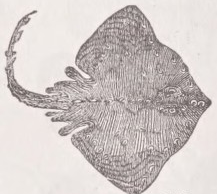
THORNBACK is the name given to a species of ray {Raja clavata) which is found all round the coasts of Europe, and locally abundant; it derives its name from the peculiar armature of the skin of its body, the upper and lower surfaces of the body of the female being armed with scattered, more or less numerous, large round osseous bucklers, each with a spine in the centre; the tail also is armed with rows of similar bucklers. In the male fish these bucklers are absent, or nearly so. The thornback does not grow to the same large size as the skates, a specimen three feet across being considered large. It is more valued as food than the other rays, and consumed in large quantities, fresh as well as salted.
[130 words — estimated reading time: 1 minute]