
A genus of euphorbiaceous plants belonging to tropical countries.
Word of the Day: Catachrestical
Croton bug
Webster's Dictionary 1913
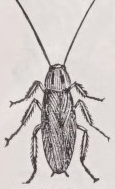
A small, active, winged species of cockroach (Ectobia Germanica), the water bug. It is common aboard ships, and in houses in cities, esp. in those with hot-water pipes.
Croton oil
Encyclopedia Britannica
CROTON OIL(Crotonis Oleum) is prepared from the seeds of Croton Tiglium, a euplrorbiaceous tree indigenous to the Malabar coast and Tavoy, and grown in many parts of the East Indies. The tree is from 15 to 20 feet in height, and has few and spreading branches; alternate, oval-oblong leaves, acuminate at the point, and covered when young with stellate hairs, and small, downy, greenish-yellow, monoecious flowers. The male blossoms have five petals and fifteen stamens; the females are apetalous, but bear three bifid styles. The fruit or capsule is obtusely three-cornered, and ¾ths of an inch long; it consists of three carpels each inclosing a seed. The seeds resemble those of the castor-oil plant; they are about half an inch long, and ∣ths of an inch broad, and have a cinnamon-brown, brittle integument; between the two halves of the kernel lie the large cotyledons and radicle. The kernels contain from 50 to 60 per cent, of oil, which is obtained by pressing them, when bruised to a pulp, between hot plates. Croton oil is a transparent and viscid liquid of a brownish or pale-yellow tinge, an acrid, peculiar, and persistent taste, a disagreeable odour, and acid reaction. It is soluble in volatile oils, carbon disulphide, and ether, and to some extent in alcohol. It contains acetic, butyric, and valeric acids, with glycerides of acids of the same series, and a volatile body, C 5 H 8 O 2 , metameric with angelic acid, termed by Geuther and Fröhlich tiglic acid, and considered by them as possibly identical with Frankland and Duppa’s methylcrotonic acid, C(C 2 H 4 ) ,, CH 8 .CO.OH. According to the chemists before-mentioned the crotonic acid of Schlippe, C 4 H 6 O 2 , is not present in croton-oil. To what the oil owes its medicinal properties has not yet been certainly ...determined. It is a rapidly-acting and strong purgative. A single drop is a sufficient dose, and need only be placed on the tongue to insure its action. It is employed in cases of obstinate constipation, paralysis, apoplexy, and dropsy. It may be added to castor-oil to increase the effect of that drug. Nausea and vomiting sometimes follow its administration, and over-doses are extremely poisonous, and bring on intestinal inflammation. The best antidote is an emetic of copper sulphate. Applied to the skin croton oil produces pustulation. It is used externally in gout, neuralgia, rheumatism, and tumours; and with oü of cajeput and rectified spirit it is employed as a liniment in lung and laryngeal diseases. Croton oil has long been known in India as a medicine, and has been in use in England since 1813. Seeds for manufacturing it are imported mostly from Cochin and Bombay. It is occasionally adulterated with olive, castor, and nut oih
9th ed. Encyclopædia Britannica, vol. 6, p. 615
[475 words — estimated reading time: 3 minutes]
[475 words — estimated reading time: 3 minutes]
Crotona
Encyclopedia Britannica
CROTONA, or CROTON, now Cotrone, a celebrated city of Magna Graecia, at the mouth of the small river AEsarus, in the country of the Bruttii, on the western shore of the Ionian Sea. It was founded in the year 710 b.c. by a colony of Achaeans under the command of Myscellus, in accordance with a decree of the oracle at Delphi. The first well-established fact in its history is its friendship with Sybaris; and till the arrival of Pythagoras the two cities continued advancing in material prosperity and cultivating the arts of war and peace with much success. The Crotoniats regarded Hercules as their tutelary divinity, and were renowned for their skill in all athletic exercises; the Sybarites were distinguished by luxury and effeminacy. The government of Crotona, oligarchical in form, had hitherto been confined to the council of 1000, who traced their descent from the Achaean founders of the city. But a secret society of 300 of the disciples of Pythagoras contrived to guide and even overawe the supreme council, till the people, who were excluded from all share in the government, expelled the Pythagoreans from the city, and established a democracy. Before this revolution, however, the Grotoniats, under the command of the celebrated athlete Milo, had marched against Sybaris, and, though opposed by an army three times their own in number, had taken it and levelled it with the ground. This event is usually dated 510 b.c. Before thirty years had elapsed, the Crotoniats themselves sustained a still more disgraceful defeat from the united forces of the Locrians and Rheggians, which, however, was not attended with such disastrous consequences to their city. During the Athenian invasion of Sicily, Crotona remained neutral; it supplied the Athenians with provisions, but refused to allow ...them a passage through its territory. In 389 b.c. the city fell into the hands of the elder Dionysius; but on his death in 377 it recovered its independence. Its prosperity, however, was greatly impaired by intestine feuds and the growing power of external foes. Being hard pressed by the Bruttians, Crotona sought and received assistance from the Syracusans, but had ultimately to conclude a treaty with the enemy, as it was now in danger from its own exiles. Menedemus, their general, defeated the exiles, and established a tyranny which lasted for some time. In the beginning of the 3d century b.c., the city was held for some years by Agathocles; and in the wars of the Romans with Pyrrhus it suffered so severely that more than half the area within its walls ceased to be inhabited. In the absence of Pyrrhus in Sicily, it was seized by the Roman consul Cornelius Rufinus (277 B.C.); but during the latter years of the second Punic War it was the headquarters of Hannibal for three successive winters. This completed the ruin of the town, which, though colonized a few years after from Rome, sank into obscurity, and is not again mentioned in history till the wars of Narses and Belisarius against the Goths. After that it remained subject to the Byzantine emperors till it passed into the hands of the Normans.
The medical school of Crotona was, in the days of Herodotus, and long after, the most renowned in Greece,—its proudest name being that of Alcmaeon. It is not known whether there was anything remarkable about the architecture of Crotona; but the temple of the Lacinian Juno, six miles from the city, was the most sacred and magnificent work of the kind in the whole of Magna Graecia, and contained, among other ornaments, the “Helen” of Zeuxis. One column of this great edifice still stands amid a mass of shapeless ruin.
About a mile from the site of the old Crotona is the modern town of Cotrone, in the Bay of Taranto, with a small but excellent harbour. It is the seat of a bishop, and retains the castle and walls that were erected in the time of Charles V. It surrendered to the English in 1806, but was again occupied by the French. Population, 7700.
9th ed. Encyclopædia Britannica, vol. 6, p. 615
[684 words — estimated reading time: 4 minutes]
[684 words — estimated reading time: 4 minutes]
A colorless, volatile, pungent liquid, C4H6, produced artificially, and regarded as an unsaturated hydrocarbon of the acetylene series, and analogous to crotonic acid.
No thesaurus entries found for "CROTON".
No Bible verses found for "CROTON".