
Being of the color of a chestnut; of a brown color. It is perhaps rarely used as a noun.
Word of the Day: Catachrestical
The fruit, seed or nut of a tree belonging to the genus Fagus. It is inclosed in a prickly pericarp, which contains two or more seeds.
Of the color of a chestnut; of a reddish brown color; as, chestnut curls.
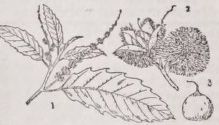
1. The edible nut of a forest tree (Castanea vesca) of Europe and America. Commonly two or more of the nuts grow in a prickly bur.
2. The tree itself, or its light, coarse-grained timber, used for ornamental work, furniture, etc.
3. A bright brown color, like that of the nut.
4. The horse chestnut (often so used in England).
5. One of the round, or oval, horny plates on the inner sides of the legs of the horse, and allied animals.
6. An old joke or story.
Chestnut
Encyclopedia Britannica
CHESTNUT. The Spanish or Sweet Chestnut, Castanea vesca (natural order, Corylaceoe), is a stately and magnificent tree, native of the countries bordering on the Mediterranean, but also ripening its fruit in sheltered situations as far north as Scotland. It lives very long, attains a large size, spreading its branches widely, and it has large lanceolate serrate leaves, long pendulous male catkins, with fewer inconspicuous female flowers, the fruit being an echinate capsule, containing from two to five nuts, of which seldom more than three are mature. The largest known chestnut tree is the famous Castagno di cento caυalli, or the chestnut of a hundred horses, on the slopes of Mount Etna, a tree which when measured nearly a hundred years ago, by Count Borch, was found to have a circumference of 190 feet. By many observers it has been maintained that this colossal tree consisted of a fusion of several trunks; but many specimens not much smaller exist in the neighbourhood, and by digging around it has been found that all the trunks end in one root. The wood of the sweet chestnut is valued by cabinet-makers and coopers; and among European timbers it was at one time esteemed second to the oak, which it so closely resembles that in old wood-work the two timbers are very difficult to distinguish. Chestnuts (the fruit of the tree) are extensively imported into Great Britain, and roasted are much eaten as a delicacy. In a raw state they have a sweet taste, but are difficult of digestion. The trees are very abundant in the south of Europe, and chestnuts bulk largely in the food resources of the poor in Spain, Italy, Switzerland, and Germany. In Italy the kernels are ground into meal, and used for thickening soups, and even for bread-making. In North America, the fruits of an ...allied species, C. americana i are similarly eaten.
The Horse Chestnut, Aesculus IIippocastanum, is in no way allied to the sweet chestnut except in name. It is a strikingly beautiful tree, especially in spring, with its large digitate leaves, and conspicuous spikes of white flowers. A useful starch maybe extracted from its kernels, but this has not hitherto been practised on an economic basis. The entire tree must be regarded as more ornamental than useful.
9th ed. Encyclopædia Britannica, vol. 5, p. 608
[384 words — estimated reading time: 3 minutes]
[384 words — estimated reading time: 3 minutes]
1. The tree which produces the chestnut. This tree grows to a great size, with spreading branches. It is one of the most valuable timber trees, as the wood is very durable, and forms in America the principal timber for fencing. The timber is also used in building, and for vessels of various kinds.
3. Horse-chestnut, is a tree of the genus Aesculus. The common tree of this sort is a native of the North of Asia, and admired for the beauty of its flowers. It is used for shade and ornament, and its nuts are esteemed good food for horses. The scarlet-flowering horse-chestnut is a native of Carolina, Brazil and the East, and is admired for its beauty.
Brown Roget’s Thesaurus §433
V. render brown, tan, embrown, bronze
Adj. brown, bay, dapple, auburn, castaneous, chestnut, nut- brown, cinnamon, russet, tawny, fuscous, chocolate, maroon, foxy, tan, brunette, whitey brown, fawn-colored, snuff-colored, liver- colored, brown as a berry, brown as mahogany, brown as the oak leaves, khaki, sun-burnt, tanned, primitive colors
No Bible verses found for "Chestnut".