
Huge flat stones resting on other stones, set on end for that purpose; supposed to be the remains of druidical altars.
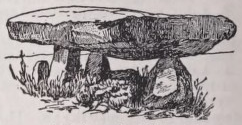
CROMLECH (Gaelic or Welsh crom, curved, vaulted, and leac or llech, a monumental stone) is the name given in Britain to those megalithic monuments exclusively which consist of a great stone supported on three or more stones set on end in the ground. In F rance, however, and on the Continent generally, it is exclusively employed to denote a totally different class of monument, for which in this country we only use the descriptive names of “stone circles,” or “circles of standing stones.” This application of the term in different countries to different classes of monuments has given rise to much confusion. The earliest known use of the word occurs in Bishop Morgan’s translation of the Bible into Welsh (1588), where “the clefts of the rocks” of our translation is rendered by cromlechydd y creigiau. Its earliest occurrence in the special sense in which it has continued to be used by antiquaries is in α description of some ancient remains by Rev. John Griffith of Llanddyfnan (1650), in which he says, “There is a crooked little cell of stone not far from Alaw, where according to tradition Bronwen Leir was buried; such little houses, which are common in this country, are called by the apposite name cromlechaw” The restricted sense in which the term has been.applied in recent times in this country has given rise to the notion that a cromlech, or great stone supported on props of smaller size, is a species of structure complete in itself, and distinct from the dolmen or chambered cairn. Mr Fergusson, in his recent work on Rude Stone Monuments, has described the monuments usually known by the term cromlech as “free-standing dolmens,” and maintains that they were never intended to be covered with a mound or cairn. It is evident that the removal of the loose ...stones of the enveloping cairn would leave its megalithic chamber exposed as a cromlech, and undeniable that many of the examples adduced as “freestanding dolmens” in England do exhibit traces of such removal. But on the other hand the steendysser or ,, Giants’ Graves” of Denmark and Sweden, which are perfectly analogous to the cromlechs of this country, are never wholly bidden in the mounds which envelop their bases. The present tendency is towards the entire disuse of the term cromlech, and the adoption of the term dolmen for all the varieties of tombs with megalithic chambers, whether “free-standing” or partially or wholly enveloped in mounds of stones and earth.