
Word of the Day: Catachrestical
Dandelion
Encyclopedia Britannica
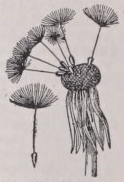
DANDELION{Taraxacum Dens Leonis), a perennial herb belonging to the sub-order Cichoracece, of the natural order Composites. The plant has a wide range, being found in Europe, Central Asia, North America, and the Arctic regions. The leaves are smooth, of a bright shining green, sessile, and tapering downwards. The name dandelion is derived from the French dent-de-lion, an appellation given on account of the tooth-like lobes of the leaves. The long tap-root has a simple or many-headed rhizome; it is "black externally, and is very difficult of extirpation. The flower-stalks are smooth, brittle, leafless, hollow, and very numerous. The flowers bloom from April till August, and remain open from 5 or 6 in the morning to 8 or 9 at night. The flower-heads are of a golden yellow, and 1| inches in width; the florets are strap-shaped, and longer than the phyllaries. The achenes are olive or dull yellow in colour, and are each surmounted by a long beak; on this rests a pappus of white and delicate hairs, which occasions the ready dispersal of the seed by the wind. The globes formed by the plumed seeds are nearly 2 inches in diameter The involucre consists of an outer spreading (or reflexed) and an inner and erect row of bracts. In all parts of the plant a milky juice is contained, the principle of which, taraxacin, has diuretic properties. On exposure to the air the juice coagulates, deposits caoutchouc, and turns of a violet-brown colour. The leaves are bitter, but when blanched are sometimes eaten as a salad; they serve as food for silkworms when mulberry leaves are not to be had. The root is roasted as a substitute for coffee, and its infusion, decoction, and extract are employed medicinally as a tonic and aperient, especially in disorders of the digestive organs and liver. ...Several varieties of the dandelion are recognized by botanists, in the commonest of which the leaves are broad and runcinate, and the outer bracts of the involucre have a downward flexure. The variety T. palustre, which affects boggy situations, and flowers in late summer and autumn, has nearly entire leaves, and the outer bracts of its involucre are erect.
9th ed. Encyclopædia Britannica, vol. 6, p. 802
[373 words — estimated reading time: 3 minutes]
[373 words — estimated reading time: 3 minutes]
No thesaurus entries found for "Dandelion".
No Bible verses found for "Dandelion".