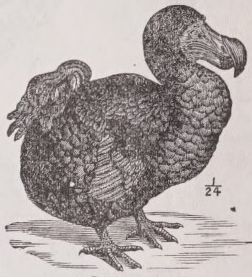
Brief mention of this remarkable creature has already been made (see Birds, vol. iii. ρ. 732), but some further particulars may be welcome. The precise year in which the Portuguese discovered the island we now know as Mauritius is undetermined; various dates from 1502 to 1545 having been assigned. Mascaregnas, their leader, seems to have called it Cerne, from a notion that it must be the island of that name mentioned by Pliny; but most authors have insisted that it was known to the seamen of that nation as llha do Cisne— perhaps but a corruption of Cerne, and brought about by their finding it stocked with large fowls, which, though not aquatic, they likened to Swans, the most familiar to them of bulky birds. However, the experience of the Portuguese is unfortunately lost to us, and nothing positive<can be asserted of the island or its inhabitants (none of whom, it should be observed, were human) until 1598, when the Dutch, under Van Neck, arrived there and renamed it Mauritius. A narrative of this voyage was published in 1601, if not earlier, and has been often reprinted. Here we have birds spoken of as big as Swans or bigger, with large heads, no wings, and a tail consisting of a few curly feathers. The Dutch called them Walghvögels (the word is variously spelled), i.e., nauseous birds, because, as is said, no cooking made them palatable; but another and perhaps better reason, for it was admitted that their breast was tender, is also assigned, namely, that this island-paradise afforded an abundance of superior fare. De Bry gives two admirably quaint prints of the doings of the Hollanders, and in one of them the Walclvvögel appears, being the earliest published representation of its unwieldy form, with a footnote stating that the voyagers brought an example alive to Holland. Among the company there was a draughtsman, and from a sketch of his Clusius, a few years after, gave a figure of the bird, which he vaguely called “ Gallinaceus Gallus peregrinus,” but described rather fully. Meanwhile two other Dutch fleets had visited Mauritius. One of them had rather an accomplished artist on board, and his drawings fortunately still exist. Of the other a journal kept by one of the skippers was subsequently published. This in the main corroborates what has been before said of the birds, but adds the curious fact that they were now called by some Dodaarsen and by others Dronten.
Henceforth Dutch narrators, though several times mentioning the bird, fail to supply any important fact in its history. Their navigators, however, were pot idle, and found work for their naturalists and painters. Clusius says that in 1605 he saw at Pauw’s House in Leyden a Dodo’s foot, which he minutely describes. Of late years a copy of Clusius’s work has been discovered in the high school of Utrecht, in which is pasted an original drawing by Van de Venne superscribed “Vera effigies huius avis Walghvogel (quae & a nautis Dodaers propter faedam posterioris partis crassitiem nuncupatur), qualis viua Amsterodamum perlata est ex insula Mauritii. Anno M.DC.XXVI.” Now a good many paintings of the Dodo by a celebrated artist named Roelandt Savery, who was born at Courtray in 1576 and died in 1639, have long been known, and it has always been understood that these were drawn from the life. Proof, however, of the limning of a living Dodo in Holland at that period had hitherto been wanting. There can now be no longer any doubt of the fact; and the paintings by this artist of the Dodo at Berlin and Vienna—dated respectively 1626 and 1628—as well as the picture by Goiemare, belonging to the Duke of Northumberland, at Sion House, dated 1627, may be with greater plausibility than ever considered portraits of a captive bird. It is even probable that this was not the first example which had sat to a painter in Europe. In the private library of the late Emperor Francis of Austria is a series of pictures of various animals, supposed to be by the Dutch artist Hoefnagel, who was born about 1545. One of these represents a Dodo, and, if there be no mistake in Von Frauenfeld’s ascription, it must almost certainly have been painted before 1626, while there is reason to think that the original may have been kept in the vivarium of the then Emperor Rudolf IL, and that the portion of a Dodo’s head, which was found in the Museum at Prague about 1850, belonged to this example. The other pictures by Roelandt Savery, of which may be mentioned that at the Hague, that in the possession of the Zoological Society of London (formerly Eroderip’s), that in the Schönborn collection at Pommersfelden near Bamberg, and that belonging to Dr Seyffery at Stuttgart are undated, but were probably all painted about the same time {viz. 1626 to 1628). The large picture in the British Museum, once belonging to Sir Hans Sloane, by an unknown artist, but supposed to be by Roelandt Savery, is also undated; while the still larger one at Oxford (considered to be by the younger Savery) bears a much later date, 1651. Undated also is a picture said to be by Pieter Holsteyn, and in the possession of Dr A. van der Willige at Haarlem in Holland.
In 1628 we have the evidence of the first English observer of the bird—one Emanuel Altham, who mentions it in two letters written on the same day from Mauritius to his brother at home. These have only of late, through the intervention of Dr Wilmot, been brought to light. In one he says: “You shall receue a strange fowle:
which I had at the Hand Mauritius called by ye portingalls a Do Do: which for the rareness thereof I hope wilbe welcome to you.” The passage in the other letter is to the same effect, with the addition of the words “if it line.” Nothing more is known of this valuable consignment. In the same fleet with Altham sailed Herbert, whose Travels ran through several editions and have been long quoted. It is plain that he could not have reached Mauritius till 1629, though 1627 has been usually assigned as the date of his visit. The fullest account he gives of the bird is in his edition of 1638, and in the curiously affected style of many writers of the period. It will be enough to quote the beginning: “The Dodo comes first to a description: here, and in Dygarrois (and no wshere else, that ever I could see or heare of) is generated the Dodo (a Portuguize name it is, and has reference to her simpleness,) a Bird which for shape and rareness might be call’d a Phaenix (wer’t in Arabia :) ”—the rest of the passage is entertaining, but the whole has been often reprinted. Herbert, it may be remarked, when he could see a possible Cymric similarity, was weak as an etymologist, but his positive statement, corroborated as it is by Altham, cannot be set aside, and hence we do not hesitate to assign a Portuguese derivation for the word. Herbert also gave a figure of the bird.
Proceeding chronologically we next come upon a curious bit of evidence. This is contained in a MS. diary kept between 1626 and 1640 by Thomas Crossfield of Queen’s College, Oxford, where, under the year 1634> mention is casually made of one Mr Gosling “who bestowed the Dodar (ablacke Indian bird) vpon ye Anatomy school.” Nothing more is known of it. About 1638, Sir Hamon Lestrange tells us, as he walked London streets he saw the picture of a strange fowl hung out on a cloth canvas, and going in to see it found a great bird kept in a chamber “somewhat bigger than the largest Tuxky cock, and so legged and footed, but shorter and thicker.” The keeper called it a Dodo and shewed the visitors how his captive would swallow “large peble stones as bigge as nutmegs.”
In 1651 Morisot published an account of a voyage made by François Cauche, who professed to have passed fifteen days in Mauritius, or “Γisle de Saincte Apollonie,” as he called it, in 1638. According to De Flacourtthe narrative is not very trustworthy, and indeed certain statements are obviously inaccurate. Cauche says he saw there birds bigger than Swans, which he describes so as to leave no doubt of his meaning Dodos; but perhaps the most important facts (if they be facts) that he relates are that they had a cry like a Gosling (“il a un cry comme l’oison ”), and that they laid a single white egg, “gros comme un pain d’un sol,” on a mass of grass in the forests. He calls them “oiseaux de Nazaret,” perhaps, as a marginal note informs us, from an island of that name which was then supposed to lie more to the northward, but is now known to have no existence.
In the catalogue of Tradescant’s Collection of Rarities, preserved at South Lambeth, published in 1656, we have entered among the “Whole Birds” a “Dodar from the island Mauritius; it is not able to flie being so big.” This specimen may well have been the skin of the bird seen by Lestrange some eighteen years before, but anyhow we are able to trace the specimen through Willughby, Lhwyd, and Hyde, till it passed in or before 1684 to theAshmolean collection at Oxford. In 1755 it was ordered to be destroyed, but, in accordance with the original orders of Ashmole, its head and right foot were preserved, and still ornament the Museum of that University. In the second edition of a Catalogue of many Natural Rarities, <fcc., to be seen at the place formerly called the Music House, near the West End of St Paul’s Church, collected by one Hubert alias Forbes, and published in 1665, mention is made of a “legge of a Dodo, a great heavy bird that cannot fly; it is a Bird of the Mauricius Island.” This is supposed to have subsequently passed into the possession of the Royal Society. At all events such a specimen is included in Grew’s list of their treasures which was published in 1681. This was afterwards transferred to the British Museum, where it still reposes. As may be seen it is a left foot, without the integuments, but it differs sufficiently in size from the Oxford specimen to forbid its having been part of the same individual. In 1666 Olearius brought out the Gottorffisches Kunst Kammer, wherein he describes the head of a Walghvogel, which some sixty years later was removed to the Museum at Copenhagen, and is now preserved there, having been the means of first leading zoologists, under the guidance of Prof. Reinhardt, to recognize the true affinities of the bird.
Little more remains to be told. For brevity’s sake we have passed over all but the principal narratives of voyagers or other notices of the bird. A compendious bibliography, up to the year 1848, will be found in Strickland’s classical work, and the list was continued by Von Frauenfeld for twenty years later. The last evidence we have of the Dodo’s existence is furnished by a journal kept by Benj. Harry, and now in the British Museum {MSS. Áddit. 3668. 11. D). This shows its survival till 1681, but the writer’s sole remark upon it is that its “fflesh is very hard.” The successive occupation of the island by different masters seems to have destroyed every tradition relating to the bird, and doubts began to arise whether such a creature had ever existed. Duncan, in 1828, shewed how ill-founded these doubts were, and some ten years latet Broderip with much diligence collected all the available evidence into an admirable essay, which in its turn was succeeded by Strickland’s monograph just mentioned. But in the meanwhile little was done towards obtaining any material advance in our knowledge, Prof. Reinhardt’s determination of its affinity to the Pigeons fColumbcfi) excepted; and it was hardly until Clark’s discovery in 1865 (Birds, vol. iii. p. 732) of a large number of Dodos’ remains, that zoologists generally were prepared to accept that affinity without question. The examination of bone after bone by Prof. Owen and others confirmed the judgment of the Danish naturalist, and there is now no possibility of any different view being successfully maintained.
The causes which led to the extirpation of this ponderous Pigeon have been discussed in a former article, and nothing new can be added on that branch of the subject; but it will be remembered that the Dodo does not stand alone in its fate, and that two more or less nearly allied birds inhabiting the sister islands of Réunion and Rodriguez have in like manner disappeared from the face of the earth. (a. n.)