
A large aquatic fowl of the genus Anas, of two varieties, the wild and the tame. The plumage is of a pure white color, and its long arching neck gives it a noble appearance.
SWAN (A.-S. Swan and Swon, Icel. Svanr, Dutch Zwaan, Germ. Schwan), a large swimming-bird, well known from being kept in a half-domesticated condition throughout many parts of Europe, whence it has been carried to other countries. In England it was far more abundant formerly than at present, the young, or Cygnets, being highly esteemed for the table, and it was under especial enactments for its preservation, and regarded as a “Bird Royal” that no subject could possess without licence from the crown, the granting of which licence was accompanied by the condition that every bird in a “game” (to use the old legal term) of Swans should bear a distinguishing mark of ownership (cygninota) on the bill. Originally this privilege was conferred on the larger freeholders only, but it was gradually extended, so that in the reign of Elizabeth upwards of 900 distinct Swan-marks, being those of private persons or corporations, were recognized by the royal Swanherd, whose jurisdiction extended over the whole kingdom. It is impossible here to enter into further details on this subject, interesting as it is from various points of view. It is enough to remark that all the legal protection afforded to the Swan points out that it was not indigenous to the British Islands, and indeed it is stated (though on uncertain authority) to have been introduced to England in the reign of Richard Coeur de Lion; but it is now so perfectly naturalized that birds having the full power of flight remain in the country. There is no evidence to shew that its numbers are ever increased by immigration from abroad, though it is known to breed as a wild bird not further from our shores than the extreme south of Sweden and possibly in Denmark, whence it may be traced, but with considerable vacuities, in a ...southeasterly direction to the valley of the Danube and the western part of Central Asia. In Europe, however, no definite limits can be assigned for its natural range, since birds more or less reclaimed and at liberty consort with those that are truly wild, and either induce them to settle in localities beyond its boundary, or of themselves occupy such localities, so that no difference is observable between them and their untamed brethren. From its breeding-grounds, whether they be in Turkestan, in south-eastern Europe, or Scania, the Swan migrates southward towards winter, and at that season may be found in north-western India (though rarely), in Egypt, and on the shores of the Mediterranean.
The Swan just spoken of is by some naturalists named the Mute or Tame Swan, to distinguish it from one to be presently mentioned, but it is the Swan simply of the English language and literature. Scientifically it is usually known as Cygnus olor or C. mansuetus. It needs little description: its large size, its spotless white plumage, its red bill, surmounted by a black knob (technically the “berry ”) larger in the male than in the female, its black legs and stately appearance on the water are familiar, either from figures innumerable or from direct observation, to almost every one. When left to itself its nest is a large mass of aquatic plants, often piled to the height of a couple of feet and possibly some six feet in diameter. In the midst of this is a hollow which contains the eggs, generally from five to nine in number, of a greyish-olive colour. The period of incubation is between five and six weeks, and the young when hatched are clothed in sooty-grey down, which is succeeded by feathers of dark sooty-brown. This suit is gradually replaced by white, but the young birds are more than a twelvemonth old before they lose all trace of colouring and become wholly white.
It was, however, noticed by Plot (N. H. Staffordshire, p. 228) 200 years and more ago that certain Swans on the Trent had white Cygnets; and it was subsequently observed of such birds that both parents and progeny had legs of a paler colour, while the young had not the blue bill” of ordinary Swans at the same age that has in some parts of the country given them a name, besides offerιng a few other minor differences. These being examined by Yarrell led him to announce (Proc. Zool. Society, 1838, p. 19) the birds presenting them as forming a distinct species, C. immutabilis, to which the English name of “Polish” Swan had already been attached by the London poulterers. There is no question so far as to the facts; the doubt exists as to their bearing in regard to the validity of the so-called “species.” Though apparently wild birds, answering fairly to the description, occasionally occur in hard winters in Britain and some parts of the European Continent, their mother country has not yet been ascertained,—for the epithet "Polish" is but fanciful,—and most of the information respecting them is derived only from reclaimed examples, which are by no means common. Those examined by Yarrell are said to have been distinctly smaller than common Swans, but those recognized of late years are as distinctly larger. The matter requires much more investigation, and it may be remarked that occasionally Swans, so far as is known of the ordinary stock, will produce one or more Cygnets differing from the rest of the brood exactly in the characters which have been assigned to the so-called Polish Swans as specific—namely, their white plumage slightly tinged with buff, their pale legs, and flesh-coloured bill. It may be that here we have a case of far greater interest than the mere question of specific distinction, in some degree analogous, but yet in an opposite direction, to that of the so-called Pavo nigripennis before mentioned (Peacock, vol. xviii. p. 443).
Thus much having been said of the bird which is nowadays commonly called Swan, and of its allied form, we must turn to other species, and first to one that anciently must have been the exclusive bearer in England of the name. This is the Whooper, Whistling, or Wild Swan of modern usage, the Cygnus musicus or C. ferus of most authors, which was doubtless always a wintervisitant to this country, and, though nearly as bulky and quite as purely white in its adult plumage, is at once recognizable from the species which has been half domesticated by its wholly different but equally graceful carriage, and its bill—which is black at the tip and lemon-yellow for a great part of its base. This entirely distinct species is a native of Iceland, eastern Lapland, and northern Russia, whence it wanders southward in autumn, and the musical tones it utters (contrasting with the silence that has caused its relative to be often called the Mute Swan) have been celebrated from the time of Homer to our own. Otherwise in a general way there is little difference between the habits of the two, and very closely allied to the Whooper is a much smaller species, with very well marked characteristics, known as Bewick’s Swan, C. bewicki. This was first indicated as a variety of the last by Pallas, but its specific validity is now fully established. Apart from size, it may be externally distinguished from the Whooper by the bill having only a small patch of yellow, which inclines to an orange rather than a lemon tint; while internally the difference of the vocal organs is well marked, and its cry, though melodious enough, is unlike. It has a more easterly home in the north than the Whooper, but in winter not unfrequently occurs in Britain.
Both the species last mentioned have their representatives in North America, and in each case the trans-Atlantic bird is considerably larger than that of the Old World. The first is the Trumpeter-Swan, C. buccinator, which has the bill wholly black, and the second the C. columbiamιs or americanus — greatly resem- bling Bewick’s Swan, but with the coloured patches on the bill of less extent and deepening almost into scarlet. South America produces two very distinct birds commonly regarded as Swans,— the Black-necked Swan and that which is called Cascaroba or Coscaroba. This last, which inhabits the southern extremity of the continent to Chili and the Argentine territory, and visits the Falkland Islands, is the smallest species known,—pure white in colour except the tip of its primaries, but having a red bill and red feet. The former, C. melanocorypha or nigricollis, if not discovered by earlier navigators, was observed by Narbrough 2d August 1670 in the Strait of Magellan, as announced in 1691 in the first edition of his Voyage (p. 52). It was subsequently found on the Falkland Islands during the French settlement there in 1764-65, as stated by Pernetty (Voyage, ed. 2, ii. pp. 26, 99), and was first technically described in 1782 by Molina {Saggio sulla Stor. Nat. del Chile, pp. 234, 344). Its range seems to be much the same as that of the Cascaroba, except that it comes further to the northward, to the coast of southern Brazil on the east, and perhaps into Bolivia on the west. It is a very handsome bird, of large size, with a bright red nasal knob, a black neck, and the rest of its plumage pure white. It has been introduced into Europe, and breeds freely in confinement.
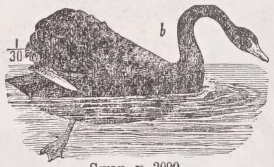
A greater interest than attaches to the South-American birds last mentioned is that which invests the Black Swan of Australia. Considered for so many centuries to be an impossibility, the knowledge of its existence seems to have impressed (more perhaps than anything else) the popular mind with the notion of the extreme divergence—not to say the contrariety—of the organic products of that country. By a singular stroke of fortune we are able to name the precise day on which this unexpected discovery was made. The Dutch navigator Willem de Vlaming, visiting the west coast of Zuidland (Southland), sent two of his boats on the 6th of January 1697 to explore an estuary he had found. There their crews saw at first two and then more Black Swans, of which they caught four, taking two of them alive to Batavia; and Valentyn, who several years later recounted this voyage, gives in his work a plate representing the ship, boats, and birds, at the mouth of what is now known from this circumstance as Swan River, the most important stream of the thriving colony of West Australia, which has adopted this very bird as its armorial symbol. Valentyn, however, was not the first to publish this interesting discovery. News of it soon reached Amsterdam, and the burgomaster of that city, Witsen by name, himself a fellow of the Royal Society, lost no time in communicating the chief facts ascertained, and among them the finding of the Black Swans, to Martin Lister, by whom they were laid before that society in October 1698, and printed in its Philosophical Transactions (xx. p. 361). Subsequent voyagers, Cook and others, found that the range of the species extended over the greater part of Australia, in many districts of which it was abundant. It has since rapidly decreased in numbers, and will most likely soon cease to exist as a wild bird, but its singular and ornamental appearance will probably preserve it as a modified captive in most civilized countries, and perhaps even now there are more Black Swans in a reclaimed condition in other lands than are at large in their mother-country. The species scarcely needs description: the sooty black of its general plumage is relieved by the snowy white of its flight-feathers and its coral-like bill banded with ivory.
The Cygninae admittedly form a well-defined group of the Family Anatidae, and there is now no doubt as to its limits, except in the case of the Cascaroba above mentioned. This bird would seem to be, as is so often found in members of the South-American fauna, a more generalized form, presenting several characteristics of the Anatinae, while the rest, even its Black-necked compatriot and the almost wholly Black Swan of Australia, have a higher morphological rank. Excluding from consideration the little-known C. davidi, of the five or six species of the
Northern hemisphere four present the curious character somewhat analogous to that found in certain Cranes (vol. vi. p. 546), of the penetration of the sternum by the trachea nearly to the posterior end of the keel, whence it returns forward and upward again to revert and enter the lungs; but in the two larger of these species, when adult, the loop of the trachea between the walls of the keel takes a vertical direction, while in the two smaller the bend is horizontal, thus affording an easy mode of recognizing the respective species of each. Fossil remains of more than one species of Swan have been found. The most remarkable is C. falconeri, which was nearly a third larger than the Mute Swan, and was described from a Maltese cave by Prof. Parker in the Zoological Transactions (vi. pp. 119— 124, pl. 30). (a. n.)
תנשמת, Lev. xi, 18; Deut. xiv, 16. The Hebrew word is very ambiguous, for in the first of these places, it is ranked among water-fowls; and by the Vulgate, which our version follows, rendered “swan,” and in the thirtieth verse, the same word is rendered “mole,” and ranked among reptiles. Some translate it in the former place, “the bat,” which they justify by the affinity which there is between the bat and the mole. The LXX. in the former verse render it ϖορφυρίωνα, the _porphyrion_, or “purple bird,” probably the “flamingo;” and in the latter, “ibis.” Parkhurst shows that the name is given from the creature’s breathing in a strong and audible manner; and Michaëlis learnedly conjectures, that in verse eighteen, and Deut. xiv, 16, it may mean the “goose,” which every one knows is remarkable for its manner of “breathing out” or “hissing,” when approached.
SWANSEA, a municipal and parliamentary borough and large seaport of Glamorganshire, South Wales, is finely situated in an angle between lofty hills, on the river Tawe, near its mouth in the beautiful Swansea Bay, a recess of the Bristol Channel, and on the Great Western, London and North-Western, Midland, and Rhondda and Swansea Bay railway lines, 45 miles west-north-west of Cardiff. Being for the most part of comparatively modern growth, the streets are laid out with great regularity. Swansea retains few traces of antiquity, and some of its more picturesque features have been destroyed to make room for the construction of docks. Of the old castle, originally founded in 1099 by Henry Beauchamp, earl of Warwick, to secure possession of his lands in the province of Gower, the principal remains are the keep, built by Bishop Gower of St David’s after the castle had been for some time in ruins, a range of arched dungeons lit by loopholes, and the hall, now fitted up for use as a volunteer drill hall. There are fragments of a wall with a Gothic window of the hospital of St David, founded by Bishop Gower in 1331. The church of St Mary’s, founded by the same bishop, was rebuilt in 1739, with the exception of the tower and chancel. The modern public buildings include the guildhall, in the Italian style with Corinthian pillars and pilasters, erected in 1846, and comprehending the municipal offices, the crown and nisi prius courts, the council chamber, and the library of the Swansea and Neath Incorporated Law Society; the royal institution of South Wales, established 1835, a building in the Ionic style, and embracing a library, a lecture hall, and a museum of geology, mineralogy, natural history, and antiquities; the free public library, schools of art, and art gallery, a fine ...new building with about 30,000 volumes (including the library of the Rev. Rowland Williams, one of the authors of Essays and Reviews) and a large number of beautiful engravings; the grammar school, founded by Hugh Gore, bishop of Waterford, in 1682; the market (1830); the cattle market (1864); the Albert hall for concerts (1864), with a smaller hall erected in 1881; the agricultural hall; the working men’s club (1875); the Prince of Wales hall (1882); and two theatres. The benevolent institutions include the general hospital, founded in 1817, and rebuilt with the addition of two wings in 1878; the Cambrian institution for the deaf and dumb, founded in 1847, and several times extended; the Swansea and South Wales institute for the blind (1865); the nursing institution (1853); the provident dispensary (1876); the eye hospital (1878); the industrial home (1859); and the sailors’ home (1864). Swansea is specially well supplied with parks and recreation grounds. They include Brynmill grounds between Parkwern and Singleton (1872), 9 acres in extent, and containing a beautiful reservoir and ornamental lawns; Cwmdonkin park, on the uplands, 13 acres, and commanding fine views; the new recreation ground, formed in 1883, 11 acres, situated between Brynmill and the Oystermouth road; Park Llewelyn, to the north of Swansea, 40 acres; and the St Helen’s Field, near the beach, about 20 acres, now being laid out. The population of the municipal borough (area 4363 acres) in 1871 was 51,702, and in 1881 it was 65,597. The population of the parliamentary borough in 1881 was 73,971. Its area then was 4777 acres, but in 1885, when Swansea received independent representation, the area was diminished, the population of this smaller area being 50,043 in 1881.
Swansea owes its prosperity to its situation in the neighbourhood of extensive collieries and to its possession of great natural advantages as a harbour. With some exaggeration it has been called the “metallurgical centre of the world,” but the title must at least be allowed in reference to copper, which is imported to be smelted from all parts of the world. The smelting of copper, which has been carried on in the district from the time of Elizabeth, is the distinctive and most important industry of the town, the others including tinplate manufacture, lead smelting, spelter and zinc manufacture, the extraction and manufacture of silver, nickel, and cobalt, iron smelting, Siemens steel manufacture, the manufacture of chemicals, of agricultural manure, and of patent fuel, and the construction of railway carriages and waggons. In Swansea Bay there are valuable oyster fisheries. The earliest harbour works on a large scale were those of the South Dock Company, begun in 1847 and opened in 1859. This dock, which has an area of about 13 acres, with a half-tide basin of 4 acres and a lock 300 feet long by 60 feet wide, is used principally for the export of coal. The north dock, completed in 1882, has an area of about 10 1 /2 acres, in addition to several other smaller docks. An important addition was made by the completion of the Prince of Wales Dock in October 1881, with an area of 23 acres; and as yet this additional accommo dation is more than sufficient for the trade of the port. In 1876 the number of sailing and steam vessels that entered with cargoes and in ballast from foreign countries, British possessions, and coastwise was 7799, of 1,068,062 tons; the number that cleared being 7549, of 1,041,078 tons. In 1885 the entrances were 7447, of 1,461,248 tons, the clearances 7051, of 1,366,117 tons. The total average value of the imports of foreign and colonial produce during the five years ending 1885 was about £2,400,000, but has been decreasing; and the total average value of the exports of the produce of the United Kingdom was about £1,500,000, but has been steadily increasing, and has reached over £2,000,000. There is a large trade with France, Portugal, Spain, and the Mediterranean ports. There is also considerable trade with South Africa, and the trade is greater with South than with North America. The exports consist chiefly of the various manufactures of the town, especially tin plates, the direct trade in which between Swansea and American ports has within the last two years attained great importance; and the imports include chiefly metallic ores, timber, and various kind of provisions. Shipbuilding and ship-repairing are carried on, but the industry is of minor importance.
Swansea owes its origin to the erection of the castle in 1099 by Henry Beauchamp, earl of Warwick, who introduced into it a garrison of English and Flemish colonists. The fortress was frequently assaulted in the 12th and 13th centuries, and in 1260 was burned down by Llewelyn ab Grwfydd, last prince of North Wales. During the insurrection of Owen Glendower against Henry IV. it was again destroyed. Swansea was created a borough by a charter of King John, which is said to be preserved among the records of the Tower of London. The earliest charter in possession of the corporation is that granted by Henry III. in 1234, conferring upon it freedom from toll pontage and other customs. Its privileges were confirmed by Edward II. and Edward III. The town was during the Civil War alternately in the hands of both parties, but in 1647 the castle was dismantled by the Parliamentarians, after which Oliver Cromwell was made lord of Swansea, of the signiory of Gower, and of the manor of Kelvey. The corporation now consists of a mayor, 6 aldermen, and 18 councillors, and the borough has a commission of the peace. From the reign of Henry VIII. it contributed along with other boroughs to return a member to parliament. In 1658 it received a charter from Cromwell permitting it to return a member for itself, but after the Restoration it resumed its character as contributory. In 1832 it became the head of a new district oi boroughs, and in 1885 it received separate representation, while a portion of its area was also included in a district of boroughs to which it gives the name. In the reign of Edward IV. the castle came by marriage to the Somerset family, and it is held by the duke of Beaufort, whose title of Baron Herbert of Gower dates from 1506.